

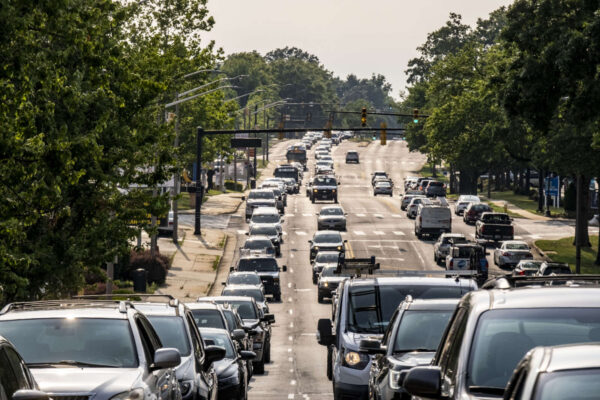
Alexandria formally unveiled its draft Duke Street Land Use Plan on Tuesday night (Sept. 29), outlining the city’s vision for the four-mile-long corridor over the next two decades.
City staff released the draft at Patrick Henry Recreation Center, and residents have until Friday, Nov. 13 to provide public comments before it heads to Alexandria Planning Commission and City Council public hearings in December.
The city says that Duke Street will see major piecemeal changes over the next 20 years, and the plan includes increased building height allowances and new areas for housing and open space along Duke Street, as well as retail areas where additional density and height will be allowed in exchange for committed affordable housing.
This is the first update to the city’s land use plan for the corridor since 1992.
Some residents are unhappy that their concerns and recommendations weren’t addressed in the plan, despite the city listing ideas on its website and whether they’re compatible with the plan.
Carter Flemming, the former chair of the Alexandria Federation of Civic Associations and the Seminary Hill Association, says that the plan largely ignores resident concerns. She says one of her biggest issues is easing traffic, and that the city has chosen to not incorporate the Duke Street Transitway, which will add more than four miles of bus rapid transit lanes by 2029, into the plan.
“The most glaring part of the whole presentation and the whole plan is this determination to avoid linking the Duke Street Transitway to this plan,” Flemming said. “Once these different neighborhoods are built out along the corridor, that will put more local people on the road, and the congestion solution this group has is not to worry about that because when we put more people in cars that actually live along the corridor, it will stop cut-through traffic.”
Christian Brandt, an urban planner with the city, said that cut-through traffic along Duke Street between Interstates 395 and 495 creates significant backups.
“We think the streets should be more for city residents and local trips versus the regional trips,” Brandt said. “Our approach is if we have more folks there, there’ll be more like residents and local people using [Duke Street]. We’ve actually seen this in Potomac Yard, by the way, about regional displacement, which is if more local folks are using the street, Waze and other technologies won’t route you that way.”
Recommendations include:
- Using interim uses to activate parking lots, retail centers, and other spaces before permanent redevelopment occurs
- Improving local connectivity, including potential bike and pedestrian links between Duke Street, Telegraph Road, Witter Fields, and the King Street Metro station
- Converting the Liebach Bridge near Charles E. Beatley Jr. Central Library into a pedestrian-only bridge with bike and scooter access
The area would also be home to 12 distinct districts with unique characters and goals.
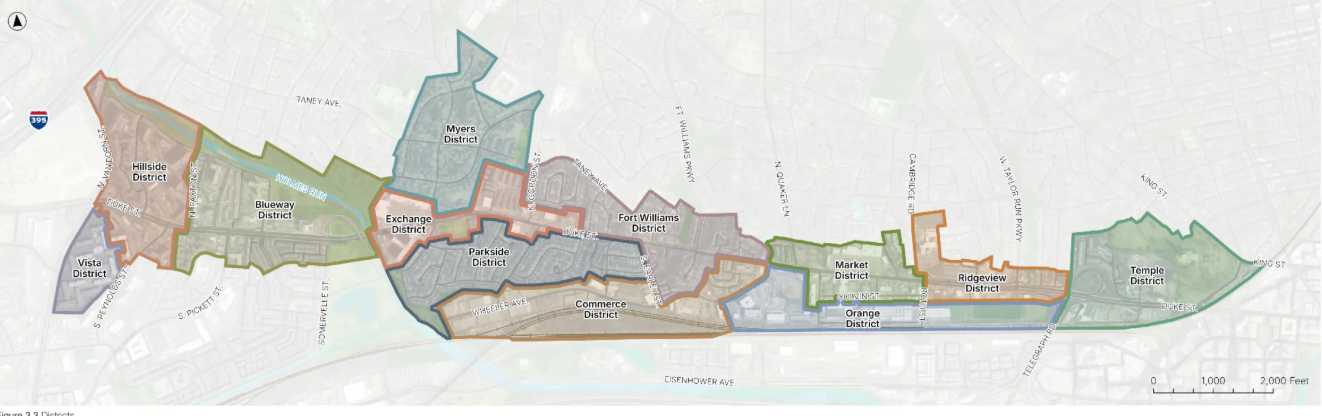
By the time the document is adopted, a number of major projects along Duke Street will be open or nearing completion. The first buildings in the sprawling WestEnd development and opening of the anchoring Inova Alexandria Hospital at Landmark are expected in 2028.
Residents can comment on the draft plan until Friday, Nov. 13, when feedback will be shared with the Planning Commission and City Council ahead of the December public hearings.
The city will also hold Zoom meetings on the plan at noon on Thursday, Oct. 8; 4 p.m. on Wednesday, Oct. 14; 5 p.m. on Tuesday, Oct. 20; noon on Monday, Oct. 26; noon on Wednesday, Nov. 4, and at 4 p.m. on Wednesday, Nov. 10.
