

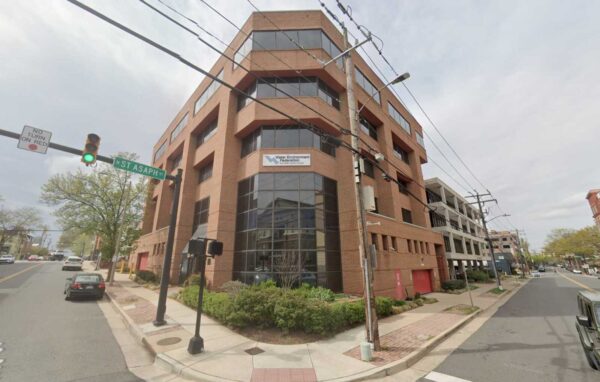
Alexandria city staff want to establish a standard permitting process for commercial-to-residential conversions.
Amid a struggling office real estate market, the city has seen a number of old office properties convert to residential use over the last several years. The proposal to create a special use permit (SUP) process for the conversions will head to the Planning Commission on Tuesday, Jan. 6.
If approved, Alexandria would join Arlington County, Montgomery County, and the District, all of which have approved similar measures in the last five years to simplify the office-to-residential conversion process, according to a city staff report.
Alexandria’s office vacancy rate is at 21.1% for 4.1 million square feet of office space citywide, just below the Northern Virginia regional average of 23%, but above the all-time high national average of 20.7 percent in 2025, according to the city.
Over the past decade, the city has converted 3.7 million square feet of commercial space to residential use, according to a recent report by Alexandria Economic Development Partnership.
The conversion process can be costly and time-consuming, as residential developments must contend with zoning requirements like open space, setbacks and minimum lot frontage, while offices don’t meet such conditions and have much higher floor area ratios (FAR).
“In general, these differences can create a regulatory barrier that may preclude adaptive reuse of a vacant or obsolete office building without significant building modifications or demolition,” city staff said in a report heading to the Planning Commission. “Because of this, applicants seeking to convert buildings that cannot meet residential requirements must navigate approval processes that sometimes require creative regulatory interpretations to access the modification provisions.”
The staff report continued, “As an example, an applicant may seek SUP approval to reduce a building’s off-street parking requirement to access the modification provisions even if the reduction is not technically necessary. Basically, the Zoning Ordinance’s structure can require applicants to pursue approvals that may not be functionally necessary, but whose procedural value is essential to legally convert a building.”
Since 2023, City Council has approved the following conversion projects:

In one of the approved conversions, at 601 Wythe Street, the building is owned by the American Water Federation, which plans to turn the five-story commercial complex into an 18-unit residential apartments. Less than a mile away, another office-to-residential conversion in Old Town recently started leasing apartments, and just around the corner, a proposal is currently pending to convert 732 N. Washington Street into a 20-unit apartment building.
The city’s proposal is below.
Staff recommends amendments to Zoning Ordinance Article XII to establish a standalone SUP procedure for conversions. Staff also recommends changes to the noncomplying provisions to establish parameters for changes of use in noncomplying buildings generally.
A. Establish SUP procedure to allow conversions
Staff proposes new section 12-1100 which would establish an SUP procedure for conversions of existing buildings, in whole or in part, to residential use. To be eligible for SUP review, the proposed residential use must comply with the use provisions in the zone. For example, a conversion SUP could not be sought in the I/Industrial zone because it does not permit residential uses.
Given the zoning challenges identified in the background section of this report, staff recommends including provisions that allow reductions to minimum zoning requirements to be requested with the SUP. These reductions include yard/setbacks, open space, off- street parking, width, frontage, and other minimum requirements established by the Zoning Ordinance. To receive approval for these reductions, the applicant must demonstrate that meeting them would be infeasible and City Council would have to determine that such reductions would comply with all applicable SUP considerations pursuant to Zoning Ordinance section 11-504. The SUP would not authorize an increase to the existing floor area or height unless the increase would comply with applicable FAR and height requirements.
B. Utilize existing SUP considerations to evaluate conversion requests
In reviewing a conversion SUP, including whether to grant reductions from minimum requirements, City Council would evaluate the request based on the existing SUP considerations established by Zoning Ordinance section 11-504. In all cases, section 11- 504 would require City Council to determine that the conversion:
- Will not adversely affect the health, welfare, or safety of persons residing or working in the neighborhood of the proposed use;
- Will not be detrimental to the public welfare or injurious to property or improvements in the neighborhood of the proposed use; and
- Will substantially conform to the Master Plan of the City.
