

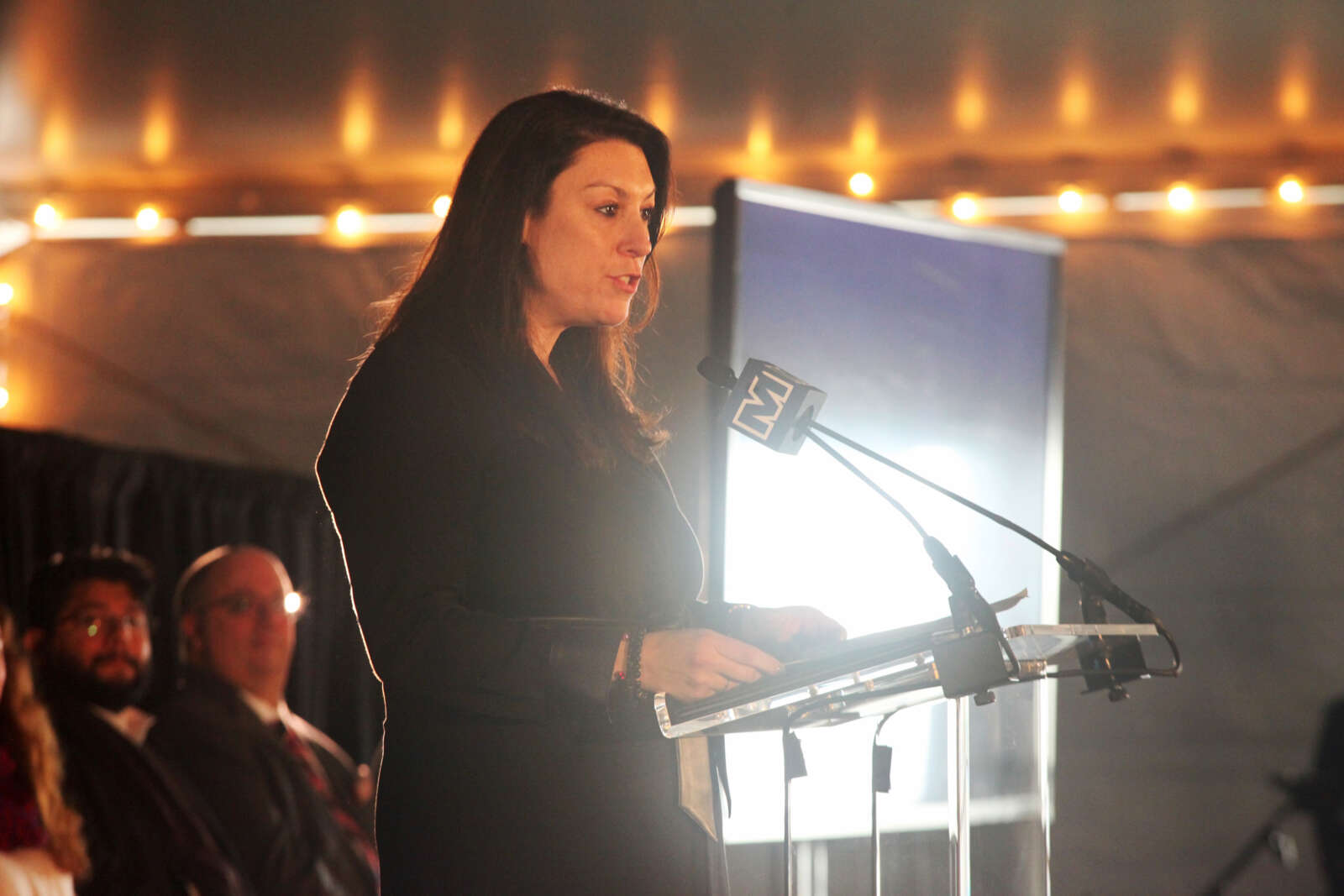
On the eve of an annual report on the city’s economy from the Alexandria Economic Development Partnership, ALXnow sat down with AEDP CEO Stephanie Landrum to discuss the future of development in three areas of the city: Carlyle, Potomac Yard and Old Town North, and the Landmark-Van Dorn corridor. These will be broken up into a multi-part series covering each location.
Potomac Yard and Old Town North are two of the major hubs of upcoming development in Alexandria, but some of the city’s ambitious plans for the neighborhoods have both hit stumbling blocks in recent years.
Potomac Yard dominated headlines earlier this year with the rise and fall of the proposed arena. For anyone just waking up from a coma for the last year: Alexandria leaders and state officials announced plans in late 2023 for a new arena to house the Washington Capitals and Wizards. Three months later, battling in the Virginia legislature fueled by intense local backlash led to those plans being scrapped.
Now, Alexandria Economic Development Partnership (AEDP) CEO Stephanie Landrum said the city is still hoping for an entertainment use to fill the arena-shaped hole in Potomac Yard development plans.
“Once we have a little bit of time to digest and really think through the feedback we received, a couple of things we felt were almost universally positive,” Landrum said. “People acknowledge and accept that entertainment is something missing from this city. There is a lack of options for, frankly, everybody. People leave Alexandria to go to concerts, movies, theaters, and roller skating. The idea of an entertainment district: people tended to like.”
Landrum said AEDP has been brainstorming and making calls to other entertainment venues, looking for something that will have a “catalytic impact” on development in Potomac Yard. The Holy Grail is in-person entertainment where people go and spend discretionary funds and groupings of uses — venues that can complement each other well.
The area also needs a hotel, Landrum said. The closest major ones are in Crystal City in Arlington or down in Old Town North.
One of the challenges in planning development in Potomac Yard, though, is pitching any new development as a safer bet than leaving the shopping center intact.
“The dynamics of the land are still the same,” Landrum said. “It’s owned and operated by a joint venture of which JBG Smith is the most visible partner, but the other partner is more conservative in terms of real estate. They’re a more passive real estate owner — a real estate pension fund represented by JP Morgan. Their issue is that they need to make money to pay pensions, they need to make money, and they’re pretty risk averse, which is why owning a strip shopping center was pretty attractive. We’re working against that in order to jump-start them to do something riskier.”
Further south, meanwhile, Alexandria’s plans for new development in Old Town North were paired with the creation of an arts district. The idea was that new development would have arts uses on the ground floor to give the area some cultural vibrancy.
While that’s had at least one success so far in the Art League, Landrum said that program has also hit some stumbling blocks.
“The thought was they’d try an experiment where they get developers to build space for free and let arts uses move in. In exchange, they got a density bonus to build residential,” Landrum said. “The piece nobody thought about was: who is going to pay for the improvements? What was delivered is what’s called a cold dark shell. Cold dark means no HVAC, no lighting, no bathrooms.”
That presented a problem for arts groups, primarily nonprofits without assets to borrow against to get the money to convert those cold dark shells into useable arts spaces.
“These nonprofits wanted to move in but had to come up with millions of dollars to do build-out, and we can’t go borrow from a bank because we don’t have an asset to borrow against,” Landrum said. “The first two, the Art League and MetroStage, were both doing that for a long time and just couldn’t get there.”
Landrum said for the Art League, AEDP was able to come up with a plan for the developer to give the asset to AEDP through an industrial development authority.
“They could take a write-off, it would be a donation, and we as an entity could borrow money to do the build-out,” Landrum said. “The flip, though, is the arts uses would have to pay us rent. Before, they were going to be rent-free for 30 years.”
Landrum said the Art League agreed, but AEDP couldn’t reach a deal with MetroStage.
“Part of their challenge is they have a specific and unique buildout and it’s very expensive,” Landrum said. “We talked about this with City Council in June. Mayor [Justin Wilson] basically said: if we can’t figure this out with MetroStage, let’s put out an request for proposal (RFP) and see who else [could move in]. That’s probably what we’re going to do this fall.”
Landrum said MetroStage could still ultimately be the tenant at The Venue (925 N. Fairfax Street) but it could go to another arts nonprofit.
Carolyn Griffin, producing artistic director at MetroStage since the groups founding in 1984, said the plan is still for them to move into The Venue.
“We were delighted to have our theater in Old Town North for 20 years and now we anticipate moving in around the corner to the 900 block of North Fairfax Street,” said Griffin. “We are fundraising and we are proceeding accordingly. It’s taken much longer than anybody hoped to raise the money, because in the course of all of this the cost has doubled.”

Griffin said the cost of the new MetroStage space has doubled from $1.5 million to $3 million. So far, Griffin says MetroStage has raised almost $2 million for the new space and is still working on that last $1 million to close the gap.
“This will be a wonderful opportunity for us,” said Griffin.
Griffin said, once the new location opens, MetroStage would be required to produce 150 performances per year.
“That’s what we do anyway, that’s how we operate,” Griffin said. “Without a theater, we produce 8-10 one-night events at the Lyceum. We have offered, in the past few years, cabarets, concerts, and play readings to full houses… we have continued to do that until we have a fully operational stage. In the meantime, the loss for MetroStage and the loss cultural and economically for the city and for artists is that we are unable to produce the additional 140 performances.”
Despite comments from the City Council that an RFP could be forthcoming for The Venue’s arts space, Griffin said neither she nor the developer know anything about an RFP in the works. Griffin said MetroStage even this week, with the developer’s approval, put up new panels and signage at the property.
“We are proceeding as originally agreed to build out a theater,” Griffin said.
