


As winter gets closer, Alexandria City Public Schools officials indicated there will be four traditional snow days this school year and changes to how snow day decisions will be shared.
Julia Burgos, the ACPS chief of school and community relations, said the decision-making process isn’t changing, but communications will.
ACPS will use a color-coded system to communicate its operating status when snow, ice, extreme cold, severe storms or other weather factors affect arrival or dismissal to schools.
A code green means schools are operating normally, while code yellow indicates a two-hour delay and code orange an early dismissal. A code blue means schools will be closed and scheduled for virtual learning. A code red indicates a full school closure.
“The goal is simple: one consistent process for deciding whether ACPS opens on time, delays, dismisses early, shifts to virtual learning, or closes, and one consistent way of telling people it changes how we have communicated operational status changes by shifting to a simpler communications approach,” Burgos said.
Chief Operating Officer Anthony Peña said ACPS has four traditional closure days available to use in the school year. Essential employees would have to report on time regardless of the operating status, except when conditions are deemed unsafe to come in.
When ACPS calls a virtual learning day, it could be either synchronous (live instruction) or asynchronous (flexible learning). In the asynchronous format, students complete work on their own time and will have access to teacher office hours. Calling a virtual learning day will depend on factors like internet connectivity, power availability, student and staff readiness and the expected length of the closure.
Planning for weather-related decisions begins as soon as 72 hours before the anticipated weather. According to Peña, ACPS will aim to make school closing decisions by 6 p.m. the evening before. However, that could be pushed to 4:30 a.m. on the school day depending on road conditions or neighboring school districts’ decisions. That 4:30 a.m. timeline is an hour earlier than the deadline ACPS previously set for snow day decisions.
Factors influencing closing decisions include if buses can run safely, if walkers and car riders can arrive safely, if activities can go on, and if school grounds can be cleared in time.
“I know people might say, ‘well, I need to know for tomorrow,'” Peña said. “Sometimes it’s not possible because the conditions on the ground are not very clear yet.”
Even if the call is not made at 6 p.m. the evening before, families will receive a message indicating ACPS is monitoring the weather and will make a call by 4:30 a.m.
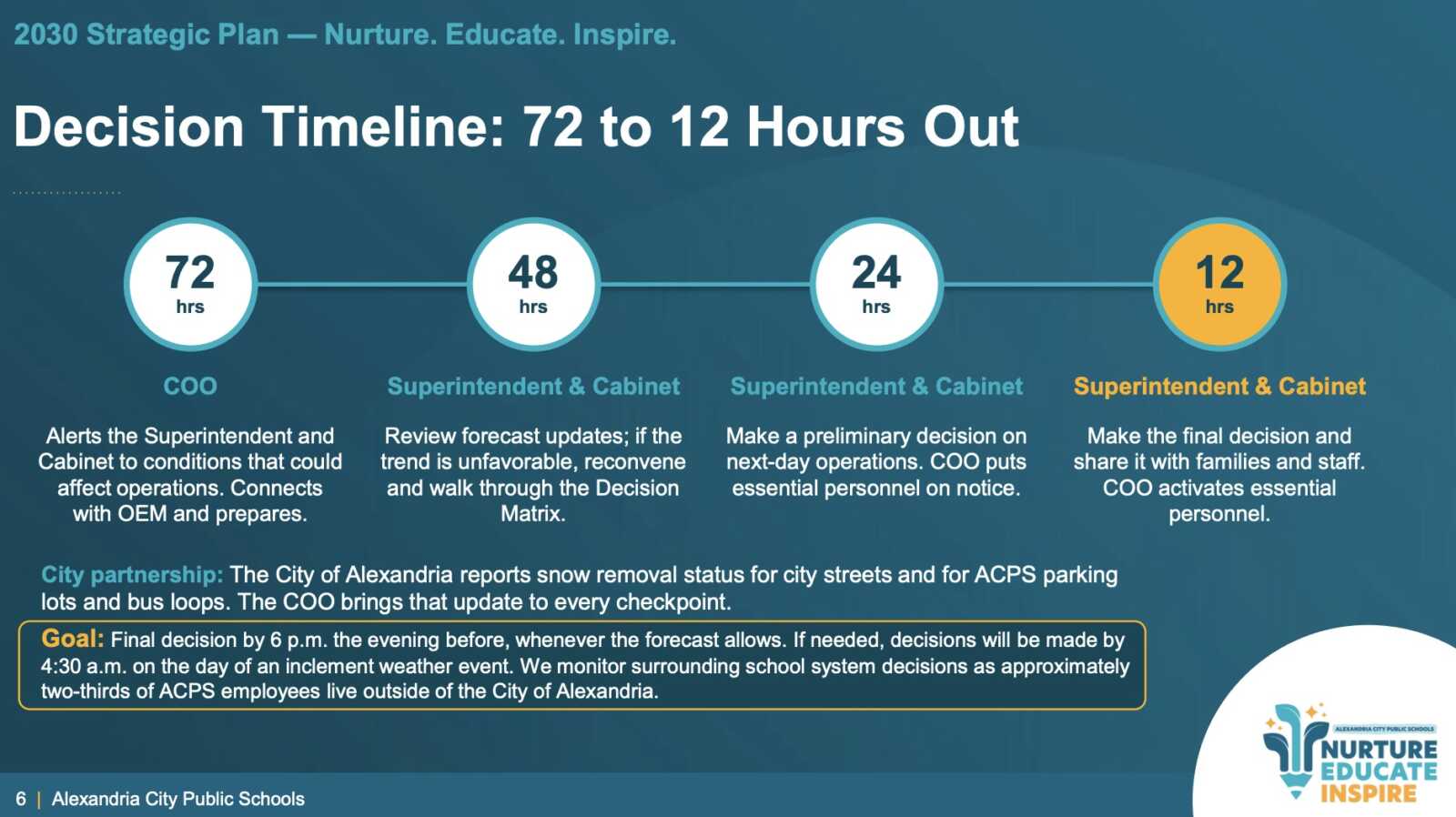
School Board Member Ryan Reyna pointed to how a large share of ACPS employees don’t live in the city.
“We also need to be cognizant of their ability to make the commute, their ability to get their kids to school safely,” Reyna said. “And I think that is a piece that often gets missed in the conversation amongst the community, that sure, we may not have snow off of the Hammond [Middle School] grounds but there may be snow in West Springfield that stops individuals from getting to Hammond.”
Momentum to Review Instructional Hours
The plan for a maximum four snow days stems from a state requirement for the school year to have 990 instructional hours or 180 school days. Chief Academic Officer Pierrette Finney said ACPS has limited snow days to work with due to having a shorter core instructional day. ACPS also wants to avoid makeup days in an already long school year.
“People want to know, in comparison to other school divisions, why don’t we have those days built in?” Finney said. “We do not have those days built in because we don’t have as many instructional minutes in the core as other school divisions.”
Officials pressed for more discussion on adding instructional time.
“The bottom line is we need to extend our instructional day,” Acting Superintendent Grace Taylor said. “If we look at peers … they’re getting more instruction in the content and upper level courses, and ultimately more competitive, so I do think this needs to be something that we look at.”
Reyna added, “The more that we can find ways as soon as possible to get additional instructional hours, especially the core content instructional hours into the day, I think the better off we will be, and the better off our students will be in that growth. I think you have a very supportive board for finding places to lean into that from a budget standpoint.”
School Board Member Kelly Carmichael Booz voiced support for looking at instructional hours and said virtual learning doesn’t work for the majority of students.
“We’re not going to solve it for this snow year, but I would like to be looking at how we can move away from even having virtual learning as an option, or if we’re hitting 15 days of kids being home, having a different process in place,” Carmichael Booz said.
