

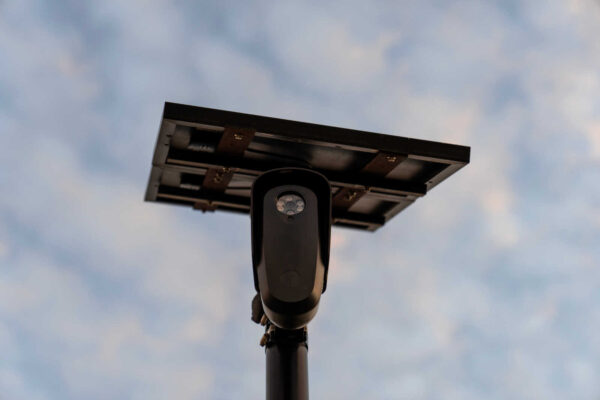
The Alexandria Police Department will release a map of automated license plate reader (ALPR) camera locations across the city by Oct. 1, the same day that it begins a third-party audit of its surveillance programs.
That’s according to a long list of answers that APD posted on the city’s website in response to questions posed at the Sept. 8 City Council meeting. At that meeting, Mayor Alyia Gaskins said that she does not think there is a role for Flock cameras in the city, and was backed up by two other Council members.
APD said it can cancel its contract with Flock at any time. In its updated FAQ page, the department contends that there were 56 instances where police use of the cameras was investigated for additional review, and that the data was “never misused for an improper, unauthorized, or non-legitimate law-enforcement purpose.”
The Alexandria Police Department has 61 license plate readers and other cameras along public roadways, according to Flock’s transparency portal. APD says the ALPRs may be used for stolen vehicle, stolen license plate and missing persons investigations, active arrest warrants, vehicles involved in felony crimes, and custom alerts for crimes not yet entered into the database. Officials say they aren’t used for immigration enforcement, driver’s license or registration violations, civil infractions or warrants, parking violations and tax violations.
Below is a list from APD on surveillance cameras in the city.
- Parking Enforcement ALPR — 10 vehicle-mounted systems used for automated parking enforcement
- Body-Worn Cameras — 628 cameras, providing approximately two per officer plus backup cameras, used as wearable recording devices
- Red-Light Cameras — Six cameras at four intersections used for traffic-safety enforcement
- Speed Cameras — Seven cameras located in school zones and used for traffic-safety enforcement
- Automatic License Plate Readers (ALPR) — 61 operational fixed cameras used for legitimate law-enforcement and public-safety purposes
- In-Car Cameras — 70 dashboard-mounted cameras and prisoner-compartment camera systems installed in police vehicles
- Public Safety Cameras — 43 total systems, including 27 pole-mounted cameras and 5 mobile trailers; 11 are currently inoperable
APD said that criminologist Robin Engel will start an independent third-party review of the technology and its data.
“Dr. Robin Engel, a nationally recognized criminologist and policing researcher at Ohio State University, is currently conducting independent reviews of APD’s data and practices related to traffic stops and uses of force to ensure fair and impartial policing,” APD said. “APD is currently finalizing an agreement with Dr. Engel to expand the scope of her review to include the ALPR program as a third area of independent assessment.”
Alison O’Connell, a former City Council candidate, recently co-founded the group DeFlock ALX. She said that APD’s FAQ page lacks transparency and does not provide an actual timeline or any steps to meet a demand to shut down the cameras across the city.
“With 61 cameras to our population, Alexandria is one of the most surveilled populations in Virginia,” O’Connell told ALXnow. “By keeping ALPRs in Alexandria, our city government and police department are violating our constitutional rights every time we get groceries, take our kids to school, or spend time in our city. The public is resoundingly against ALPRs in the community, and we need the police and city government to be responsive to what we, the people, want.”
In Virginia, Flock data can only be shared between local and state law enforcement agencies, raising concerns that Alexandria’s data could be shared via another jurisdiction. As privacy concerns mount, Alexandria’s neighbors are moving away from using the technology. The Arlington County Board recently voted to discontinue use of Flock cameras and the Fairfax County Board of Supervisors voted to suspend installation of Flock cameras. The Fairfax County School Board also banned Flock-style ALPRs from school grounds.
APD said there is no set timeline for evaluating ALPR alternatives.
“APD is evaluating ALPR alternatives, including their capabilities, data-control features, and ability to meet public safety needs,” the department said. “A specific timeline has not yet been established and will depend on the scope of the evaluation, community engagement, procurement requirements, and available alternatives. APD will provide additional details as the process progresses. The department is meeting with vendors in the upcoming weeks.”
APD did not answer the following questions posed by City Council:
- Of the 266 arrests attributed to ALPR support — over what period, out of how many searches? Your January memo cited 266 arrests, 134 stolen vehicles recovered, 14 firearms seized, and 20 missing persons located as directly attributed to ALPR. Over what time period? Out of how many total searches? And what does ‘directly attributed’ mean — who makes that determination and by what method?
- Of the 134 stolen vehicles recovered since March 2023, how many recoveries were initiated by an ALPR hit, rather than an owner’s telematics alert or a citizen report?
- How does the placement of APD’s ALPR cameras relate to auto-theft patterns across the city, particularly given the 2023 deployment in response to a rise in stolen vehicles?
APD will conduct a second community listening session on Flock cameras and other technology use in the city on Wednesday, Oct. 7, from 6:30-7:30 p.m. at Patrick Henry Recreation Center (4653 Taney Avenue).
