

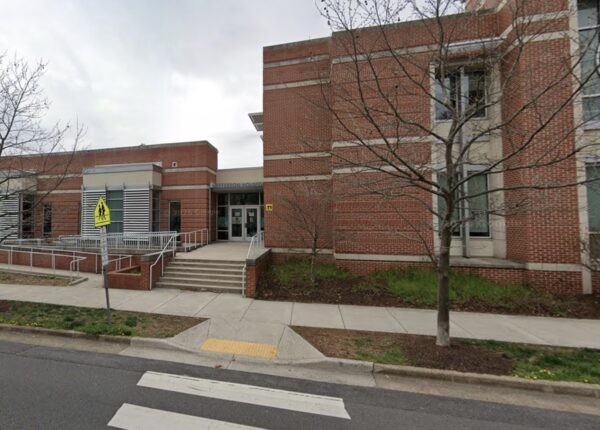
The Alexandria City School Board is taking another look at options to relieve middle school capacity challenges.
The School Board’s Thursday (Oct. 29) work session compared the plan to convert Jefferson-Houston PreK-8 School into a middle school and Patrick Henry K-8 School into an elementary school with other alternatives. The School Board gave direction during the Capital Improvement Program process in December 2024 to convert the two K-8 schools.
For this year’s capital budget discussions, the School Board requested additional options to address middle school capacity challenges. Alexandria City Public Schools recruited Cooper Carry Architects to conduct feasibility studies for alternatives — converting Cora Kelly School into a middle school, turning James K. Polk into a middle school while maintaining the elementary school, converting Jefferson-Houston to a middle school, and converting Patrick Henry to an elementary school.
The discussion came as the School Board will receive the proposed FY 2028-37 CIP budget from Interim Superintendent Grace Taylor on Thursday (Nov. 5). Taylor will also appear at City Council’s annual budget retreat with department heads on Saturday, Nov. 7.
Enrollment data will also be presented to the School Board in the coming weeks.
At the work session, ACPS staff projected middle school capacity could reach 118% by the 2030 fiscal year due to enrollment shifts between elementary and middle school levels. However, projections show middle school enrollment could drop below 100% capacity after the 2032 fiscal year even with the Jefferson-Houston conversion adding a net 407 spaces in fall 2030.
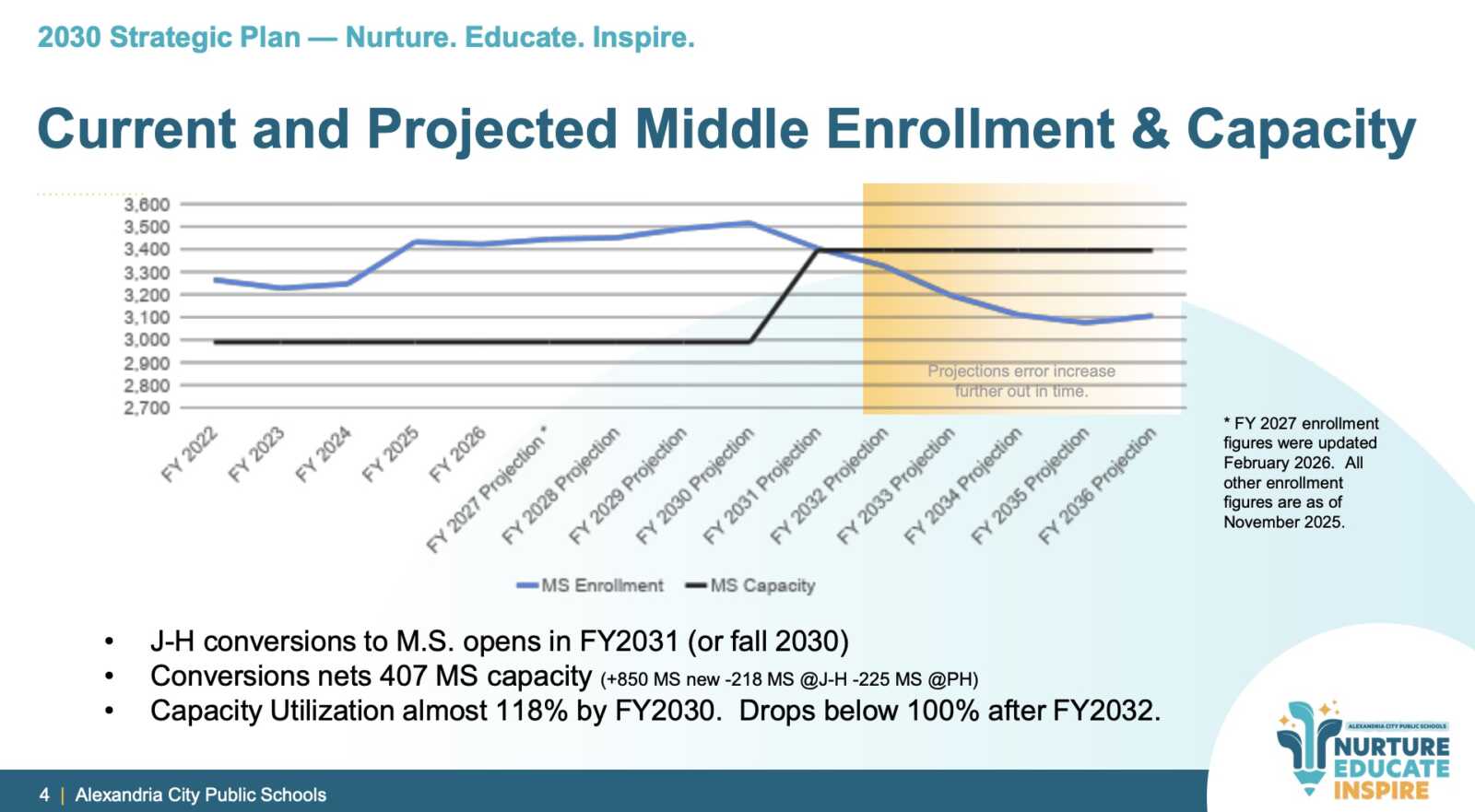
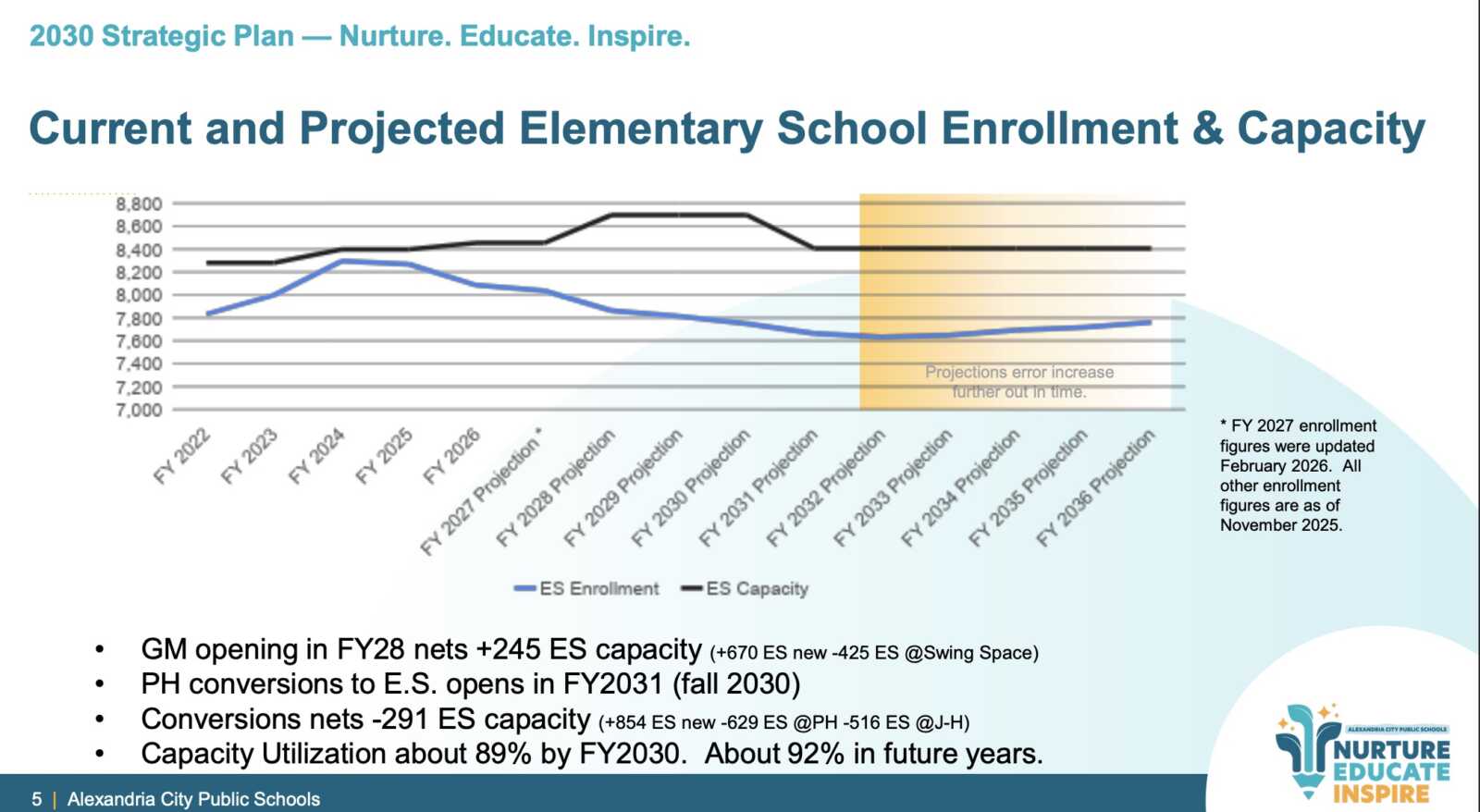
For the elementary level, schools are expected to be at 89% capacity by the 2030 fiscal year and an average 92% in future years. The reconstructed George Mason Elementary’s opening in the 2028 fiscal year will yield 245 new spaces, while Patrick Henry’s conversion in fall 2030 would yield a net loss of 291.
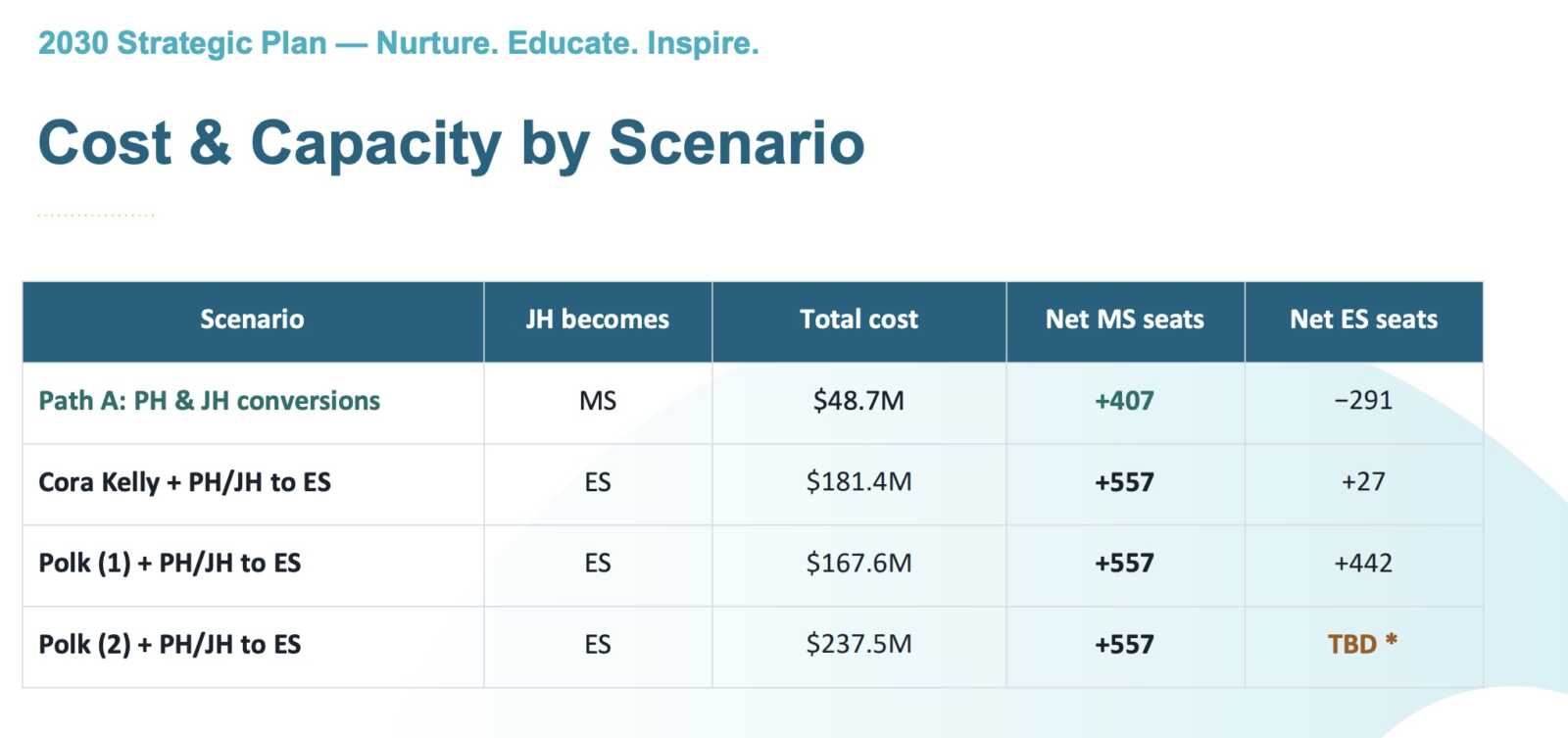
ACPS staff indicated the most cost-effective conversion option is the $48.7 million Patrick Henry and Jefferson-Houston conversion already accounted for in the capital budget.
According to cost estimates, converting Cora Kelly School into a middle school would cost $181.4 million, while a new middle school at Polk Elementary while maintaining the elementary school would cost $167.6 million. Reconfiguring the whole Polk Elementary site into a new elementary and middle school would cost an estimated $237.5 million. The Cora Kelly and Polk Elementary options include the conversions of Patrick Henry and Jefferson-Houston to elementary schools.
The Cora Kelly and Polk options would provide a net 557 new middle school seats, compared to 407 for the existing Patrick Henry and Jefferson-Houston option.
Another option to increase capacity — eight modulars at the two middle schools — would cost $16.8 million and add 407 middle school seats without conversion of Patrick Henry and Jefferson-Houston. Chief Operating Officer Anthony Peña said the modulars may not be cost effective in the long term.
“It provides short-term support, but heating issues, indoor air quality is a very big issue to maintain, and then depending where they located, rodents and pests,” he said. “Many districts are phasing them out because it’s just hard to maintain, and then eventually if the building becomes underenrolled, they just sit around there and become office spaces.”
While the School Board didn’t commit to a decision during the work session, members called for more data.
School Board Member Ryan Reyna sought similar data presented during the redistricting process on where growth is happening in the city.
“If we could bring those back and or update them, inclusive of, a reminder of where some of the affordable housing units have been approved and when those hit,” Reyna said.
School Board Member Donna Kenley called for a comprehensive analysis on the Patrick Henry and Jefferson-Houston conversions accounting for new enrollment trends.
“We have declining enrollment, we have expenses growing, we have an immigration problem with regards to children are leaving our area because of threats and immigration and removal,” Kenley said. “Families are being disrupted, a high cost of living, all of this together, and I just want to understand how we are obtaining data.”
Several School Board members agreed on having updated enrollment data to make a final decision.
“One component of the conversation moving forward has to be updated enrollment numbers so that we can be much more cognizant of where and how enrollment is changing and we’re not making decisions based off of prior data,” Reyna said.
Some members also stood behind the School Board’s decision to move away from K-8 schools.
School Board Member Tim Beaty noted the goal of getting all schools to 90 to 100% capacity.
“[George Washington Middle School] is too crowded. Hammond [Middle School] is too crowded,” Beaty said. “It’s not a good situation right now. We need to change that situation, and if slightly declining in numbers still mean we’re going to be at 110, for me that’s not acceptable.”
School Board Member Alex Scioscia agreed with Beaty based on his experience attending George Washington Middle School.
“When I was at GW it was GW1 and GW2, which I’m sure was also a logistical nightmare but I mean that was a big school for me going from George Mason to GW,” Scioscia said. “I just think these schools are just too big, and we want to have great education, great experiences for these kids without basically overwhelming them or not being able to give them that kind of one-on-one or anywhere close to that that I think ACPS strives for.”
School Board Member Michelle Rief indicated building another new school wasn’t the route to go if enrollment declines would cause buildings to be underutilized.
“I think the situation that’s going on right now is that we need more middle school seats but we have sufficient elementary school seats because we’re building George Mason. We’ve done some modernizations. We’ve created more seats,” Rief said. “When you look at [the Patrick Henry and Jefferson-Houston conversion option], what I see is it’s balancing out the middle school and the elementary school, which I think is needed and it’s trying to get us to an optimal utilization without being like underutilized or overutilized anywhere.”
School Board Chair Christopher Harris called for more analysis of a “no build” option and noted the plan is dependent on city funding.
“We’re reevaluating going forward, and we can’t ignore the challenges that we have fiscally as well as the city,” Harris said. “They still have to fund this. So we can come up with the best plan, but if we don’t have the money to fund it, or if it’s 10 years out when the problem has already been solved, what are we talking about?”
The CIP will go to a public hearing on Nov. 10 and will be adopted by the School Board on Dec. 17.
Jefferson-Houston PreK-8 School image via Google Maps
