

A new public dashboard will help residents stay informed on different aspects of water quality in the Potomac River.
The Reservoir Center for Water Solutions launched the dashboard in June alongside Anacostia Riverkeeper, Anacostia Watershed Society and Potomac Riverkeeper Network.
The dashboard resulted from conversations with the riverkeeper networks on water quality monitoring being one of the challenges they face. It tracks several indicators of water quality — water temperature, pH, turbidity, chlorophyll, chloride, dissolved oxygen and conductivity — and provides data on E. coli bacterium via the Chesapeake Monitoring Cooperative.
Nicole Horvath, program manager at the Reservoir Center, told ALXnow sensors in the water connected to a buoy or dock send readings every 15 minutes to update the dashboard. Xylem, a private company that funds the Reservoir Center, provided the real-time monitoring equipment.
“The biggest thing is if folks are interested in going out in the water to kayak, paddle board, fish, they can get a sense of what the water quality is like in that area, where they might be going to recreate along the river,” Horvath said.
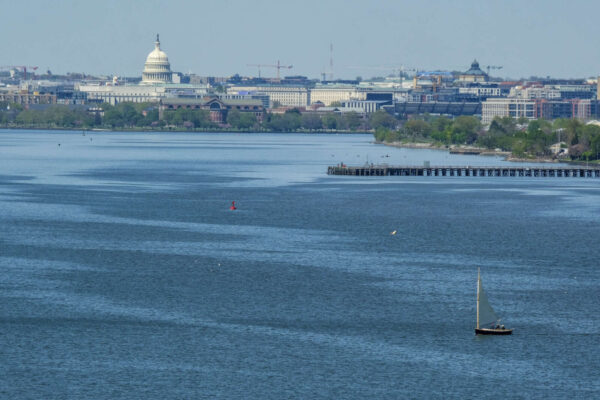
The dashboard has several water monitoring sites on the Anacostia and Shenandoah Rivers, but its one Potomac River is located at National Harbor, Md. across from Alexandria. The Potomac River was the site of a Jan. 19 sewer pipe collapse, which released hundreds of millions of gallons of sewage.
“The recent catastrophic sewage spill in the Potomac taught us many lessons. Among them is the vital importance of reliable and timely water quality monitoring and reporting,” said Betsy Nicholas, president of Potomac Riverkeeper Network. “This new tool enables us to gather information and to distribute it more effectively than ever before so that river users and enthusiasts can know where and when contact with the water is safe for all who rely on it.”
Different indicators on the dashboard can indicate good and bad times to do activities like paddle boarding and fishing.
“Dissolved oxygen is the measure of how much oxygen is available for aquatic organisms, and so if you’re going to go fishing, you probably don’t want to fish in an area with really low dissolved oxygen, because the fish are probably moved away,” Horvath said. “Turbidity is an indicator of how cloudy the water is, and we typically see high turbidity after there’s been a lot of rain. Generally the thought process is, this is a lot of stormwater runoff from the land, and so with that generally comes not just cloudiness — you can’t see what’s in the water — but then also a lot of other pollutants are usually carried with those particles, and so it just may not be the best time to go in the water.”
Another indicator — chlorophyll — measures algae, and some algae blooms can produce toxins that are harmful to dogs. Horvath says chlorophyll levels can become high when there’s been runoff from rain containing nutrients that feed algae in the water.
While E. coli monitoring is a key way to track river health amid sewage spills, other indicators can track concerns from harmful discharge.
“If somebody illegally discharges water into [the Potomac or Anacostia] that is very acidic, from like some type of industrial treatment without it going through a wastewater treatment plant, then that would spike, make the pH really acidic,” Horvath said. “This equipment could pick that up quickly, as opposed to samples that are only taken weekly. And then the riverkeepers would be alerted to that, they would know that this was like way outside of a range, and then could go and inform the proper authorities to go look and see what’s going on.”
Spikes of chloride in the winter can also result from leftover road salt. That can in turn impact fish and other aquatic organisms not used to a salty environment.
More on the indicators tracked on the dashboard:
- pH – Measures how acidic or basic the water is. Extreme levels can harm fish, affect nutrient availability, and increase toxicity of compounds like ammonia.
- Dissolved Oxygen (DO) – Shows how much oxygen is available for aquatic life. Low levels often indicate algal blooms or organic matter decomposition.
- Conductivity – Reflects the concentration of dissolved salts and minerals. Sudden changes can signal pollution from winter road salt or industrial discharge.
- Water Temperature – Influences oxygen levels, species health, and algal growth. Warmer water holds less oxygen and can stress aquatic ecosystems.
- Chloride – Indicates the presence of salts that can harm freshwater species. Often linked to winter road salt and wastewater.
- Chlorophyll – A proxy for algal growth. Excessive algae can block sunlight, deplete oxygen, and release toxins.
- Blue-Green Algae Pigment (Phycocyanin) – Detects cyanobacteria activity and the risk of harmful algal blooms, which can produce toxins affecting aquatic life, pets, and human health.
- Turbidity – Measures water clarity. High turbidity reduces light, affects photosynthesis, and can harm fish and bottom-dwelling organisms.
- Fluorescent Dissolved Organic Matter (fDOM) – Tracks dissolved organic material that may indicate wastewater inputs or stormwater runoff. (Anacostia sites only.)
- E. coli – An indicator of fecal contamination from sewage, agricultural runoff, or wildlife waste. Note: E. coli data is sourced through the Chesapeake Monitoring Cooperative and is not real-time.
Aside from informing residents about real-time water quality, Horvath says the dashboard increases their environmental awareness.
“Maybe people pay more attention to that storm drain that’s on their street that has a bunch of trash sitting in it or leaves sitting after a storm, and they’ll pick it up because they don’t want that going to our waterways,” Horvath said. “I think another thing that is an important thing to note is that all of this water does become our drinking water at some point, or it’s someone’s drinking water. I used to work at a water utility, and what I always told people is that the better quality the river water is, the easier it is for us to filter it and make it safe for people to drink.”
Alexandria recently took a major step toward improving water quality in the Potomac River. RiverRenew, a new waterfront tunnel system and sewer infrastructure, went online on July 1. It replaced the 19th-century combined sewer system primarily in Old Town to divert around 120 million gallons of raw sewage from entering the Potomac River every year. The combined sewer system experienced overflows during many rainfall events, according to wastewater servicer AlexRenew.
