

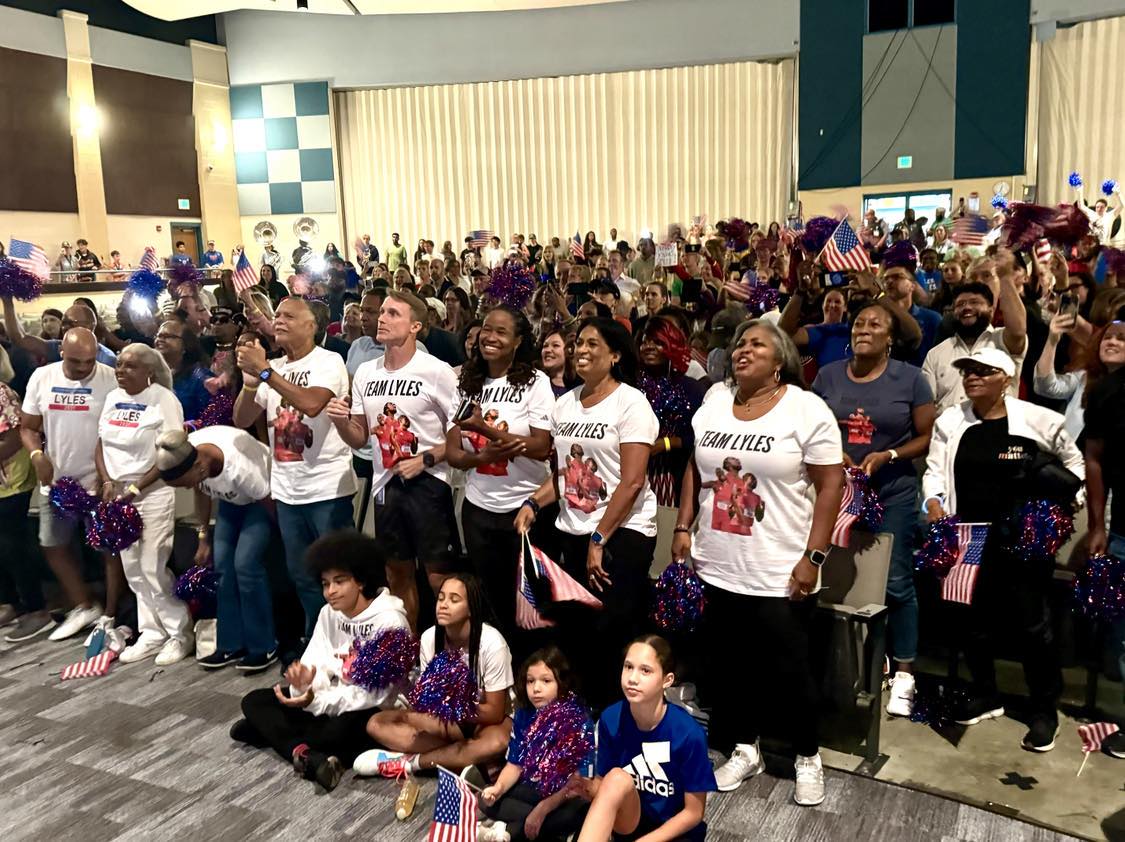
Hundreds of Alexandrians watched and cheered as hometown racing champion Noah Lyles won a bronze medal in the 200 meters in the Paris Olympics on Thursday.
Letsile Tebogo of Botswana won the race with a time of 19.46 seconds, U.S. sprinter Kenny Bednarek earned silver with 19.52 and Lyles got third with 19.70.
Lyles’ grandmother, Dede Caine, sat with other members of the family in the packed auditorium of Alexandria City High School.
“It’s amazing and invigorating,” Caine said of the experience of watching her grandson on the big screen. “Ever since he was a little kid he told us that he was going to the Olympics, and I used to always tell if that’s what you want, that’s what you’re going to do.”
Lyles won the gold medal in the 100 meters last week, cementing his stature as the fastest man in the world, but his quest for gold in the 200m has proved elusive. It’s his second consecutive Olympic games to win bronze for the event.
Per NBC broadcast, Noah Lyles was diagnosed with Covid two days ago and decided to compete anyhow. He was seen in recent days wearing a mask and was treated by medical personnel at the stadium. It’s unclear whether Lyles will be able to compete in the 4x100m relay race.
City Council Member John Taylor Chapman said that it’s a special thing to have an Olympian from your home town.
“It’s definitely not common to be the hometown of the fastest man in the world,” Chapman said. “It’s great to see him continue to elevate, continue to just be amazing.”
Lyles is a 2016 ACHS graduate.
