

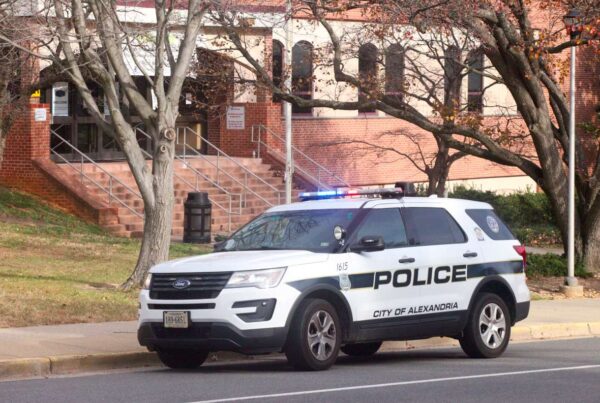
A public hearing will be held Thursday (April 16) on the revised memorandum of understanding between the Alexandria City School Board and the Alexandria Police Department.
Alexandria City Public Schools is required to have an MOU with the police department due to the presence of school resource officers in schools, and it must be reviewed at least every two years. The proposed agreement would be in effect from July 1, 2026 to June 30, 2028.
APD provides one SRO sergeant and five SROs to ACPS, according to the city.
The school division has continued using the 2023–2025 MOU, which had been extended several times while the new proposed agreement was being revised. One of the proposed changes that drew controversy among city and school leaders was designating SROs as “school officials,” which would give SROs access to ACPS student records.
Several changes are included in the new proposed MOU, including the removal of the school official designation for SROs.
“The [previous MOU proposal] expressly designated SROs as school officials, which would allow them additional access to education records in certain circumstances, so long as it was necessary for the purpose of their job, and that is now completely gone,” Bob Falconi, legal counsel for ACPS, told the School Board Thursday (April 9).
Language was also added to clarify that parental consent is required for police questioning of students in non-urgent circumstances.
“Generally speaking, law enforcement is allowed to question a student in an exigent circumstance, but if it’s a non-exigent circumstance, they need to get parental consent,” Falconi said. “If there’s an emergency situation, then they will not necessarily get consent, and that is just clarifying what the current practice is.”
Another change outlines principals’ obligation to notify police of alcohol and drug crimes that could constitute felonies, which is mandatory reporting under Virginia law.
“The [School Board] Governance Committee had concerns about that, because not putting in additional clarity regarding this type of reporting could lead to unintentional overreporting where a principal may not necessarily want to report an incident of alcohol possession, but may feel like they’re obligated to do that,” Falconi said. “And so while we can’t obviously contradict what the Code of Virginia says about permissive contact of law enforcement, we can put things in there to make sure our principals are better informed.”
The agreement proposes training for principals on alcohol and drug crimes that would be felonies. If principals are unsure whether a crime constitutes a felony, they could contact ACPS legal counsel.
School Board member Ryan Reyna said he appreciated the language on principals’ reporting requirements but believes it should go further.
“Obviously, we want the training. We want the clarity, the extent to which we can be clear about when and when not to raise these to a level law enforcement,” Reyna said. “No student should be drinking and they have alcohol in their system on school grounds, to be very clear. And yet, we know that that does happen from time to time. I don’t know that that, in my mind, needs to raise to the level of connection to law enforcement.”
School Board member Abdulahi Abdalla said reportable amounts of drugs could be a gray area for principals.
“If a student comes with the smell of a marijuana or if they’re seeing that they’re under the influence, is that considered a felony offense?” Abdalla said. “I think just clarifying that and providing more support for our administrators and teachers on how to address these topics without putting our students in risk is what I would like to see.”
School Board member Ashley Simpson Baird, who worked on the MOU in the School Board’s Governance Committee, explained the training will help principals make the decisions despite not being lawyers or law enforcement officers.
“The really sticky part of the law is where it lands on non-felony offenses that gives leaders the right to but they’re not required to report. I think it’s too gray. And so I think those are the places where we need more legal advice. We need more training for our staff. So we’re trying to reflect the exact language that is in the law. But I don’t think the law is written very well, and I’m not sure it’s achieving its intended or getting the right intention.
“We sort of landed that training is the best way to have more nuanced conversations with our school leaders to equip them with the knowledge and the tools and the advice to make better decisions, rather than drawing a very clear line in the sand when they are not lawyers, they are not law enforcement officers to make that sort of call,” Simpson Baird said.
School Board Chair Michelle Rief called for advocacy to the Virginia General Assembly to clarify gray areas of the reporting requirements.
“There hasn’t, I think, been a consensus in the state legislature about what should and shouldn’t be reported in some of these areas,” Rief said. “I think that that is what of makes it challenging.”
Simpson Baird said the proposed MOU is still a “working document.” A final vote has not been scheduled, but the School Board must have an MOU approved before the current one expires June 30.
Residents can sign up for Thursday’s public hearing by noon Wednesday (April 15). The hearing will begin at 5 p.m.
