

Nestled within an industrial area of Alexandria’s Eisenhower West, a seemingly nondescript startup with a small sign near its front door is revolutionizing wireless communication in challenging environments around the world.
Saltenna moved to Alexandria from its previous headquarters in McLean last August, and its 20 employees have been using its proprietary plasmonic wave technology to help various U.S. government agencies communicate in dense jungles, underwater and through metal. The technology essentially shrinks light waves down to a nanoscale and guides them on various surfaces via an antenna.
R. Ashley Johnston, Saltenna’s chief operating officer, told ALXnow the company currently holds five patents and has more than 50 in the pipeline.
“We’ve developed antenna technology that can make what we call plasmonic waves,” Johnston said. “They can actually attach themselves to surfaces. We’ve developed antenna technology that allows that to happen. That’s basically our secret sauce.”
Saltenna was founded in 2017 by physicist Igor Smolyaninov. The company’s office is laid out like a workshop, with sectioned-off cubicles surrounding staff-built simulations of harsh environments, like oil rig pipes.
“These waves exist,” Johnston said. “The idea now is, how do we control them? How do we maximize what we do with them?”
Johnston says that the company has contracts with the Air Force, the Army, Navy and supports U.S. Special Operations Command. He said the days of divers using hand signals underwater will soon be a thing of the past.
“Up until recently, divers communicating wirelessly was just impossible,” Johnston said. “There’s physics behind it now that we understand … We can now get divers to communicate underwater. We’ve had people from prime contractors, going, ‘This stuff is impossible.’ We take them out to a quarry, divers dive, and they go, ‘What? How are you guys doing this?'”
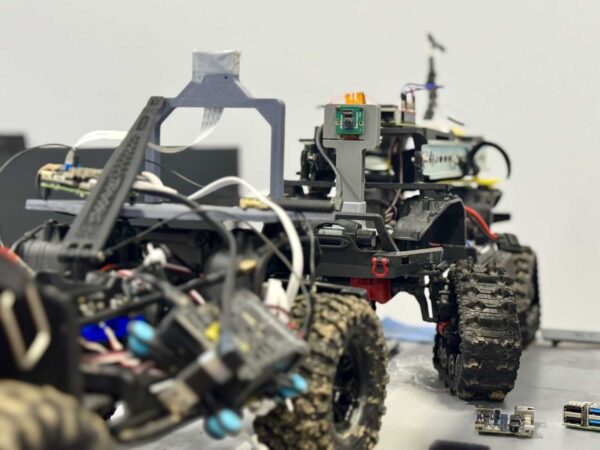
That means antennas that can plug into small handheld radios for divers, as well as larger antennas for unmanned surface vessels like rovers and drones.
Retired U.S. Navy Capt. Denny Brisley, Saltenna’s chief strategy officer, said that the technology has multiple applications — all around the world, to unmanned automobiles, and even in space.
“It would turn the lunar surface into a surface for wireless communication,” Brisley said. “What we’re doing for one part of the Department of War is we’re using our plasmonic technology to have command and control of unmanned ground vehicles. We are talking to the Air Force. We have a proposal in that the Air Force helped us put together, because those robot dogs, they work really well, except when they are patrolling around the jungle, they have a problem communicating.”
Johnston said the company’s new location, which shares building space with tech problem-solvers Building Momentum on Eisenhower Avenue, is unique in its ability to foster creativity and collaboration.
“Spaces like this are all over the place in Silicon Valley,” Johnston said. “There’s no place like this in the D.C. metro area.”
