

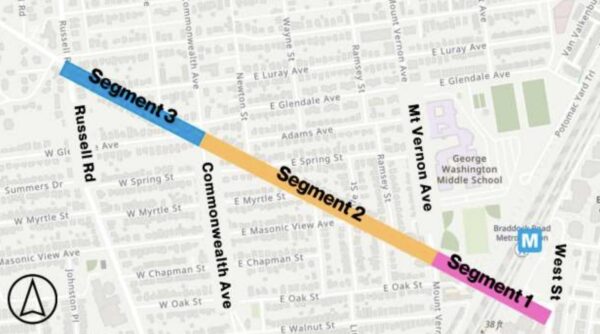
After a meeting that stretched into the early morning hours today (Tuesday), the Alexandria Traffic and Parking Board approved a proposed redesign of the Braddock Road corridor that would remove parking, construct new bike lanes and install other safety improvements for bicyclists and pedestrians.
The board approved the full staff recommendations for Braddock Road between West Street and Russell Road in the Rosemont and Del Ray neighborhoods, prompting the project to continue forward in the design phase.
The changes approved by the parking board include:
- Reducing lanes in each direction from two to one on Braddock Road between Mount Vernon Avenue and West Street
- Removing on-street parking on Braddock Road between Mount Vernon Avenue and Russell Road, except about 100 feet in the unit block of E. Braddock Road and 60 feet in the 200 block of E. Braddock Road
- Removing on-street parking on Commonwealth Avenue between Braddock Road and Spring Street
- Consolidating the turn lanes and through lanes on the Braddock Road approaches to the intersection of Braddock Road, Russell Road, and W. Alexandria Avenue
- Consolidating turn and through lanes at approaches to the intersection of Braddock Road and Commonwealth Avenue
- Consolidating the eastbound turn lanes and through lane on Braddock Road at Mount Vernon Avenue, and convert the westbound lanes from three left, through and right lanes to two through/left and right-only lanes.
- Adding a commercial loading zone on Braddock Road between the Yates Corner driveway entrance and the Metro Linear Trail
- Relocating one disability parking space from the unit block of W. Braddock Road and adding ones on Hancock Avenue at Braddock Road and Luray Avenue at Braddock Road
Approved changes will allow the city to fill in bike lane gaps between Mount Vernon Avenue and Russell Road, providing connections to the Potomac Yard Trail, the Metro Linear Trail, Braddock Road Metro Station and on Commonwealth Avenue.
On the section between West Street and Mount Vernon Avenue, the city will add a two-way protected bike lane on the north side of the street and retain a bike lane on the south side. The sections between Mount Vernon Avenue and Commonwealth Avenue as well as Russell Road and Commonwealth Avenue will get new bike lanes, and the latter segment is wide enough to provide protected bike lanes with barriers.
Upon approval, Alex Carroll, Alexandria’s Complete Streets program manager, said the city will have to address concerns from the Alexandria Fire Department regarding road configuration changes around the Braddock Road Metro station.
“We need to continue to coordinate on the design to make sure that they don’t get stuck behind any queues of traffic, so that they actually continue to have space to bypass traffic to get to an emergency,” Carroll said. “We actually have [an] emergency vehicle preemption plan to be installed at the signals next year, which would allow emergency vehicles to send a signal to the intersection to get the green light when they’re coming through, so that they can can get through that faster than they would ordinarily.”
The city has worked on the Braddock Road Corridor Improvements project since last year. Outreach efforts garnered engagement from hundreds of residents, including a survey last fall in which the “vast majority” of 587 respondents “supported the project goals,” according to the docket. However, the removal of on-street parking proved to be a controversial change, drawing several written and in-person comments.
Carroll noted the recommendations were based on city policies in the Alexandria Mobility Plan, 2016 Pedestrian and Bicycle Master Plan, Vision Zero Action Plan, Complete Streets policy, Environmental Action Plan and Safe Routes to School Walk Audit for George Washington Middle School.
“There’s a lot of different priorities for different people in this area, different land uses, different places that people are trying to go, and different ways that they’re trying to get there,” Carroll said. “Ultimately, we’re trying our best to balance a lot of needs here and determine what the highest and best use of public spaces for the vast majority of people who use this corridor.”
Parking, disability space relocation draw concerns
Following a staff presentation on the changes, residents waited until nearly 10 p.m. for the public comment period and spoke past 1 a.m., offering both criticism and support for the changes.
The removal of on-street parking on most sections of Braddock Road between Mount Vernon Avenue and Russell Road drew concerns from several speakers. According to the board’s docket, there are 105 on-street parking spaces on Braddock Road between Russell Road and Mount Vernon Avenue.
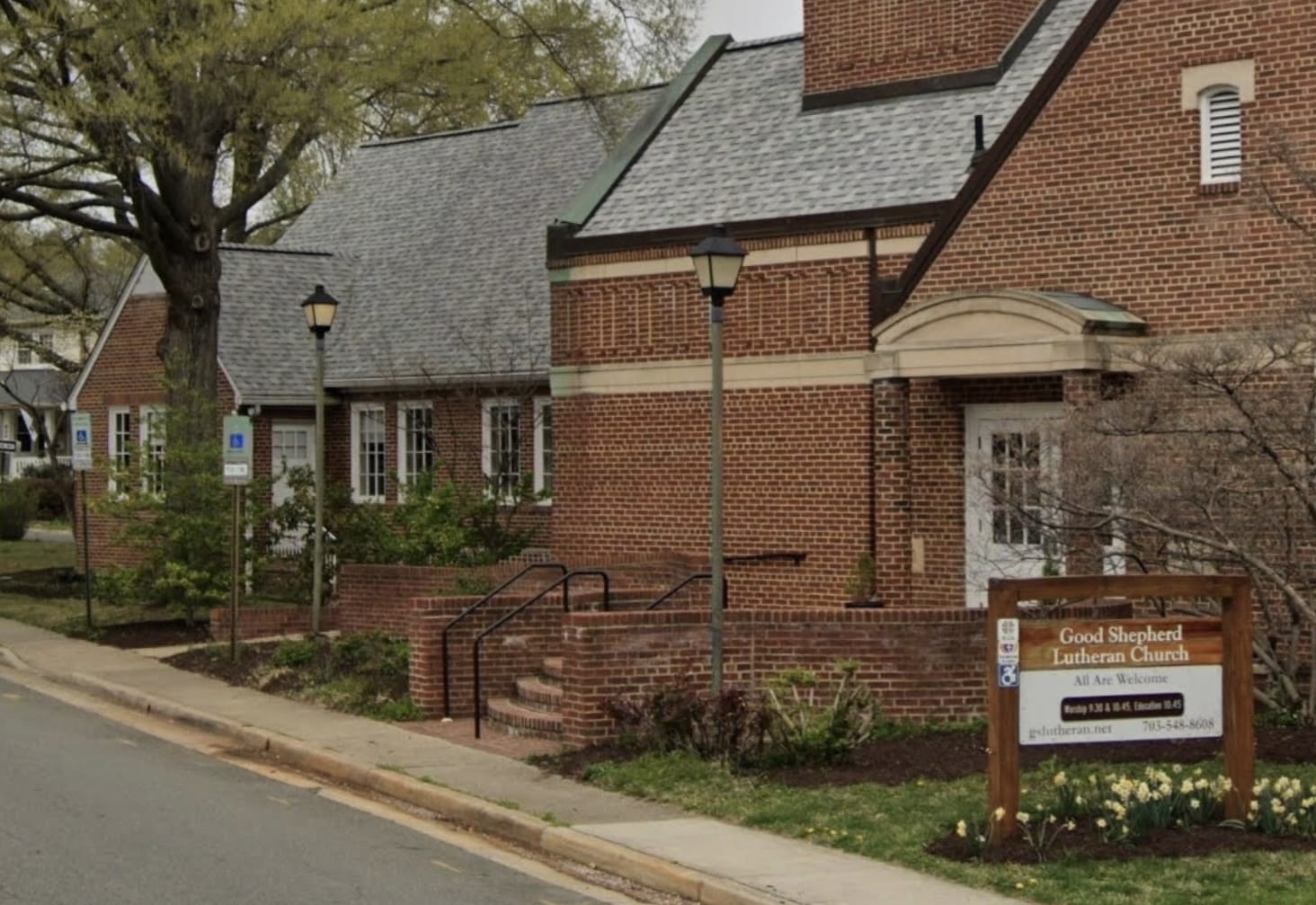
Leaders and members of Good Shepherd Lutheran Church spoke against parking removals, as the church does not have off-street parking and relies on the street parking. The Rev. Kate Costa recognized the importance of cyclist improvements, but said the church needs the disability space moved closer to the building and approximately 50 spaces for churchgoers.
“We have many members from Del Ray who bike to church. We have one member who regularly bikes 10 miles to come to church,” Costa said. “It’s important to us, but it’s also important to us to be able to to access our building for those who do drive a good distance.”
Anna Anderson, who uses the disability space at the church, said she needs a closer space due to a permanent condition.
“I can’t walk the distance of the proposed new handicap accessible parking spaces that were in the plan,” Anderson said. “I need to be much closer to the ramp than that.”
Opposed residents also pointed to concerns with removing turn lanes holding up traffic during congested times.
Braddock Road resident Elizabeth Trigg, whose family walks and bikes, expressed concern at the possibility of a traffic bottleneck as a result of removing turn lanes. The bottleneck, she said, could lead to “aggressive cut-through traffic on side streets as drivers seek a path of least resistance, increased idling and emissions and a loss of accessibility for service vehicles, deliveries, and the residents who rely upon access and the guests who sustain our community.”
Former Alexandria Sheriff Dana Lawhorne said he believes safety improvements would be more beneficial west of Russell Road.
“There was only six accidents [in the project’s second and third segments] in almost seven or eight years,” Lawhorne said. “There’s 71 accidents from Russell [Road] to King Street. The way I feel about it is, move up Braddock Road more west and address those issues.”
Supporters point out dangerous conditions
Speakers in favor of the project said bicyclists and other multimodal users face safety risks and fear dangerous traffic conditions without bike lanes.
“Protected bike lanes are a welcome change for someone like me who has a healthy fear of riding my bike in the street alongside cars,” Rosemont resident Jacquelyn Kittredge said. “It only takes one distracted driver for a cyclist to be seriously injured or worse. Protected bike lanes encourage more people to bike because they see that it can be safe.”
Asa Orrin-Brown, who uses a e-bike to get around for his photography business, detailed safety risks faced when biking.
“When you’re westbound headed toward Russell [Road], the drivers, especially in the afternoon, are extremely aggressive and are speeding very, very fast,” Orrin-Brown said. “I’m also traveling with the legal speed of traffic, and I had so many experiences with people passing me illegally on the spot with a double-yellow striped line speeding well over the speed limit.”
Mike Doyle, founder of Alexandria Families for Safe Streets, said the protected bike lanes will increase safety for bicyclists and pedestrians.
“I can empathize with a lot of the folks here tonight about losing their parking, but I would respectfully suggest that safety is the priority,” Doyle said. “I can speak from personal experience. I was crashed into by a driver of an SUV seven years ago.”
Tim Shaw, whose daughter uses a wheelchair, said the protected bike lanes could be a safer alternative to navigating driveway curb cuts.
“This is a major corridor in the city,” Shaw said. “To make it truly accessible, we need dedicated lanes for wheelchairs, strollers, bikes, runners, scooters … The status quo is not a viable solution.”

Braddock Road resident Joe Fray said improvements near the Metro station will improve the quality of life for the neighborhood.
“I have a young daughter, and she loves riding her bike, and she’s getting to the age where she can be trusted to ride around the neighborhood on her own — but the street in front of our house is terrifying for her,” Fray said. “Despite these risks, these public thoroughfares are and should be for everyone, and giving up on street parking in front of my house is worth it for these improvements and the diffuse benefits they create.”
Carroll told the board the design phase will continue into 2027, followed by implementation into 2028.
Photo 2 via Google Maps; Photo 3 via Google Maps
