

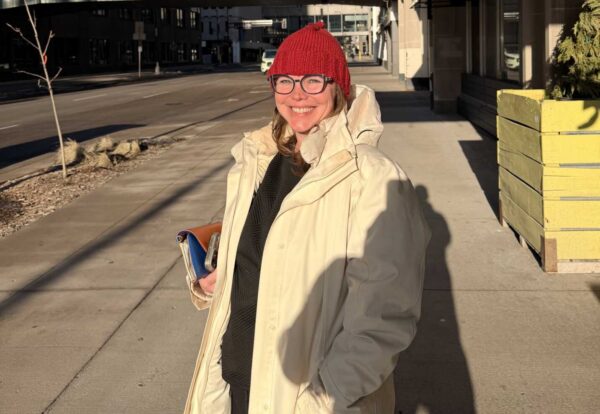
Alexandria City School Board member Kelly Carmichael Booz visited Minnesota last week as part of a project to inform educators on how to respond to U.S. Immigration and Customs Enforcement activity.
Booz, who is from Minneapolis, visited the Twin Cities from Feb. 9-13, in the wake of the fatal ICE shootings of U.S. citizens Alex Pretti and Renee Nicole Good and the widely reported drawdown of ICE agents there. Her project, a report for the American Federation of Teachers, aims to offer “resources and trainings” for school districts and unions on what to do when ICE enters their communities, she told ALXnow.
“If the law was being followed and if due process was being followed, I think we’d be having a very different conversation,” Booz said. “But that’s not what’s happening.”
During the trip, Booz met with local unions and school board members. She is now working with a colleague to build out proposals and trainings for AFT that can be used nationwide.
“I’m also looking at this in terms of somebody who lives in Alexandria on the School Board,” she said. “When I look at the 45% immigrant population within ACPS, I am concerned about how we are making sure that we’re protecting our own community.”
In the General Assembly, a proposal by Del. Alfonso Lopez (D-3) that would prohibit federal immigration enforcement from operating in schools, hospitals and polling places has made progress this month.
Two weeks ago, between 250 and 300 Alexandria City High School students staged an afternoon walkout protesting ICE. It was shortly followed by similar actions in Arlington, where hundreds more middle and high school students walked out for the cause.
In Minnesota, Booz said that of more than 32,000 students who attend St. Paul Public Schools, over 6,000 students have opted for virtual learning over the past few weeks. Last month, the Pioneer Press reported that approximately 55% of students who speak Spanish at home were also noted absent on Jan. 16.
Booz said the trip was a sobering and inspiring experience. It was also heartbreaking to see her hometown beset by federal immigration agents, she said.
“They are doing virtual school by choice,” Booz said. “Teachers are doing hybrid learning. Families aren’t able to pay their rent and there’s a ton of mutual aid that’s happening to try to help families get money and groceries.”
In a blog post, Booz wrote that the activity in Minneapolis and St. Paul has “disrupted schools, frightened families, and mobilized educators across Minnesota.”
“In one district serving 33,000 students—70 percent Black, brown, and Indigenous, with nearly a third receiving English language services—between 6,000 and 7,000 students had stopped attending school in person,” Booz wrote. “Not because of snow (as if snow would stop school in Minnesota), but because their families were afraid.”
Booz continued, “Teachers and parents described Immigration and Customs Enforcement (ICE) vehicles circling school buildings with cameras out the windows, filming who came and went. Agents staged in school parking lots. Special education support vans with students inside were pulled over, and drivers were questioned. Families were detained at workplaces, meaning a child would arrive home from school to find no one there.”
Booz’s work is expected to be published on the AFT website, Share My Lesson.
