

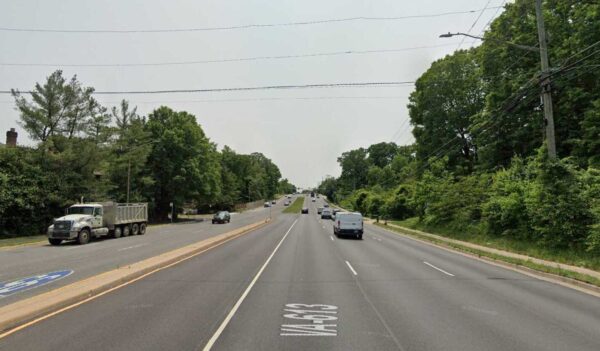
Recommendations for safety, transit, cyclist and pedestrian improvements on S. Van Dorn Street at the Alexandria border in Fairfax County will be open for public review next month.
After considerable public input earlier this year, the Virginia Department of Transportation has outlined improvement alternatives for the 2.5-mile stretch of roadway in the South Van Dorn Street STARS Study (Strategically Targeted Affordable Roadway Solutions).
The alternatives will be discussed at an open house from 7-8 p.m. Wednesday, Jan. 14 at Thomas Edison High School (5801 Franconia Road), and VDOT estimates that the study will be completed in late 2026.
The study provides Fairfax County with VDOT-endorsed choices for roadway improvements for the area of S. Van Dorn Street between Telegraph Road and the Alexandria city limits, as well as three-quarters of a mile of Franconia Road between Grovedale Drive and S. Van Dorn Street.
According to VDOT:
Within the study limits, South Van Dorn Street traffic counts range from 14,000 to 37,000 vehicles a day, while Franconia Road traffic counts range from 22,000 to 32,000 vehicles a day. South Van Dorn Street has a 35 mph posted speed limit between Telegraph Road and Franconia Road (Route 644); a 45 mph posted speed limit between Franconia Road and I-95/I-495 (Capital Beltway); and a 35 mph posted speed limit between I-95/I-495 and the Alexandria city limits. Franconia Road has a 35 mph posted speed limit between Grovedale Drive and South Van Dorn Street.
There are two alternatives for the intersection of S. Van Dorn Street and the ramp to Interstate 495, located near the Alexandria border.
Alternative 1: Eastbound lane reconfiguration

The proposed changes include:
- Improved striping [to] reduce weaving, enhance safety and improve operations
- Enhanced advanced signage to alert driver to lane configuration
- Red inlaid pavement markers and signage to alert drivers to wrong way
- Ground mounted delineators for enhanced lane separation
- Existing signage to remain
“These changes would increase safety by reducing driver confusion and the occurrence of weaving with the left and right turn movements,” VDOT said in a release.
Alternative 2: Eastbound dual right configuration

The proposed changes include:
- Improved roadway widening [to] increase capacity and improve operations.
- Enhanced advanced signage to alert driver to lane configuration
- Red inlaid pavement markers and signage to alert drivers to wrong way
- Additional eastbound right-turn lane
- Install “No Turn on Red” sign mounted on signal mast arm for additional lane
- Existing signage to remain.
“These changes would increase capacity and improve operations by adding an additional lane for the eastbound right turn movement,” VDOT said. “This will also enhance safety by providing an additional lane for I-495 northbound off ramp vehicles to exit towards.”
The VDOT study also offers multimodal improvement suggestions and other safety recommendations at the following locations. Alternatives range from installing new, high-visibility crosswalks and pedestrian signals, to modifying existing medians, restricting U-turns and more.
- S. Van Dorn Street at Franconia Road
- S. Van Dorn Street at Crown Royal Drive
- Franconia Road at Beulah Street
- S. Van Dorn Street at Kingstowne Blvd
- S. Van Dorn Street at Telegraph Road
- Fairfax Triangle
The study’s recommended alternatives are available to view on the VDOT website.

Photo via Google Maps
