

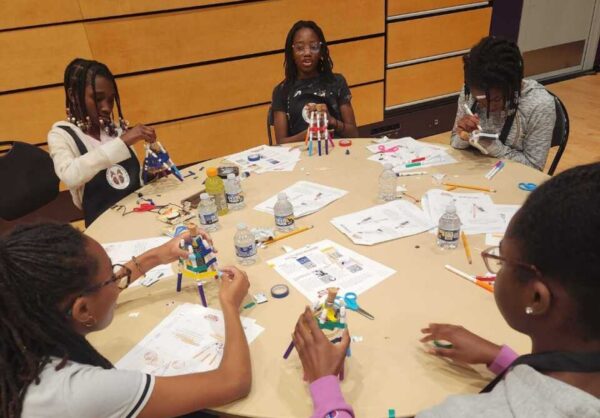
With two new grants, a STEM education nonprofit in Alexandria is looking to expand its programming to more Virginia students.
Rosie Riveters plans to introduce its hands-on learning tools to some 2,300 students across six Virginia schools, with support from a $40,000 grant from NBC4 Washington and T44 and a grant collaboration with Microsoft’s TechSpark Initiative. The tools are part of the nonprofits’ Rosie Labs program, which provides interactive STEM-themed lesson kits.
Five of the recipient schools are in Alexandria and Arlington; the sixth is Mecklenburg County Middle School in Baskerville. The latter is supported through the Microsoft initiative, which aims to “expand economic opportunity, job creation and innovation” by encouraging AI literacy in K-8 students, according to a release.
“We’re really not just focused on STEM, but the power of STEM to build critical thinking and problem solving skills,” CEO Brittany Greer told ALXnow. “We do that through what we call ‘productive struggle opportunities.'”
This means the nonprofit’s kits “are designed so that participants have moments where they get it wrong, before they get it right.” The process of trial and error helps students build confidence, Greer said.
Through NBC4 and T44’s Local Impact Grant, about 1,500 Northern Virginia students and 50 teachers will be provided with Rosie Riveters’ kits.

The Baskerville school was selected as it represents a region of Microsoft’s reach. The company has a data center in Boydton.
“We want families to drive past buildings and know what happens inside of them,” Greer said. “We want them to know what the apprenticeship process looks like, or the co-op program looks like, or, you know, the fact that there might be internship opportunities in high school — but we want them to know that before they’re in high school.”
Since its founding in 2016, Rosie Riveters has delivered programming to 76 schools, including 43 locations in Northern Virginia. Greer said the nonprofit’s goal is to act as “connectors between industry and community.”
Rosie Riveters also aims to address STEM’s “workforce gaps” by providing more educational opportunities to young women and girls, a goal Greer said is motivated by numbers: “28% of the STEM workforce is women, and 5% of it are women of color,” she said.
“It’s about resourcing communities to understand what job opportunities are available within STEM, and for industries to be able to resource and understand that their talent in their backyard,” Greer said. “It’s really a pathway into opportunity and being able to make those connections.”
Rosie Riveters is part of the TechSpark program’s third cohort of fellows, which is comprised of nonprofit leaders across the country.
Photos via Rosie Riveters/Facebook and NBC4 Washington.
