



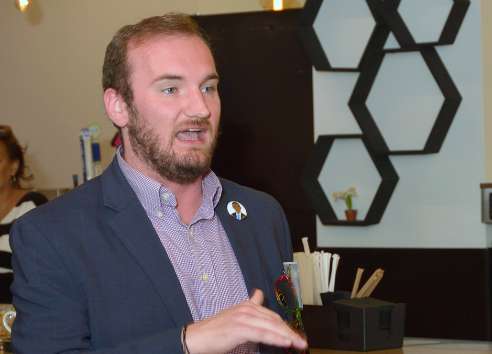

Without the pandemic keeping James “Jimmy” Lewis and his campaign team from unleashing their ground game, he says that years of door-knocking experience will significantly improve his second Democratic primary bid for Alexandria’s City Council.
Lewis faces 10 opponents, including four incumbent Council Members, for the six Council seats in the June 18 Democrat primary. He placed eighth in the 2021 primary with 6,606 votes, and that was 730 votes behind Kevin Harris. Like Lewis, Harris is trying again this cycle to get in the top six spots to secure his nomination for the November election.
“It’s going to be a tight race,” Lewis said, adding that his performance in the last primary was impacted by the pandemic. “I will say that I had significant concerns about knocking on someone’s door and asking them to come out during a pandemic, when no one was vaccinated.”
He continued, “I also had significant reservations about asking my volunteers to do that. So in 2021, we did not do a lot of door knocks. Until late April we were just dropping literature at doors. Other candidates chose to risk, frankly, their health and other people’s health. We chose not to do that. And if that’s the reason I lost, because I was protecting public health, I’m happy to have lost for that reason.”
In April, Lewis placed fifth in the Alexandria Democratic Committee’s straw poll for City Council.
The 33-year-old has been a senior director for policy and advocacy for the American Society of Consultant Pharmacists for the last three-and-a-half years. Before that, he spent seven years as the communications director for U.S. Rep.
Lewis is the chair of the City’s Traffic and Parking Board, and has been a member of that body for more than a decade. He is also the vice president of the West End Business Association, and lives in the West End of the city with his husband. He has lived in Alexandria for 13 years, and last year was named as a 40 Under 40 honoree by the Alexandria Chamber of Commerce.
“It has been interesting education in the city on the transportation and the infrastructure,” Lewis said of the Traffic and Parking Board. “It’s 11 years of doing everything from transportation commission, where do we want the high transit corridors? Where do we want BRT (bus rapid transit) all the way through? Do we put the stop sign on this side of the intersection or that side of the intersection? Those are big questions, and it might seem a little trivial, but it’s different when it’s your kid’s bus stops.”
Lewis grew up in Monongahela, Pennsylvania, a small town outside Pittsburgh. He began campaigning at a young age for his relatives, a few of whom were local elected officials. He has a Bachelor’s degree in biology and international relations from The College William and Mary and a Master’s in strategic studies from the U.S. Army War College, the latter of which he attended as a civilian through his Congressional contacts.
He lists the environment, affordable housing, flood prevention, mental health, public safety, business success and a strong school system as his top issues.
Lewis said that the city is experiencing a climate emergency and supports an “all-of-the-above” approach to reduce emissions from existing buildings. He said in a recent questionnaire that the city must add “incentives and stricter requirements” to reduce emissions.
“Given the level of emissions generated, energy efficiency, on-site generation, tree canopy and electrification all need to be priorities for existing buildings,” Lewis said. “We need an all-of-the-above approach, including extensive public recognition, reducing bureaucracy and potential incentives, to drive private landowners and shared equity communities (condos, etc.) to reduce carbon emissions.”
On the failed Potomac Yard arena deal, Lewis said that the fault lies with Republican Governor Glenn Youngkin. After four months of frenetic activity following the Dec. 13 announcement that the Washington Wizards and Capitals were moving from D.C. next door to the Potomac Yard Metro station in a brand new $2 billion arena and entertainment district, the Virginia State Senate squashed the proposal by not including it in their budget package.
Lewis said that conversations should begin on the type of innovations that should be introduced to the area, and that the city should be specific with what it wants to see for the area.
“We need to be specific so we can find a partner that creates good-paying jobs and catalyzes future development that starts to reduce the tax burden on residents,” Lewis said.
Lewis previously said that in order to prepare for major zoning changes that the city needs to focus on master planning infrastructure improvements. He also said that the city needs to focus on low income home ownership opportunities for residents.
“When somebody isn’t making 60% of the area median income, the bank’s not going to finance them,” Lewis said. “But if we’re coming in as a city, and we’re investing in this property with this program, there are ways.”
On fundraising, Lewis has spent the bulk of the $42,270 he raised, leaving himself with $7,285 on-hand, as of June 6, according to recently released quarterly campaign finance reports. He’s received 82 contributions of $100 or more totaling $24,947; 219 contributions under $100 totaling $12,722.
His top donors are former School Board Member Marc Williams ($4,200), the NOVA Area Labor Federation ($2,500), former Del. Ira Lechner ($1,000), 2021 City Council candidate Bill Rossello ($1,000), the Northern Virginia Association of Realtors ($1,000) and former Virginia Senate Majority Leader Dick Saslaw ($1,000). Other notable contributions include retired Sheriff Dana Lawhorne ($300), Sheriff Sean Casey ($250) and Clerk of Court Greg Parks ($150).
While he did not endorse a mayoral candidate, Lewis said that the city needs a mayor who is not afraid of making a decision.
“While I think there is a value in talking, you cannot talk forever,” Lewis said. “Eventually a decision has to be made.”
