


Last month, Alexandria residents and city leaders honored the legacy of Joseph McCoy by placing a wreath at the location of his lynching at the corner of Cameron and Lee Streets in Old Town. Within 36 hours, that wreath was stolen, and on Saturday a group of determined residents placed a new wreath at the site.
“Mr. McCoy was killed, murdered, by the act of hate,” MacArthur Myers told ALXnow. “We can’t bring him back, but we can be a voice for him from now on. God has given us two powerful words to express emotion — hate and love. Let the healing begin with love, which is so much more powerful.”
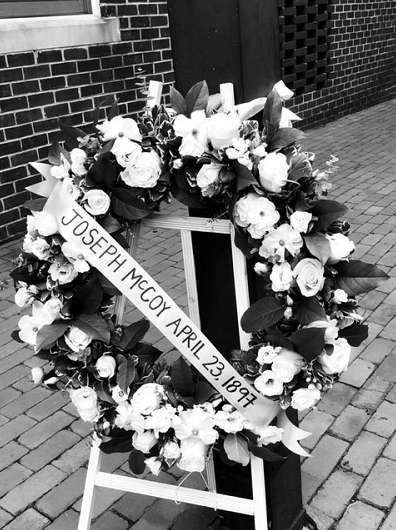
More than a dozen residents attended the brief ceremony. The 19-year-old McCoy was arrested without a warrant and then murdered 123 years ago, on April 23, 1897, by a mob of white residents who stormed the Police House (now City Hall), where McCoy was being held after being accused of sexually assaulting three women. He was shot, stabbed and hanged from a lamppost.
McCoy’s death is one of two lynchings that took place in Alexandria. The other was 20-year-old Benjamin Thomas, who was shot to death and hanged the following year by a mob of residents at Fairfax Street near King Street.
No one was arrested for their deaths.
McCoy and Thomas have been included in the Equal Justice Initiative Community Remembrance Project. Their names have been added to a steel pillar representing lynchings that occurred in the city — just one of more than 800 pillars representing 4,743 terror lynching victims around the country.
Since last year, the city has been in the process of bringing its EJI pillar home from Montgomery, Alabama.
https://www.facebook.com/photo.php?fbid=10222615262274138&set=a.1573117811750&type=3&theater
