

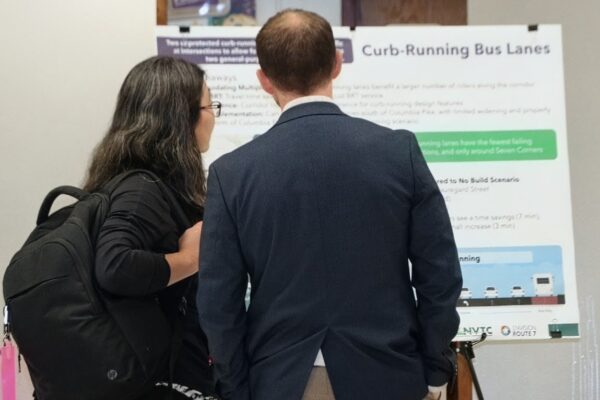
Key decisions remain to be determined — including how to fund it — but plans for the proposed 14-mile bus rapid transit (BRT) line from Alexandria west to Tysons continue moving forward.
Northern Virginia Transportation Commission (NVTC) officials on Monday (Nov. 16) detailed results of their study of the eastern portion of the proposed BRT line, running from Seven Corners in the west to Alexandria’s Southern Towers and/or Mark Center in the east.
At the meeting, held in Bailey’s Crossroads, NVTC staff seemed to suggest moving forward with a design having passengers board from stations along the curb, rather than in the center of the roadway.
“We see benefits to more riders” by going the curbside option, NVTC senior planner Vikram Sinha said at a community forum held in Bailey’s Crossroads. Putting bus stops in the center of the road would lower travel times for passengers taking the route for longer distances, he said, but would not help riders making shorter journeys.
“The bus is not just for commuters,” Sinha said.
His comments came as he detailed results of a lengthy evaluation of BRT options on Route 7 from Seven Corners east to Alexandria.
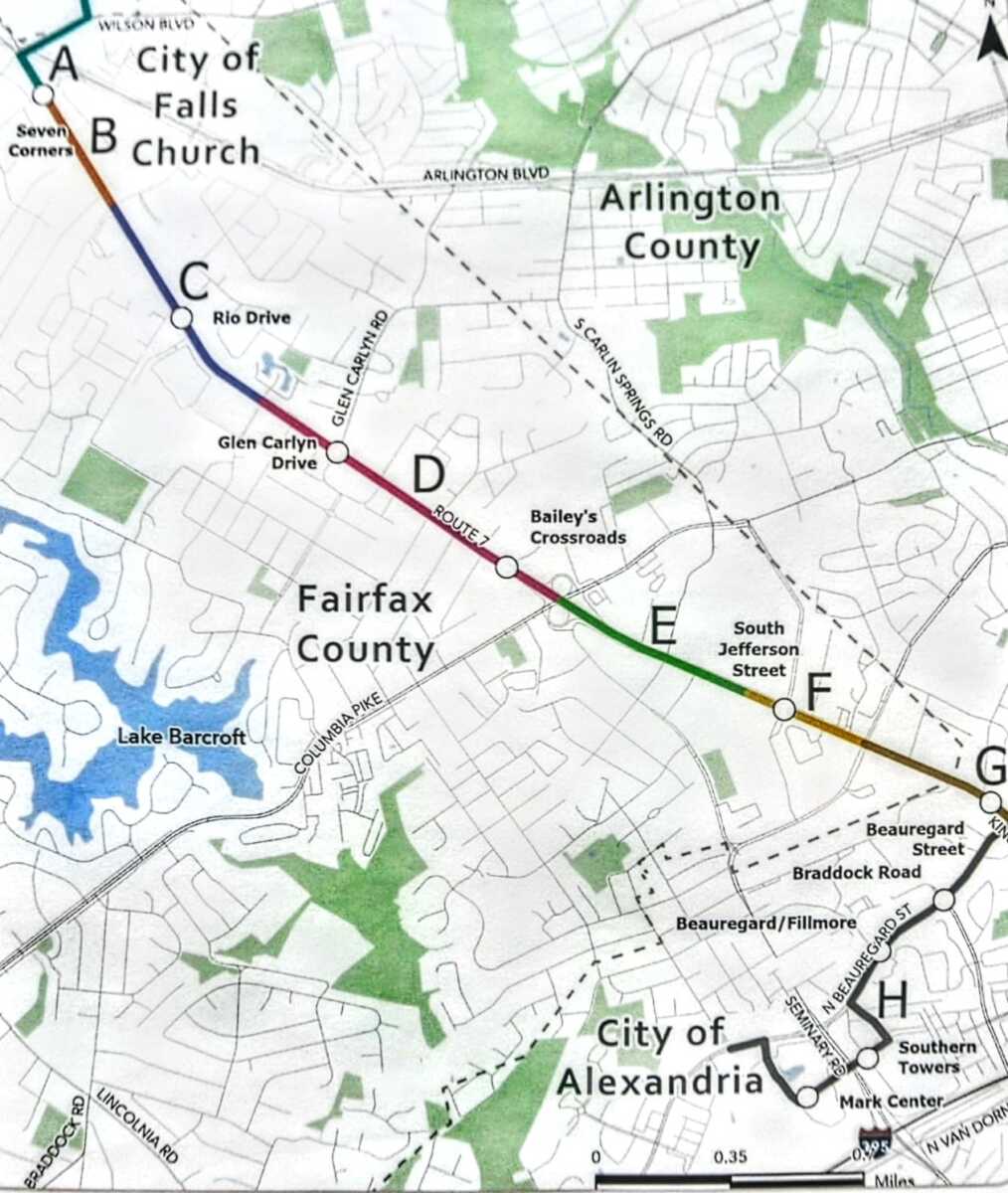
It is the easternmost portion of a planned 14-mile BRT line that would have one terminus at the Spring Hill Metro station in Tysons. The network would then run east through portions of three jurisdictions — Fairfax County, Falls Church and Alexandria — using roadway owned by the two cities and, in Fairfax County, by the Virginia Department of Transportation (VDOT).
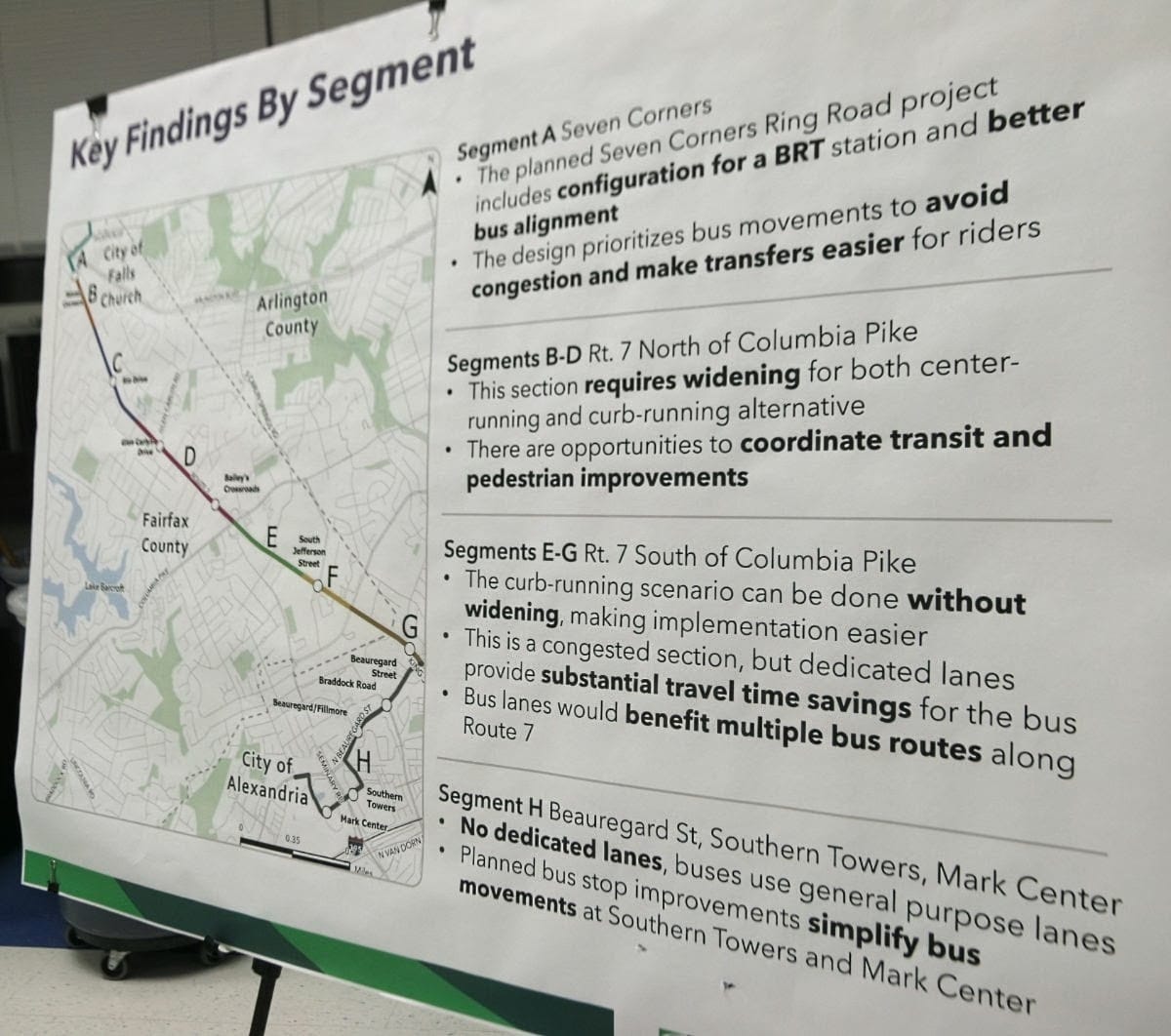
For the BRT section being discussed at the Nov. 16 meeting, both curbside bus loading and center-island loading would be likely to reduce travel times for buses compared to the current situation, where buses share travel lanes with other vehicles.
But using curbside passenger loading likely could be done with less need to acquire expensive right-of-way, and had the support of a majority of riders surveyed over the past year.
While curb-running buses might require a reduction in travel lanes, the option would have fewer negative impacts on intersections and “can potentially be implemented faster and at less cost” in some portions of the route, Sinha said.
With no current funding identified for the project, local governments, VDOT and regional bodies have the time to consider their options. Sinha said there would be “an opportunity to mix and match” different approaches in different areas of the route.
Though unlikely to be as expensive as the nearly $1 billion BRT project known as “The One” being developed for Fairfax’s Route 1 corridor, the Route 7 BRT project will run into the hundreds of millions of dollars no matter which design options are selected.
It will be part of what regional leaders hope will be a growing network of BRT lines aimed at getting people out of their own vehicles and onto transit.
It also could serve as a model for the rest of the commonwealth, said Sarah Bagley, Alexandria’s vice mayor and NVTC’s chair, at a recent meeting.
Already operating is Metroway, a BRT route linking Alexandria and Arlington. Among those in planning stages is the Duke Street Transitway, a $102 million project that would add more than four miles of bus rapid transit lanes along Duke Street between the King Street-Old Town Metro station and the Alexandria-Fairfax border near the site of the former Landmark Mall’s redevelopment.
On hand at the Nov. 16 meeting were representatives from VDOT, local governments and the Virginia Department of Rail and Public Transportation.
The Route 7 corridor is home to about 40 separate bus routes, including Metrobus and local systems like DASH and Fairfax Connector. The primary transit provider is Metro’s F20 line, Virginia’s busiest bus route with more than 2 million trips per year.
On Dec. 14, Metro will introduce limited-stop F2X service to the corridor, with even shorter times between buses. With the additional service, bus wait times in the corridor are expected to decline to just six minutes.
“We’re hoping this new service can meet some of the upcoming demand,” Sinha said.
Planning for future transit initiatives on the Route 7 corridor from Tysons to Alexandria began in 2013, with analysis of alternatives starting four years later. That analysis determined that a BRT approach would best serve riders and cost less than a light rail system.
