

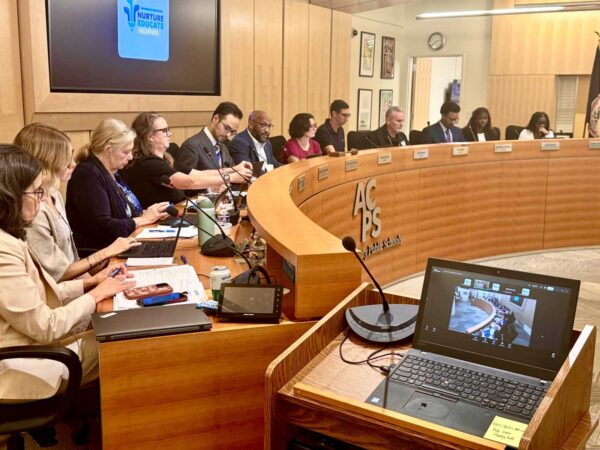
Ahead of the next General Assembly session in January, Alexandria City Public Schools officials have some new and recurring priorities for state legislators on their minds.
Tonight (Thursday), the Alexandria City School Board will be asked to approve the legislative priorities for 2027. The item is on the board’s consent calendar for its 6 p.m. meeting.
One of the asks is a familiar issue for ACPS and other Northern Virginia school districts. ACPS is requesting state legislators revisit the funding formula used to appropriate state funds to K-12 public schools. Instead of the staffing-based formula, ACPS seeks a “model that reflects actual education costs and directs additional resources based on student needs, including economically disadvantaged students, English Learners, and students with disabilities.”
Earlier this year, School Board Members Michelle Rief and Ashley Simpson Baird detailed in a blog post how the state’s funding formula shifts most of the K-12 funding costs onto localities. The members noted Virginia is one of nine states using the staffing-based funding model, compared to 35 using the student-based model.
According to the blog post, the state multiplies needed staff by student enrollment and multiplies staff by assumed salary and benefit costs in the Standards of Quality method. The total gets split between the state and locality based on the locality’s ability to pay (Local Composite Index).
Alexandria receives the maximum Local Composite Index score (0.8000), which assumes the city can locally fund about 80% of school costs.
“The LCI relies heavily on property values, income, and sales tax revenue,” the School Board members said in the blog post. “Localities with a high LCI are expected to fund most school costs locally; localities with a low LCI receive more state support.”
Gov. Abigail Spanberger (D) indicated the state’s funding formula needs an update after over 50 years to better help school divisions with funding challenges and meeting student needs. The governor set a goal of studying and updating the formula by the end of her term (end of 2029), the Virginia Mercury reported.
The full list of proposed legislative priorities for ACPS is as follows.
Adopt a Student-Based Funding Model
- Replace Virginia’s staffing-based Standards of Quality (SOQ) funding formula with a model that reflects actual education costs and directs additional resources based on student needs, including economically disadvantaged students, English Learners, and students with disabilities.
Exempt COCA from the Local Composite Index
- Provide the Cost of Competing Adjustment (COCA) as a full state payment, funded outside the Local Composite Index (LCI), so it reflects the true cost of competing for staff in high-cost labor markets.
Assessments, School Performance and Support Framework, and Accreditation
- Increase state funding for schools identified as needing additional support and for professional development tied to the Framework. Ensure improvement guidelines are evidence-based and flexible enough to address local goals and needs. To best support school improvement implementation, accelerate the release of accountability and federal identification prior to the start of the school year allowing for meaningful planning and rapid access to funds.
- Reduce reliance on standardized test mastery as the primary measure of school performance and recognize meaningful learning gains.
- Create and support accreditation and accountability systems that reflect research on the time required for English learner students to acquire content area academic language skills.
Predictable Implementation of Standards, Assessment, and Accountability Changes
- Require the Virginia Department of Education to provide at least one full crosswalk year before significant changes to standards, curriculum, assessments, accountability measures, or SOL cut scores carry high-stakes consequences, and to phase in cut score changes gradually with remediation resources so students and schools are not penalized during the transition. During the crosswalk year, VDOE should deliver finalized standards, assessments, guidance, business rules, data specifications, and aligned instructional resources, along with school-level preview reports that reflect the cut scores and assessments in effect when results count. Results should be reported for informational purposes so divisions can identify and resolve implementation concerns. If VDOE cannot meet these conditions for 2028-29, schools should be held harmless from label reductions, and VDOE should seek federal flexibility on new identifications.
Support Responsible Use of Artificial Intelligence
- Provide clear Virginia Department of Education guidance on responsible use of generative AI by students and educators, while preserving local authority to establish policies aligned with instructional priorities. Establish uniform statewide protections for student data used by AI-enabled products and services, including prohibiting vendors from using student data to train commercial AI models and requiring disclosure of how data is collected, stored, and shared.
- Preserve local authority to restrict or prohibit student use of generative AI while allowing educators to use approved tools to support instruction and reduce administrative burdens.
- Fund AI literacy within digital citizenship and technology instruction and provide sustained professional development for teachers and administrators.
- Avoid rigid statutory mandates that require specific AI tools or practices.
Invest Meta Settlement Funds in Student Well-Being
- Allocate a significant share of Virginia’s Meta settlement funds to school divisions through a formula-based distribution to support student mental health staff and services, “unplugged” programming, out of school time activities, and digital literacy for students and families. These funds should supplement, not replace, the state’s share of SOQ funding.
Expand State Support for School Solar Projects
- Support increased state resources to help offset the cost to install solar energy systems and connect to the grid, including funding for interconnection, infrastructure upgrades, and related project costs.
The General Assembly is expected to convene on Jan. 13, 2027.
