

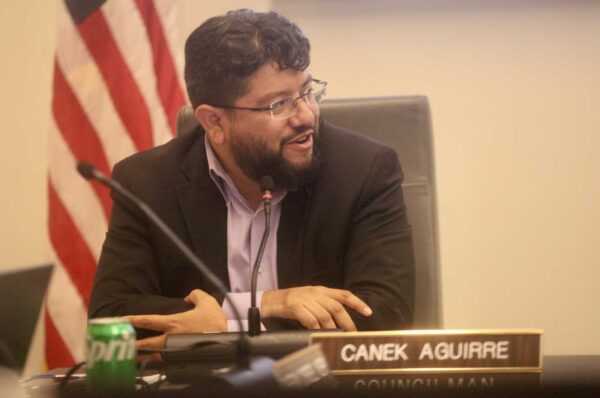
Members of Alexandria City Council and the Alexandria City School Board appointed to a special committee found some common ground as they met for the first time Tuesday (Aug. 25) to discuss School Board election reforms.
On Tuesday, the committee shared some agreement on increasing term lengths from three to four years. While there wasn’t any initial consensus on staggering terms, members will continue discussions at the next meeting and will also start dialogue on board size.
City Council and the School Board established the ad hoc committee to consider possible School Board election reforms such as staggered terms, term lengths and the size of the nine-member board. Council Members Canek Aguirre and Sandy Marks were appointed to represent City Council, and Kelly Carmichael Booz and Abdulahi Abdalla are representing the School Board.
Such reforms on the election of members would require a city charter amendment to be submitted to the Virginia General Assembly. The School Board’s next election is in November 2027.
Booz thanked the City Council for being willing to work with the School Board on election reforms. The School Board had first sought in a 2018 resolution to look into staggered terms, term lengths, board size and the potential for different forms of representation like at-large seats.
“The School Board and Council are two independently elected bodies with different responsibilities, but the work of our two bodies is deeply connected,” Booz said. “And I think it’s fair to say that we’ve had some challenges over the course of the last year working together, and I’m hoping that this can be a model of how we can work together moving forward more effectively.”
The nine-member School Board is currently elected for three-year terms every three years. Three members are elected each from Districts A, B and C.
While the General Assembly could consider a charter amendment as soon as next year, other election considerations create a tight deadline to implement changes in the 2027 election. Candidates for School Board can start filing as soon as Jan. 2, 2027, and they must declare which district they are running in.
That means City Council would have to hold a public hearing and approve a city charter amendment before a state legislator would seek an emergency charter amendment before Jan. 2.
Certain items like changes to districts are also covered under the Virginia Voter Rights Act, which requires a 60-day review from the time it is submitted to the Virginia attorney general’s office for pre-clearance.
If the charter amendment is sought for the 2030 election, the General Assembly could take it up in 2029 to take effect by Jan. 1, 2030. City Council’s vote to advance the charter amendment would have to happen by late 2028.
Aguirre said the “process will take the time that it needs to,” whether it meets the 2027 deadline or not.
“If everything falls into place and we can get this done for the 27 election, that’s a big if,” Aguirre said. “But that has to be almost a unanimous decision here within two or three meetings, going through the public hearing, the resolution, everything else, going back to our respective bodies, and then going to the General Assembly … If it doesn’t, this body is tasked with coming up with recommendations that we can move forward with in the future.”
Dialogue Begins on Four-Year Terms, Staggered Terms
There was some support for moving from three-year to four-year terms, which could potentially be aligned with the four-year presidential election cycle.
“I am especially interested in aligning with an existing and predictable election cycle for the purposes of our registrar and electoral board and the cost and voter education cycle,” Marks said. “I think that that makes a lot of sense in terms of ease of democratic process for the people.”
Booz said other Northern Virginia school districts either do four-year staggered or concurrent terms. She believes adding one more year to terms would partially help the shared goal of improving continuity.
“The first year when you come on as a school board member … it’s definitely a learning curve to jive and figure out how you’re working together as a governing body,” Booz said. “So now we’re in that second year where we’re working more together.”
She added, “Especially if you’ve had a really big turnover, which happened on the board I was in in 2013 where we have seven brand new members come on, having another year where you’ve got folks that are digging through the work, and if you’re working through the strategic plan and focus on that long-term work, I think is key.”
Committee members had more mixed opinions on the idea of staggered terms.
Marks is hesitant to take away the voter’s will to elect a completely new School Board if they choose. That voter choice applies to City Council elections as well, since all seats are up for grabs at the same time.
“When voters have a right, I don’t want to take that away, and right now voters have the ability and the right to decide what the board looks like and achieves,” Marks said.
Booz countered in favor of allowing voters to have a say in School Board elections more often and that Virginia currently has elections every year.
“To some degree, I actually think that this is a more democratic process as you move to staggered because you’re allowing people to weigh in on a more regular basis in terms of the issues that are impacting the school division,” Booz said.
Abdalla said he has “reservations” about staggered terms but is open to a discussion.
“I think we owe it to the community to explore the option,” Abdalla said. “If it ends up yielding that we don’t go down that route and four-year terms is best, or we maybe not end up doing four-year terms and going with staggered, is a conversation that I’m looking at.”
Aguirre also expressed hesitancy about staggered terms but agreed to discuss it with the committee.
“What I do respect from the School Board body is if they feel that this is something that can help with their efficiency of governance, if this can help with continuity and some of their stability, then it’s something that I am willing to have a conversation around,” Aguirre said.
Next Steps
The committee did not debate board size, but Aguirre called for having that conversation at the next meeting.
Another item sought by the School Board — compensation increases — would have to be approved by the board. For the next election cycle, School Board pay increases would have to be approved by Dec. 31, 2026 but wouldn’t take effect until the new board is in place after 2027 elections.
Abdalla said officials need to look at solutions to School Board turnover and little to no competition in elections.
“It’s a hard job,” Abdalla said. “It’s not easy, and I think just saying that out loud and making the community aware of it, and we are trying to take steps in mitigating the level of difficulty by having a four-year term and hopefully discuss staggers or reductions, whatever pillars that we’re discussing in the future, but we just have to be honest.”
Marks said the conversation on election reforms has been a “long time coming.”
“I’m really thrilled to be part of a collaborative process where we get to talk and ultimately, hopefully, come up with a plan or a new plan that both bodies can find broad consensus in, so that our state delegation might feel comfortable bringing it to the legislative body and opening up our charter to do that,” Marks said.
The ad hoc committee will meet next on Sept. 15. The committee is expected to meet again in October and produce a final report by early November.
