

Alexandria has pushed back the timeline on a project to stabilize the Taylor Run stream and sanitary sewer infrastructure at risk of damage from erosion.
The city’s Department of Transportation & Environmental Services Stormwater Division and design consultant AECOM hosted a community briefing Monday (July 20) to present the 60% design on the Taylor Run Infrastructure Stabilization Project. The $2.1 million project is based on recommendations from the Taylor Run Consensus Building Group, a stakeholder group formed to address community concerns from the previous stream restoration proposal. The former proposal drew controversy over its environmental impacts, leading City Council to send the full stream restoration back to study in 2021.
The city delayed the project timeline since the last design meeting in March. According to the new timeline, 100% design could be complete by the end of April 2027, followed by contractor procurement through September 2027 and construction between October 2027 and March 2028.
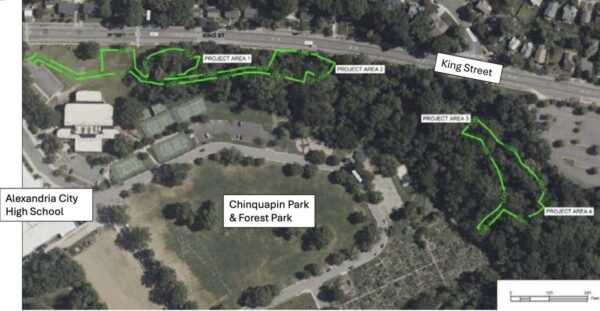
The Taylor Run Infrastructure Stabilization Project will be split into four project areas over 540 noncontinuous linear feet south of King Street near Chinquapin Park and Forest Park. Plans call for a scaled-back stream stabilization to address erosion around the stream while protecting surrounding infrastructure, including sanitary sewer pipes, manholes, stormwater pipe outfalls and the park’s trail. According to the city, the project also focuses on preserving mature trees and wetlands and minimizing disturbance and vegetation removal.
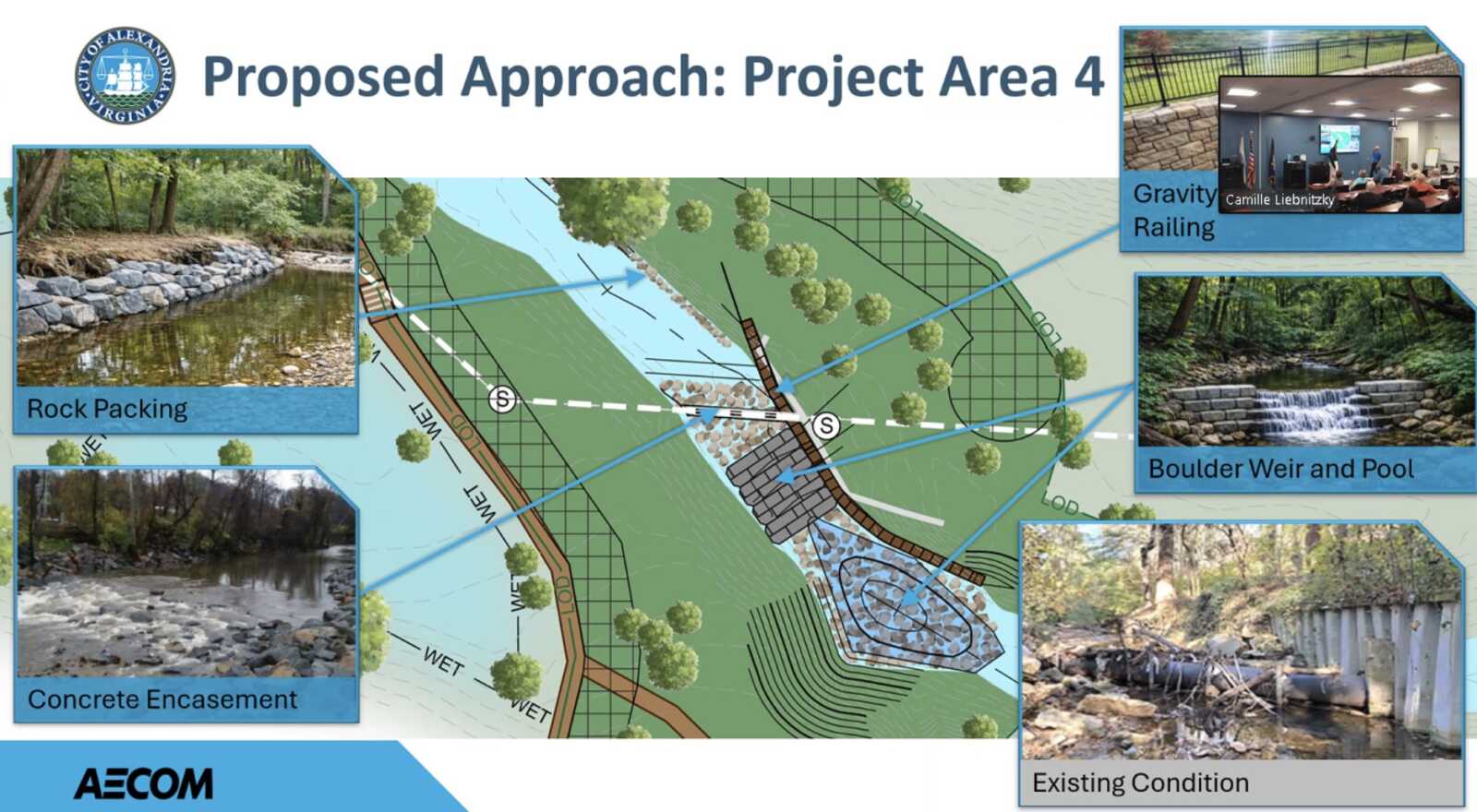
In Project Area 1, a plunge pool with sizing standards from the Virginia Department of Environmental Quality was originally proposed in the 30% design plan. Now, the project team is pursuing a smaller plunge pool using Natural Resources Conservation Service calculations that they say wouldn’t require maintenance except fallen trees or other debris landing in the fence or safety railing.
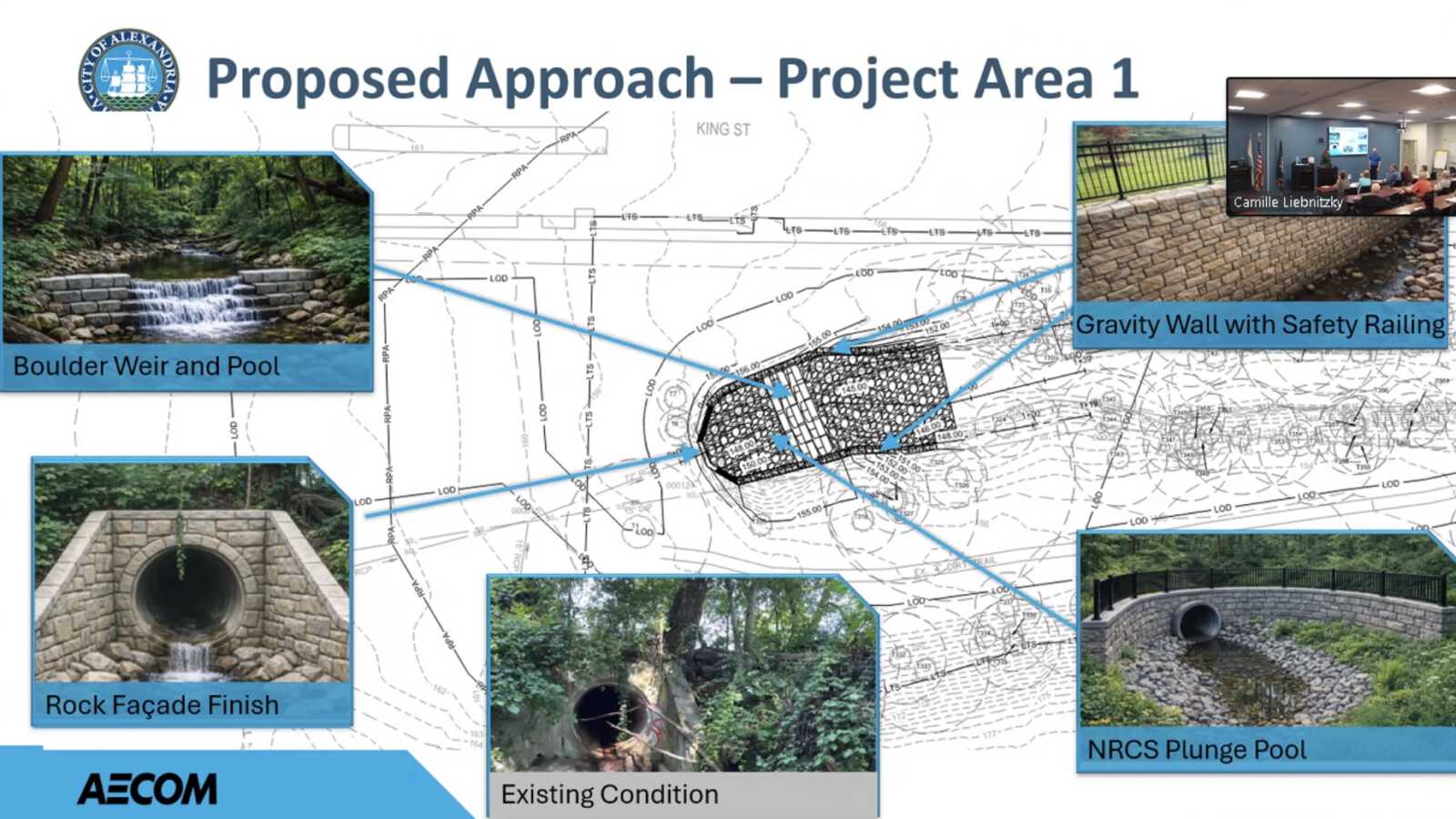
Other components of the design include gravity walls with safety railing along the four project areas, a boulder weir and pool (a type of step-pool sequence) in three of the project areas.
“We have to remember that we’re doing a minimal intervention here, so we’re only doing the gravity walls where we need to and stabilizing the banks where we need to specifically for at-risk infrastructure, because that is what is approved by City Council to move forward,” Camille Liebnitzky, an environmental engineer for the city, said.
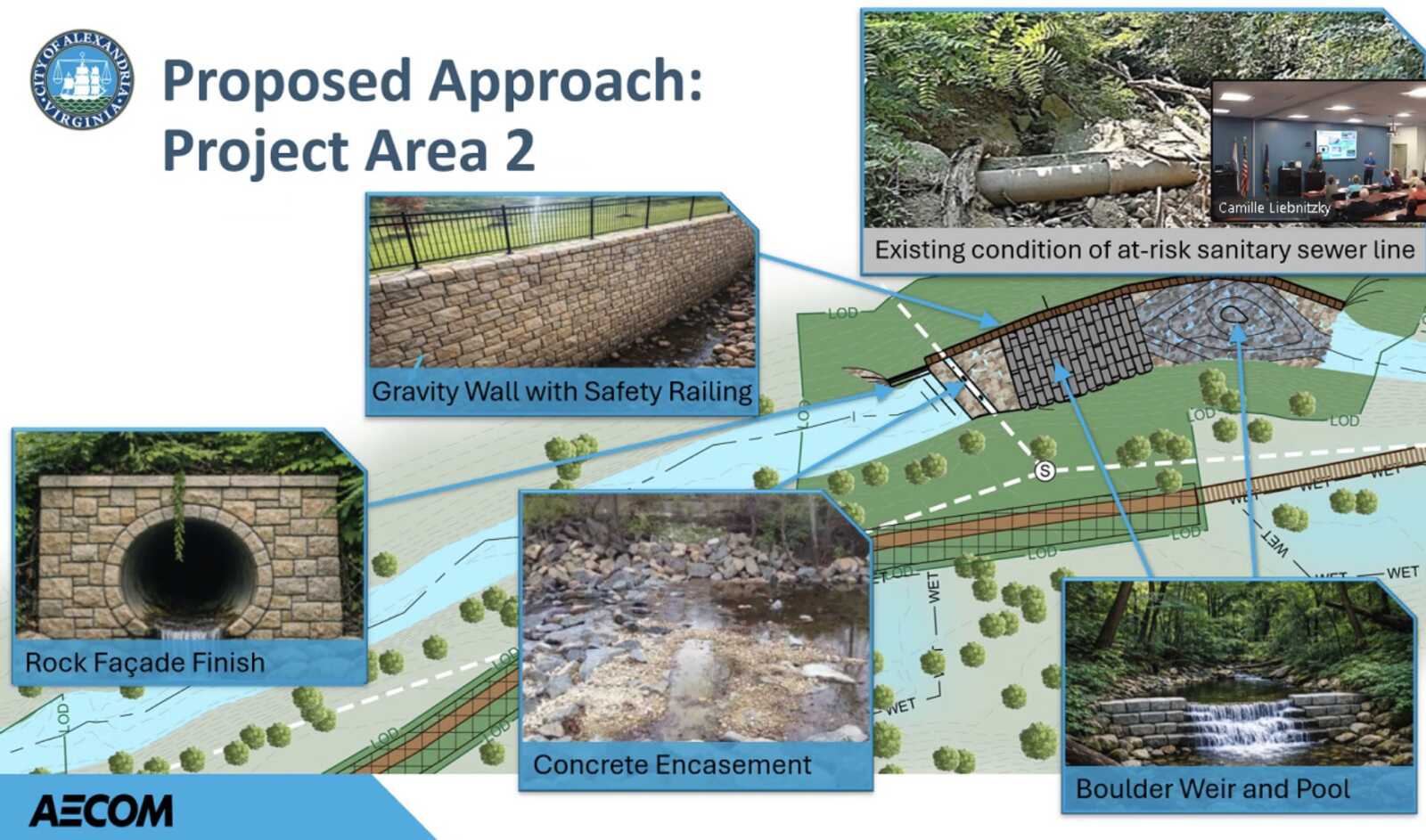
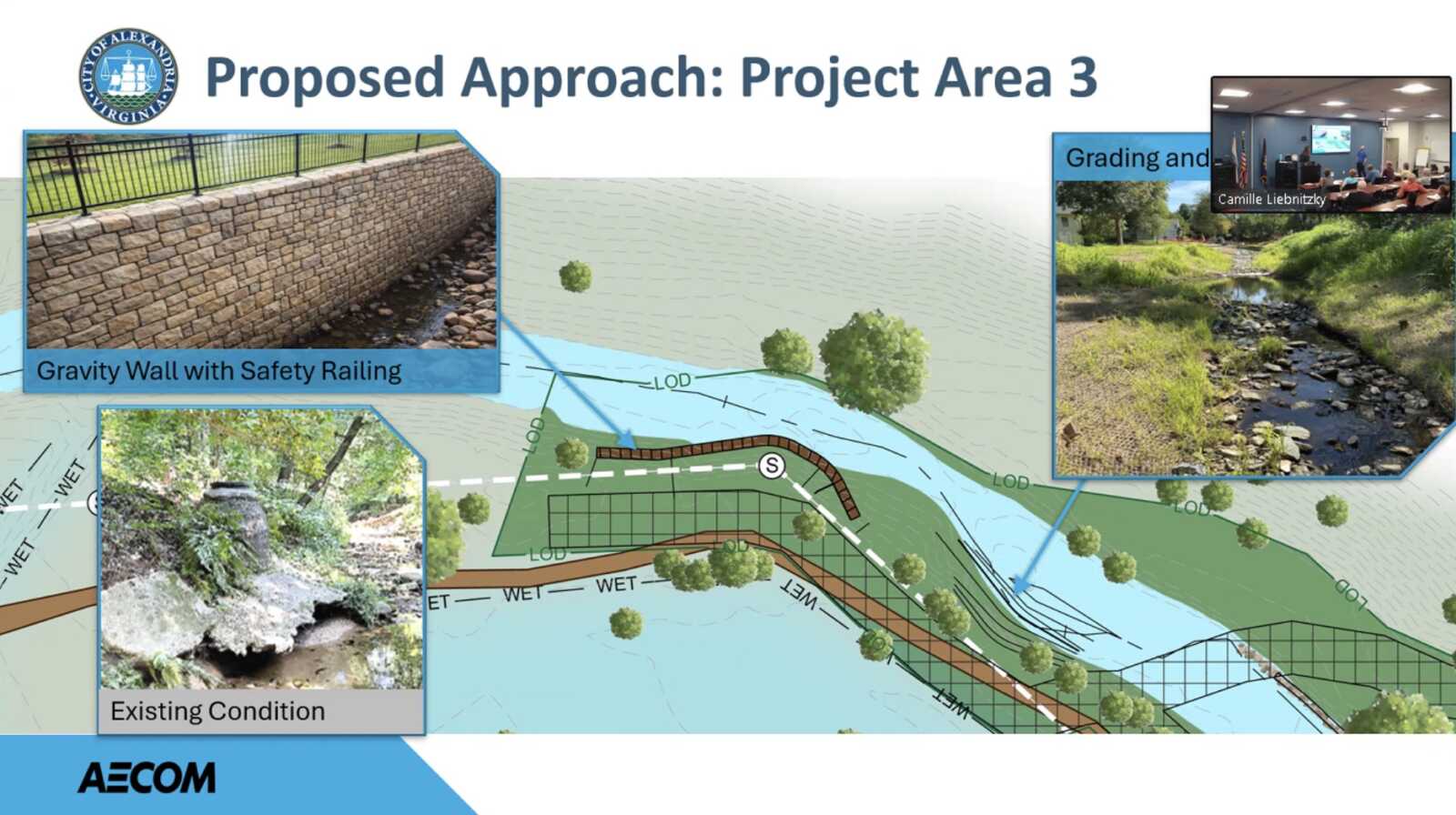
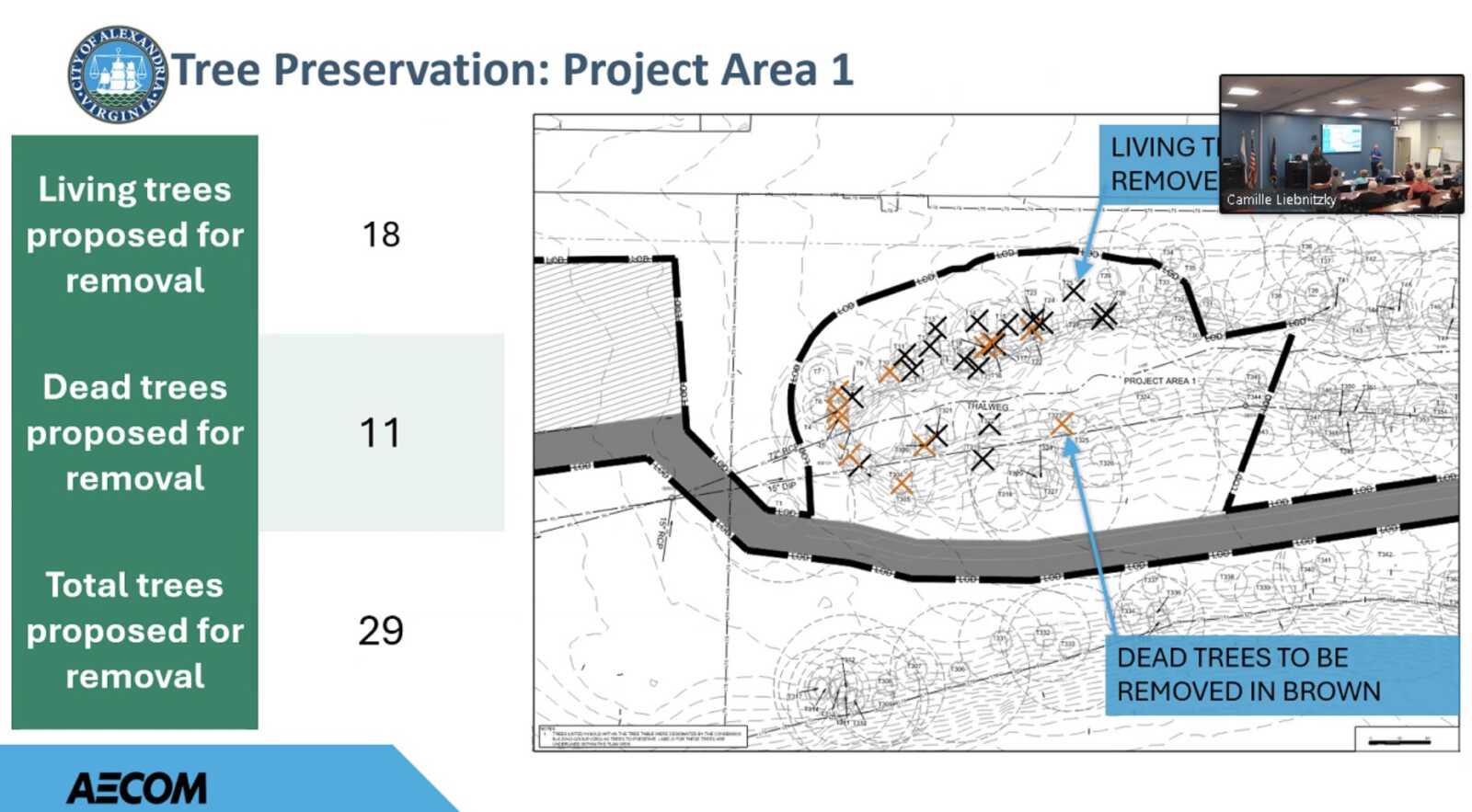
The 60% design plan revealed specifics for tree preservation along the stream. The biggest impact is proposed in Project Area 1 at the Chinquapin Park entrance next to Alexandria City High School, with 29 trees (11 dead trees and 18 living trees) proposed for removal. Two dead trees and two living trees each are proposed for removal in Project Area 2 and 3, while two living trees and five dead trees are proposed to be removed in Project Area 4.
Overall, 70 new canopy trees and 350 new understory trees or shrubs will be planted as replacements. According to Brandon Alderman, a certified ecological restoration practitioner and senior stream designer at AECOM, signage will be set up to alert the contractor about trees that shouldn’t be removed.
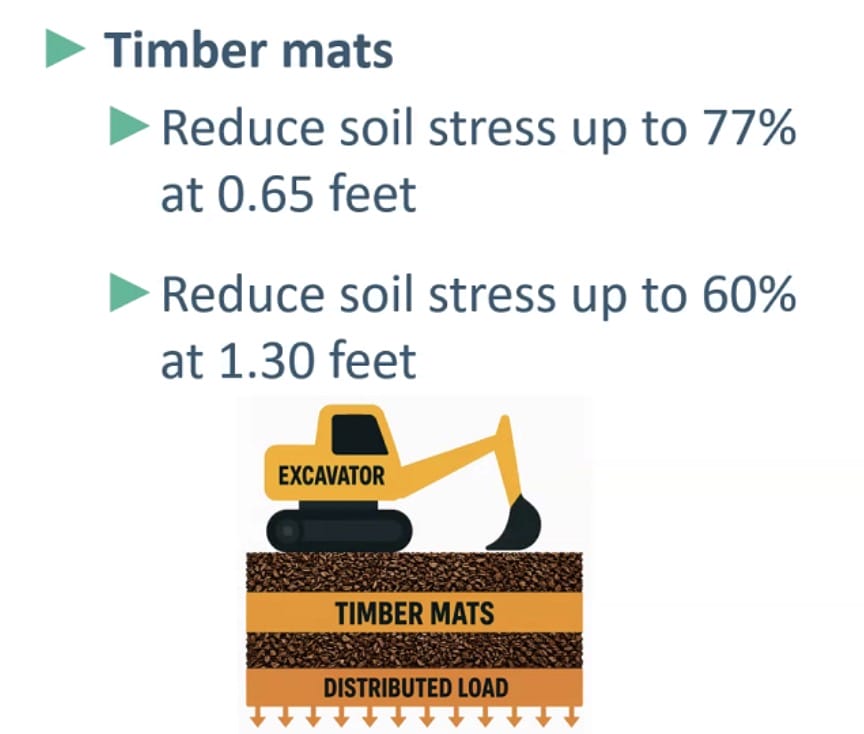
At a previous meeting, residents had expressed concerns about heavy construction equipment compressing soils and damaging roots. Alderman said there are plans to use a mulch mat access road with a timber mat, deck mat and boarding layers for that reason.
“One of the things that we do as practitioners is commonly we use a mulch mat access road, because of just generally the sensitivity of the project and just wanting to kind of make sure we don’t do any adjacent environmental damage,” Alderman said.
The city is collecting public feedback on the 60% design through Wednesday, July 29.
“It is really important that we get specific feedback on this specific design because we are at 60%. We’re going towards 90[%],” Liebnitzky said. “We’re really trying to solidify the design.”
This article has been updated to reflect the new public feedback deadline.
