

Two alternatives to a larger plunge pool for the Taylor Run stream stabilization project — with fewer impacts to trees — were proposed as the project moves closer to construction.
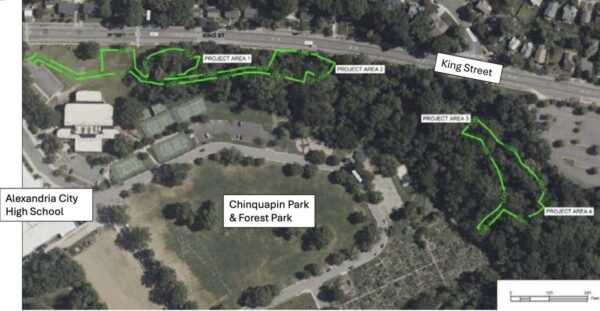
The city is conducting the Taylor Run Infrastructure Stabilization project on about 1.7 acres around Chinquapin Park near Alexandria City High School. It replaced the original stream restoration project that City Council sent back to study in 2021 amid controversy over its environmental impacts. The project aims to address erosion around the stream while protecting surrounding infrastructure, including sanitary sewer pipes, manholes, stormwater pipe outfalls and the park’s trail.
The city’s Department of Transportation & Environmental Services Stormwater Division and design consultant AECOM hosted a community briefing last Thursday (March 27) to present two new options for Project Area 1 at the Chinquapin Park entrance next to Alexandria City High School. The options were prepared in response to public feedback on the 30% design concept presented last November.
Project Area 1 currently features a deteriorating 72-inch outfall that has been covered with graffiti. Brandon Alderman, a certified ecological restoration practitioner and senior stream designer at AECOM, said erosion is significant on the stream bank in the existing plunge pool area.
The option presented in November’s 30% design proposal was a plunge pool with sizing standards from the Virginia Department of Environmental Quality.
“With that design, because of the size of the plunge pool … we’ll have an extensive length of wall that was required to stabilize those slopes. And so with that, I think there was some public feedback of, ‘can the plunge pool be a little smaller, does it have to be so big, do we need the wall to be so long?'” Alderman said.

The two new options are a smaller plunge pool using Natural Resources Conservation Service calculations and a stilling basin with no wall. The smaller plunge pool would not be as deep or as long and would require a shorter wall.
For both plunge pool options, stormwater flow would enter a large pool from the pipe, step down into a smaller pool and then continue downstream as a dissipated flow, according to Alderman.
The DEQ plunge pool would be 36 feet long, 30 feet wide and three feet deep, plus an additional three and a half feet for riprap — an erosion protection layer. The NRCS plunge pool is proposed to be 26.3 feet long, 29.4 feet wide and 0.8 feet deep, plus 4.12 additional feet for riprap. Overall, the NRCS option would require about a foot and a half less of digging, according to Alderman.
“There is a deeper protection of riprap material, but overall excavation would be about a foot and a half less deep through the subgrade, so a little bit less earthwork proposed in order to get the NRCS plunge pool in place,” Alderman said.


The stilling basin option would require demolition of parts of the existing pipe and headwall. Alderman said the stilling basin would dissipate flow from the stormwater pipe when it reaches a baffled wall, stepping down to a pool before returning to the existing grade and flowing downstream.
“Just for safety reasons, these do come with some sort of railing or fencing just to prevent people from going down in there,” Alderman said.
In previous years, Taylor Run restoration plans drew criticism from environmentalists concerned about the removal of trees and other vegetation along the stream.
Alderman said the DEQ plunge pool option would remove 31 trees — 19 living and 12 dead. The NRCS plunge pool option would remove one fewer living tree and one fewer dead tree. The stilling basin option would remove 22 trees total — 12 living and 10 dead. Alderman noted that while the stilling basin has less impact on trees, it presents a maintenance concern.
“The main issues that we’ve ever seen from a con is that these baffles, especially in an urban environment, can sometimes become pretty heavily blocked with trash and debris at times,” Alderman said. “Either leaf fall in the winter or debris or something like that, can sometimes cause issues where there needs to be a pretty ongoing maintenance at times to keep these clean and functioning properly.”
Maintenance would not be required for the NRCS plunge pool option, except in cases of fallen trees or other debris landing in the fence or safety railing.
The 60% design with the chosen option for Project Area 1 is expected in May. The project team is also preparing a permitting package for review by the U.S. Army Corps of Engineers. The city will host additional public meetings on the 60% and 90% design submissions to gather feedback, according to Alderman.
A cost estimate for the new design options was not included in the presentation. The city’s 30% design submission with the DEQ plunge pool estimated the cost of Project Area 1 to be approximately $263,000.
According to the latest project timeline, 100% design could be complete by the end of September, followed by contractor procurement through February 2027 and construction between March and September 2027.
