

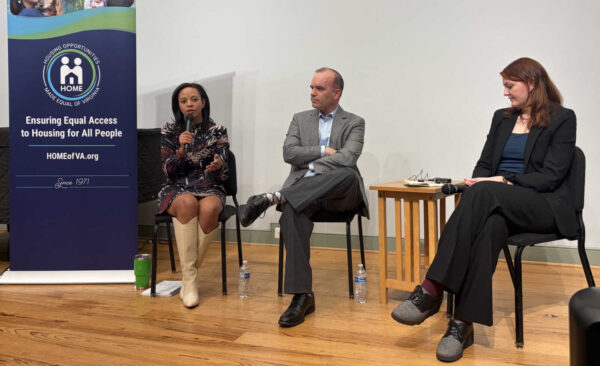
Mayor Alyia Gaskins shared possible initiatives to preserve Alexandria’s dwindling affordable housing supply during a conversation with an editor at The Atlantic last night (Monday).
Gaskins and Yoni Appelbaum, author of “Stuck“, met at The Lyceum to discuss affordable housing, the history of zoning laws and how Alexandria should approach ongoing efforts to update its Housing Master Plan.
Gaskins, who said the city is now down to fewer than 6,000 naturally occurring affordable units — as opposed to 18,000 in 2000 — used a three-legged stool metaphor to talk about solutions, with legs representing the creation of new units, preservation of existing units and tenant protections.
“It’s hard to choose just one [leg], because a stool doesn’t work if it’s lopsided,” Gaskins said. “But I think, if I had to think through where I would hope that as a community, we focus next, it would really be on sort of the preservation leg of that stool.”
Gaskins listed three actions she is focused on implementing.
- Work with private landlords to invest in naturally occurring affordable housing stock to ensure existing units’ quality
- Have an inventory of existing affordable housing and a strike fund, or the ability to intervene when units are at risk of acquisition and subsequent rent increases
- Create a city acquisition fund to purchase and maintain existing affordable housing
Some 100 guests attended the free discussion, which was hosted by Housing Opportunities Made Equal (HOME) of Virginia and moderated by Policy Director Laura Dobbs.
Gaskins and Appelbaum delved into other topics ranging from zoning laws’ roots in anti-Chinese racism, to federal impacts on Alexandria’s affordable housing, lived experiences with housing stability and foreseeable housing solutions.
Appelbaum, whose new book investigates the nation’s history of zoning and discriminatory housing policies, talked about how the rise of construction barriers has contributed to inflated housing costs and losses in opportunity.
“By 1980, anything you want to build anywhere in the country is subject to government approval, and that government approval is now subject to legal challenge,” Appelbaum said. “That means that anyone with sufficient time and money and dedication can now exercise a kind of a veto over new development. It’s a shift that takes a while to be felt.”
The nationwide changes have made it “almost impossible” to build adequate housing supplies in prosperous communities, he added.
Overall, the shift has caused a “profoundly weird” scenario, he said: “Many people now assume that if a place is economically prosperous, it just makes sense that the housing is unaffordable.”
“That just wasn’t historically true in this country,” Appelbaum added.
Last night, the Mayor said she and her husband work a combined five jobs to be able to rent in Alexandria. She also reflected on her childhood, when she and her single mother lived in affordable housing.
“The truth is, we were dealing with mold and rodents on the inside, and so I became more keenly aware of issues of housing quality,” she said.
More recently, Gaskins said she has noticed a tonal shift toward aggression in engagements from the public over the past few years — something that makes it more difficult to have meaningful conversations with residents.
Looking forward, Appelbaum said elected officials should seek to balance constituents’ needs and desires with “imperfect solutions that may not make everybody happy, but will advance the general good as best they are able.”
He also said the most important conversations about affordable housing are not about floor area ratios, but people — something he thinks some advocates are getting wrong.
“If you ask Americans, you know, do you want an apartment building to be built in your backyard? Most of them will say, ‘no’ … They worry about the construction noise, they worry about the shadows. They worry about, maybe, the plying under of a green lot or having a tough time parking when they come home at the end of the day. Those are reasonable concerns …
But if you ask the same question a different way, if you say, ‘Do you think that your community should be one that young families can move into? Do you think that the seniors who live here ought to have the chance to age in place, and have accessible housing so they can stay in the community, and continue to be active within it and maintain the social ties and attend the same church that they were baptized in? Do you want those kinds of units in your community? Do you think that the nurses and the teachers and the firefighters who serve this community ought to be able to raise their own kids in this community and send their kids to school with your kids? How about your adult children?’ …
If you ask those questions, you get a really different response, and those questions don’t have anything to do with floor area ratios.”
Gaskins hopes residents remember two things as the city continues to update its Housing Master Plan.
“We are a city that is a collection of neighborhoods, and every neighborhood does not want the same thing,” Gaskins said, before sharing a quote she admired from former Arlington County Board Chair Katie Cristol.
“Character is not just building. Character is also the characters who make up your city,” Gaskins said.
