

Editor’s Note: The Transportation Planning Board voted Wednesday to defer the I-495 Southside Express Lanes project. Read the full story here: Transportation board unanimously defers I-495 express lanes project, directs VDOT to report back in 2026
The National Capital Region Transportation Planning Board will vote today on whether to include a controversial express toll lanes project through Alexandria in its long-range transportation plan — a decision that could determine whether the 11-mile highway expansion moves forward or faces years of delay.
The TPB will vote on one of two resolutions: R1-2026, which includes VDOT’s I-495 Southside Express Lanes project in the regional plan, or R2-2026, which defers it. The project would extend express lanes from the Springfield Interchange through Alexandria and across the Woodrow Wilson Bridge to MD 210 in Prince George’s County, Maryland.
Without inclusion in the plan, VDOT cannot obtain federal environmental approval or proceed with construction.
The path to today’s vote
In June 2024, amid unresolved concerns from Alexandria and Maryland officials, the TPB directed staff to conduct two separate air quality conformity analyses—one with the project and one without. This allowed the region’s long-range transportation plan to stay on schedule while giving VDOT time to address outstanding issues.
The results, presented in July, showed minimal differences in regional air quality impacts between the two scenarios.
Alexandria’s opposition
Alexandria Mayor Alyia Gaskins has emerged as a key opponent. In September, she cast the deciding vote that blocked the Northern Virginia Transportation Authority from endorsing the express lanes expansion. Without Alexandria’s support, the NVTA measure failed to meet the population threshold required for approval.
“Ultimately, none of our questions have been answered, and nothing has changed in the way that we have been advocating for,” Gaskins said at a September City Council meeting.
In April, Gaskins wrote to VDOT, warning the project would bring “substantial consequences” to local neighborhoods. The city has requested noise, traffic, and air quality analyses before a preferred alternative is selected, and has raised concerns about induced demand, safety impacts, and effects on local streets.
Maryland’s concerns
Maryland officials share concerns about traffic impacts on their side of the Woodrow Wilson Bridge. In an October 2025 letter to Acting Maryland Secretary of Transportation Samantha Biddle, State Senator C. Anthony Muse and Delegates Veronica Turner, Jamila Woods, and Kriselda Valderrama expressed “strong opposition” to the proposal.
“This project would funnel high-speed traffic directly onto Maryland roadways, especially MD-210 (Indian Head Highway), one of the most dangerous corridors in the region,” the legislators wrote, calling MD-210 “The Highway of Death.”
At a May town hall hosted by Delegate Jamila Woods, more than 200 constituents voiced opposition to the proposed toll lanes.
The rail transit question
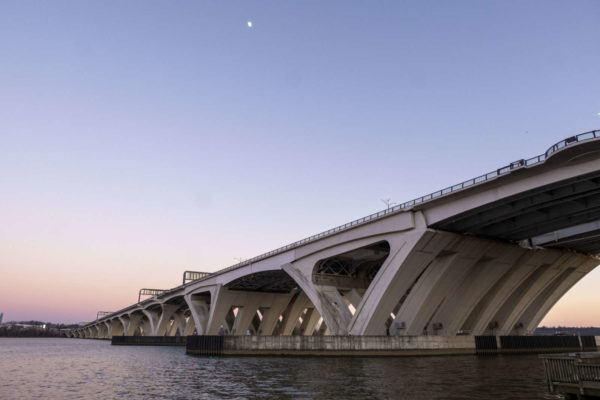
A central issue is the future of the Woodrow Wilson Bridge. The 2000 federal Record of Decision for the bridge reconstruction preserved the inside lanes for future rail transit.
Critics worry that converting those lanes to express lanes now would make a future Metro extension across the Potomac prohibitively expensive or impossible.
In an April 2024 letter to TPB Chair Christina Henderson, VDOT Commissioner Stephen C. Brich stated that the department “is fully supportive of future rail transit over the WWMB and as such is continuing to pursue rail preservation by advancing alternatives that can be pursued in the near term while including flexibility for the long term.”
In a June 2024 letter to the Washington Metropolitan Area Transit Authority, VDOT committed that “VDOT’s adherence to this requirement will not result in costs for WMATA to convert the space when they are ready to implement service.”
The project details
VDOT developed two alternatives for the 11-mile corridor:
- Alternative A: One express lane in each direction
- Alternative B: Two express lanes in each direction
Both alternatives include preservation of space on the Woodrow Wilson Memorial Bridge for future rail transit, new bus service between Central-West Prince George’s County and Tysons, and new bicycle and pedestrian facilities. The express lanes would operate similarly to existing HOT lanes in Northern Virginia, with vehicles carrying three or more people traveling toll-free.
VDOT initiated the environmental study in 2022 and held public hearings in June 2024, receiving nearly 1,000 comments.
The case for moving forward
Fairfax County Board of Supervisors Chairman Jeff McKay supports the project, though he acknowledged to NBC4 Washington that the votes for approval may not be there.
“The express lanes project that has been proposed is the only project being worked on that would relieve gridlock in this section of the Beltway,” McKay said. “It’s the only one right now. And the no-build alternative has us in a couple of years with upwards of a one-hour delay on the bridge approach in Maryland and in Virginia.”
McKay said if the TPB votes down the project today, it will be years before it becomes eligible for discussion again.
Air quality analysis
According to TPB staff analysis, the conformity analysis found that total regional emissions for Volatile Organic Compounds and Nitrogen Oxides were identical with and without the I-495 SEL project.
PM2.5 emissions with the project are 0.1% lower than without it, and greenhouse gas emissions are identical for both scenarios.
What happens next
If the TPB approves the project, staff will finalize the air quality conformity analysis, the Draft Vision 2050 Plan, and the Draft FY 2026-2029 Transportation Improvement Program with the project included. These documents would be released for a required 30-day public comment period, with final approval possible at the TPB’s December 17 meeting.
If the board defers the project, VDOT can resubmit it for inclusion in plans or as an amendment to Visualize 2050. However, a new air quality conformity analysis would typically take 6 to 9 months, plus additional time for public comment — effectively delaying the project by more than 2 years.
The meeting begins at 12:00 p.m. today at the Metropolitan Washington Council of Governments. The meeting is available to be watched virtually here and below.
This is a developing story. Check back for updates following the TPB vote.
