

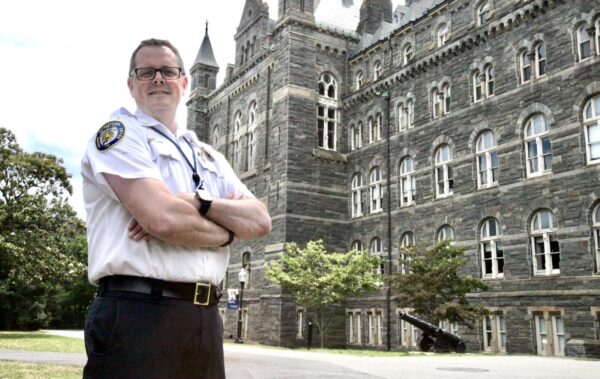
Former longtime Alexandria police officer Courtney Ballantine is adjusting to a new role after being promoted to chief of police of the Georgetown University Police Department.
All the badges Ballantine wore in Alexandria, from captain on down, sit in a shadow box near his desk. Four days after retiring from the Alexandria Police Department on Aug. 1, 2025, Ballantine put on a new uniform as the deputy chief of police at Georgetown University. A few weeks later, then-chief Jay Gruber got a new job at American University and Ballantine was named interim chief.
“It’s surreal that I’ve gotten to where I am,” Ballantine told ALXnow. “It wasn’t on my bingo card, if you will.”
After being named interim chief, Ballantine worked with administrators to merge Georgetown’s Department of Public Safety at Georgetown’s Capitol Campus with the Georgetown University Police Department. Since then, Ballantine has overseen both campuses.
“We have a lot of cool people coming onto the campus,” Ballantine said. “The Clintons are here, the Pelosis are here. I got to meet Tom Brady, who was the commencement speaker for this past graduation. He’s super nice … It’s things like that where I ask myself, ‘How did I get here?'”
After six months as interim chief, Ballantine was promoted to the chief’s job in February. With a force of about 100 total staff, he’s managing security for essentially a small city with 20,000 students and 7,500 staff spread out across Georgetown’s Hilltop and Capitol campuses.
“We are a third of the size of the Alexandria Police Department,” he said. “I’m having the time of my life because I feel like we’re making some really cool progress, not just with the police department, but our relationships in the community and across the university. It’s pretty cool.”
Ballantine and his officers are armed with batons and pepper spray, but no firearms.
“It took a long time to get used to not looking for [his service weapon] with my elbow,” Ballantine said. “I don’t have to worry about the liability of being armed. We rely on the Metropolitan Police Department to respond with lethal force.”
Ballantine says a lot of his time has been spent building trust with administrators, faculty and students.
“It really boils down to spending time with somebody, talking with them, understanding what their lens is so that when we work together it makes sense,” he said. “I work with amazing people. We work hand in hand with facilities and athletics, and the officers want to be here for the right reasons. It’s magic. It’s a natural conversation where everybody comes to the table and is respectful, we all listen and decisions get made.”
In Alexandria, Ballantine commanded APD’s Patrol Operations Division, Special Operations Division, Community Engagement Division, the ACORP Unit, and served as the department’s liaison to the mayor and members of City Council. He joined the department in 2000 after earning a bachelor’s degree in criminal justice from Radford University, got promoted to sergeant in 2007, lieutenant in 2014, was made acting captain in 2021 and officially became a captain in 2022. In 2023, he graduated from the prestigious FBI National Academy and in 2024 earned his master’s degree in public safety from the University of Virginia.
Ballantine said that APD is a good training ground for future chiefs of police.
“You can learn about all the facets of the organization and how it works,” Ballantine said. “You have the opportunity to go to the FBI National Academy, you can engage with other agencies within the city, the state and federal government. If you want the opportunity, it’s yours to take.”
APD officers who became police chiefs:
- Mike Kochis, chief of the Charlottesville Police Department
- Shahram Fard, chief of the Falls Church Police Department
- Cleveland L. Spruill, division chief of police at the National Institutes of Health
- Raul Pedroso, chief of the Fairfax City Police Department
- Dave Huchler, deputy police chief for the Town of Vienna
- Former APD Chief David Baker
- Former APD Chief Don Hayes
- Former APD Chief Earl Cook
- Former Greenville Police Department Chief Hassan Aden
