

Alexandria posted a significant year-over-year increase in the number of residents counted as homeless, with major upticks in the number of Black residents and children experiencing homelessness, according to new data.
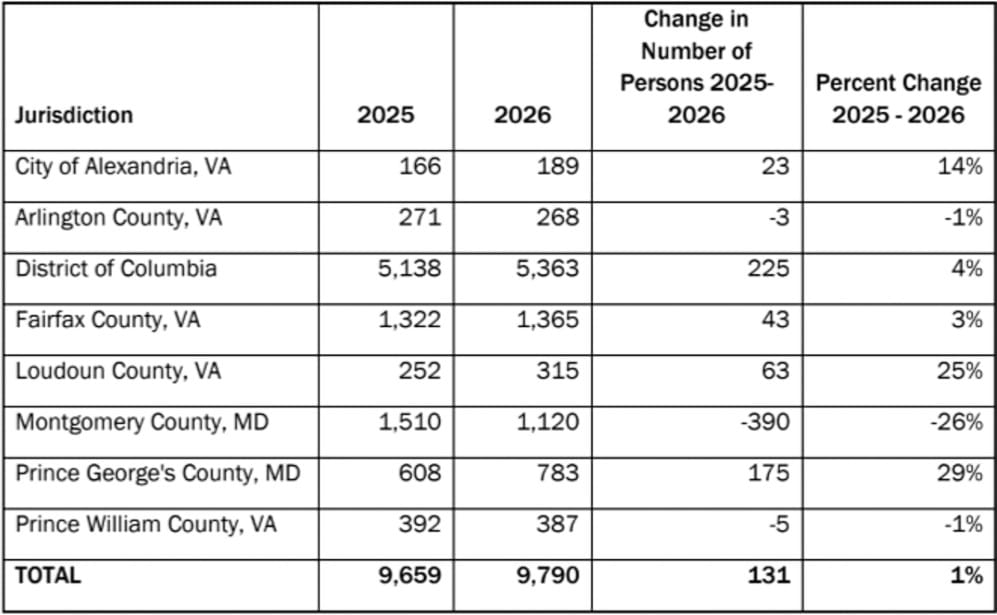
A total of 189 people across the city were tabulated as experiencing homelessness in the 2026 Point-in-Time Survey, conducted in early February across the Washington region.
The annual count is coordinated by the Metropolitan Washington Council of Governments (COG). Results were reported at COG’s May 13 board meeting.
Though up 14% from the 2025 survey, the 2026 count of 189 was within the range Alexandria has seen for much of the past decade. Since 2019, totals in Point-in-Time surveys have ranged from 120 (2022) to 207 (2020).
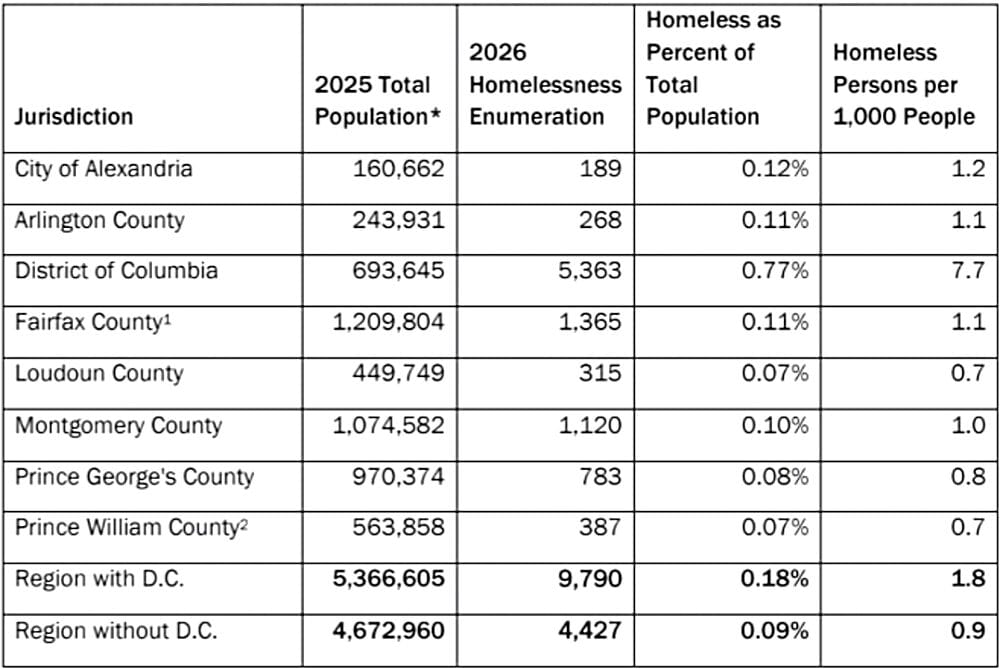
At 1.2 homeless persons per 1,000 residents, Alexandria had, by a narrow margin, the highest per-capita rate of homelessness in the D.C. suburbs, where the 2026 rate was 0.9 per 1,000 people.
The 2026 report showed that 71% of those identified as experiencing homelessness in Alexandria’s 2026 count were Black or African American, an increase from 64% in 2025. Black residents comprise 21% of Alexandria’s total population, according to the city government.
That disparity has the attention of the city government and the Partnership to Prevent and End Homelessness in the City of Alexandria, which have created a Pathways to Opportunity and Access Committee to provide education and awareness.
The Point-in-Time count also found an increase in the number of children experiencing homelessness, rising from 36 in 2025 to 56 this year.
City is responding, but faces challenges
According to city officials, reductions in safety-net funding as the pandemic ebbed have exacerbated challenges for some individuals and families, as have broader economic factors affecting the region and nation.
In a narrative provided as part of the Point-in-Time report, city officials said:
“One factor that impacts the increase in those experiencing homelessness is Alexandria’s housing market, where costs are so high that the existing funding subsidies do not go as far as they once did, ultimately serving fewer households. Another factor is the continuing economic spikes in housing, food and transportation costs. Without additional resources and policies like those established in response to the pandemic, the impact of continuum-of-care services has been limited to reactive solutions.”
In the report, city officials pointed to a number of steps being taken to address homelessness in the community, including:
- Collaboration with community partners such as the Alexandria Health Department, Community Services Board and Neighborhood Health to “support residents in a holistic way”
- Providing $600,000 to Carpenter’s Shelter in rapid rehousing funding
- Using housing tax credits to develop affordable housing, including the Waypoint, the Spire and Square 511
- Increasing efforts to provide permanent supportive housing for residents and families with earnings below 50% of area median incomes, with priority given to those discharged from state psychiatric facilities, residents of groups homes, those with frequent interactions with the criminal justice system or hospitals, and those experiencing chronic homelessness
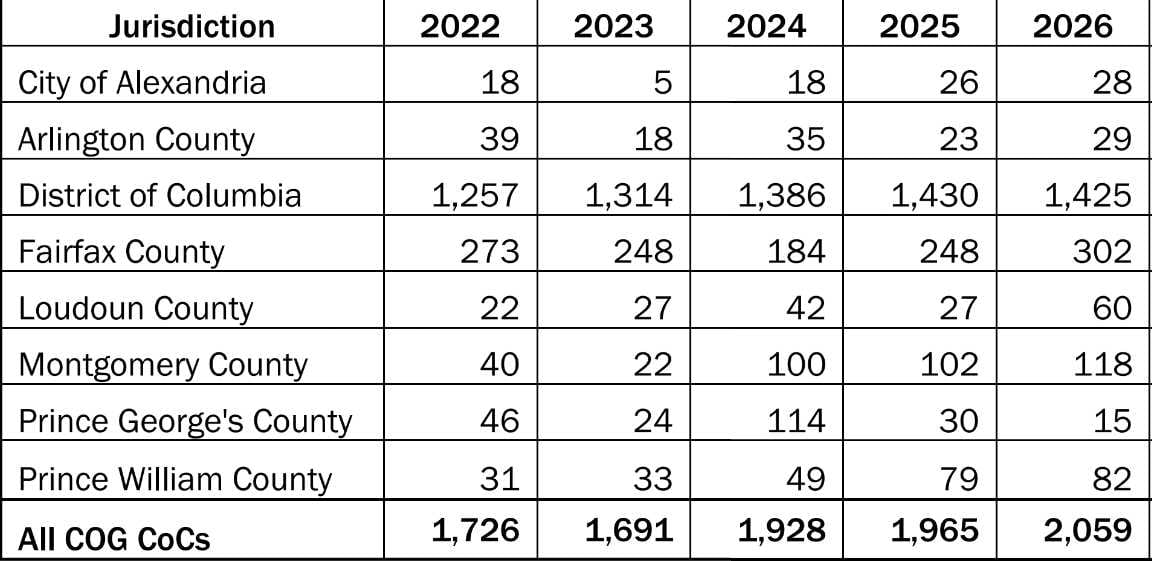
In the 2026 data, 28 individuals were described as chronically homeless in Alexandria, up from 26 and the highest level since the pandemic.
Those considered chronically homeless meet one of two thresholds:
- Experiencing continuous homelessness for one year or longer
- Experiencing homelessness at least four times over three years, totaling 12 months or more
Regionally, the number of people determined to be chronically homeless grew 5% year over year to 2,059, with the bulk — 1,425 — reported by the District of Columbia.
Regional levels of homelessness rise slightly
Across the Washington region, the 2026 Point-in-Time count of those experiencing homelessness totaled 9,790, up 131 individuals (1%) from 2025.
The 2026 count was conducted Feb. 4. It was postponed from late January, when counts typically occur, due to winter weather.
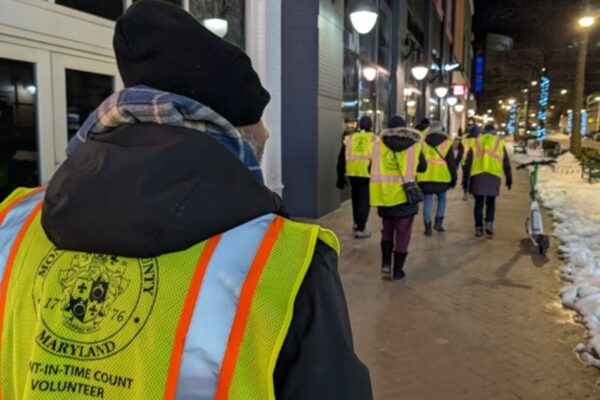
Volunteers and local government personnel fanned out across the region to count those living in unsheltered conditions, while shelters provided occupancy information included in the total numbers.
Those in shelter facilities represented 87% of those counted.
Christine Hong, who chairs COG’s Homeless Services Planning and Coordinating Committee, said the report has built-in limitations but still provides valuable insights.
“Although it’s an imperfect measure, it provides an important regional snapshot,” said Hong, a human services official with the Montgomery County, Md., government.
The data “tells us who was counted on one night,” she said, “[but] does not tell us causation, does not by itself tell us exactly why someone became homeless, why one jurisdiction increased while another decreased.”
Funding cuts, impacts to seniors raise concerns
Addressing the COG board, Hong acknowledged “significant cuts” to supportive-housing programs either implemented or proposed by the Trump administration. More may be on the horizon.
“We are still anticipating threats and continuing uncertainty,” she said.
The metropolitan Washington region receives about $77 million in annual federal funding for homeless services, including housing and supportive services. In January, the COG board formally requested that Congress and the U.S. Department of Housing and Urban Development find ways to prevent any disruption in grant funding for the current year.
One concern raised at the meeting was an increasing level of homelessness among the region’s seniors.
“Older adults experiencing homelessness face unique vulnerabilities due to health or mobility limitations,” the Point-in-Time survey reported. “They may also have more significant health concerns not typically seen in homeless services systems, such as Alzheimer’s disease or cancer.”
The report noted that “the average life expectancy of a person experiencing homelessness is estimated between 42 and 52 years, compared to 78 years in the general U.S. population.”
