

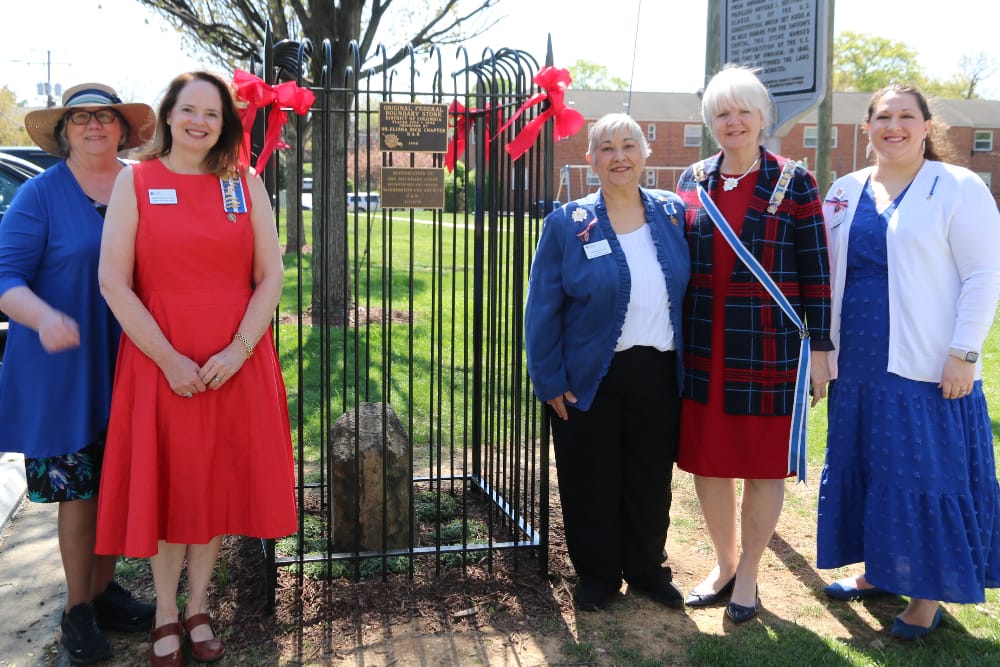
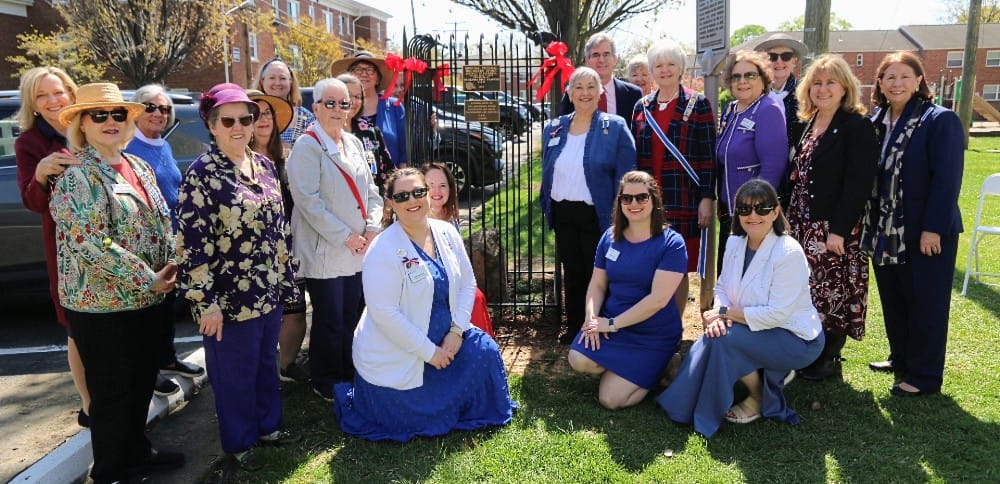
An Alexandria patriotic organization last week rededicated one of the original D.C. boundary stones, which its members have cared for over the past three-quarters of a century.
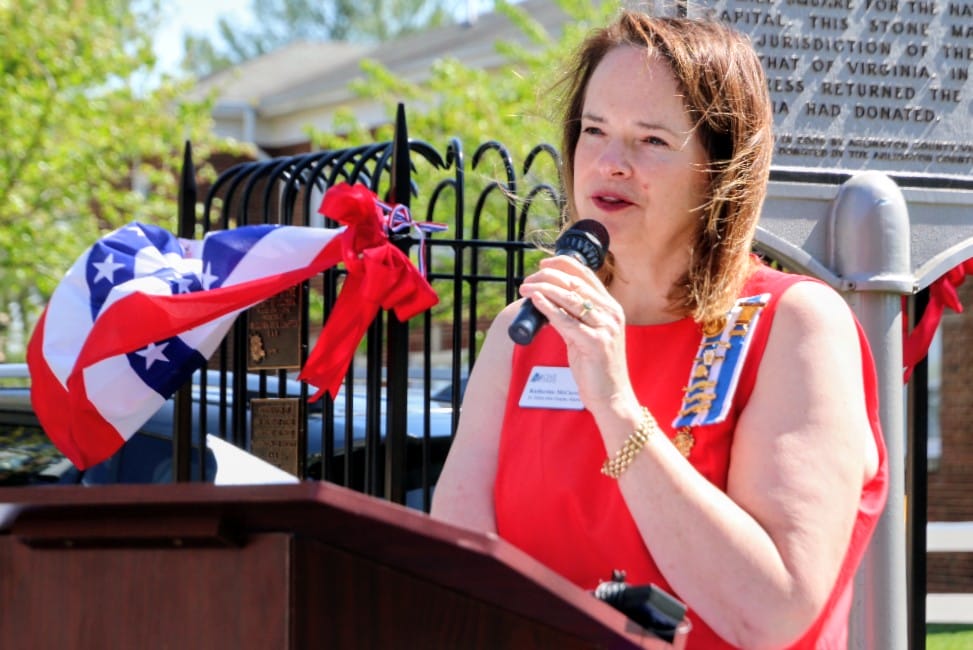
Members of the Dr. Elisha Dick chapter of the National Society Daughters of the American Revolution held a rededication ceremony April 10 for Boundary Stone Southwest 8.
Members of the DAR chapter have been responsible for safeguarding the stone since taking on the duties at a similar dedication ceremony on Dec. 5, 1950.
This year’s rededication represented the culmination of more than a year of preservation work, including installing new fencing and a commemorative marker explaining the stone’s significance.
Linda Ferrara, regent of the chapter, told ALXnow the rededication effort was one of her organization’s projects to mark the 250th anniversary of American independence.
“We are delighted to celebrate” its completion, she said.
The 4-foot-high stone was among those placed in the ground in 1791 to mark the boundary between Virginia and the future District of Columbia, which at the time included all of Alexandria County — today’s Arlington County and the city of Alexandria.
Virginia’s land contribution to the District of Columbia was returned to the commonwealth in 1846. Today, the stone marks the boundary between Arlington and Fairfax counties in the 6100 block of Wilson Blvd. near the Upton Hill community.
The boundary stones are “living pieces of history woven into our very own communities,” said Kathleen Mayer Rugh, Virginia state regent for the DAR.
The stones are reminders of the “vision, sacrifice and determination that shaped our young nation,” she said at the ceremony.
Joining ceremony participants was the color guard from Joint Base Andrews and several news outlets.
The new fencing is modeled after the designs used by the national DAR in 1915-16, when the organization acquired deeds to most of the markers and worked to “save the stones from oblivion,” said Katherine McCarron, who chairs the chapter’s historic preservation committee.
Southwest 8 was not among those that gained protection in 1915. McCarron said the farmer on whose land it rested refused to give permission to the DAR to fence it off.
The marker then disappeared, only to be found in the Columbia Pike area by a hiker in the late 1940s. Shortly thereafter, it was returned to its original location, and members of the Dr. Elisha Dick chapter began to care for it.
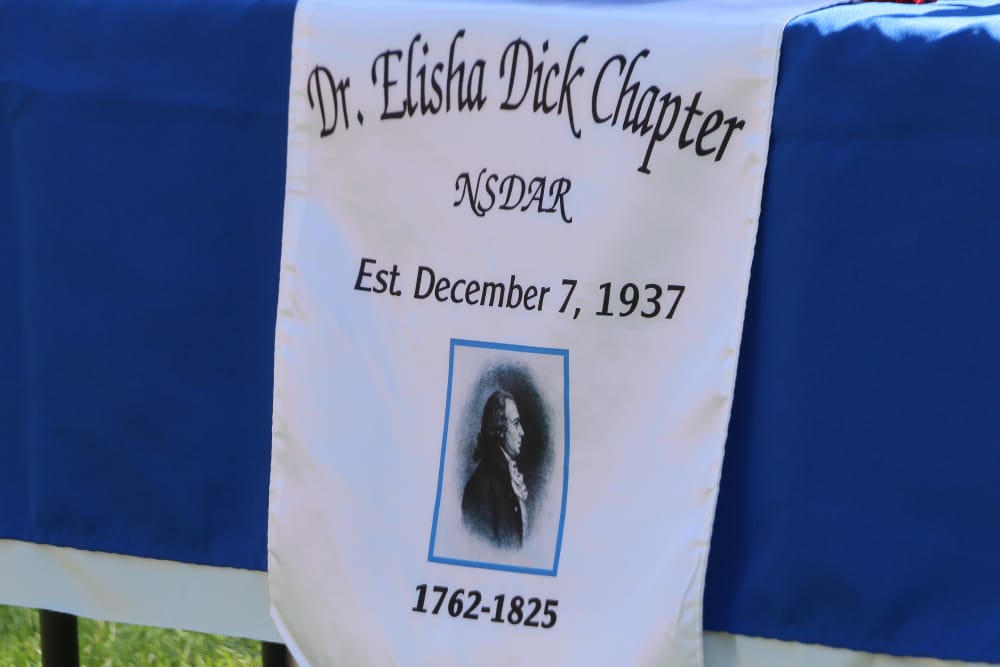
The chapter dates its roots to 1937, and in recent years has seen membership growth, several members told ALXnow. Many members live in the city, but others are spread across Northern Virginia and beyond.
The chapter is named for Elisha Cullen Dick (1762-1825), an Alexandria physician and one-time mayor (1804-05) who was friends with his fellow Mason, George Washington.
Dick was among the physicians summoned to Mount Vernon on Dec. 14, 1799, as Washington lay dying. Four days later, he presided over the Masonic rites at Washington’s funeral.
An enslaver for much of his life, Dr. Dick had a change of heart in the early 1800s, emancipating those he had enslaved and becoming a Quaker.
Southwest Stone 8 not only marks the boundary between Arlington and Fairfax, but also between the Patrick Henry Apartments (constructed in 1955) and Seven Corners Apartments. DAR officials thanked the management and staff of both properties for supporting the marker site’s refurbishment.
Residents of the apartments may not realize it, but they live on land connected to one of the most famous songs of all time.
During the Civil War, Julia Ward Howe visited Fort Ramsey, located on Upton’s Hill near the boundary marker. From her experiences watching a military review there in 1861, Howe was inspired to pen the words to “Battle Hymn of the Republic.”
The sandstone boundary markers were quarried in Aquia Creek, Va., which also provided the building blocks for the White House and early stages of the U.S. Capitol.
While the boundary marker can be visited, non-resident parking is not allowed at the two apartment complexes. Street parking is available nearby.
