

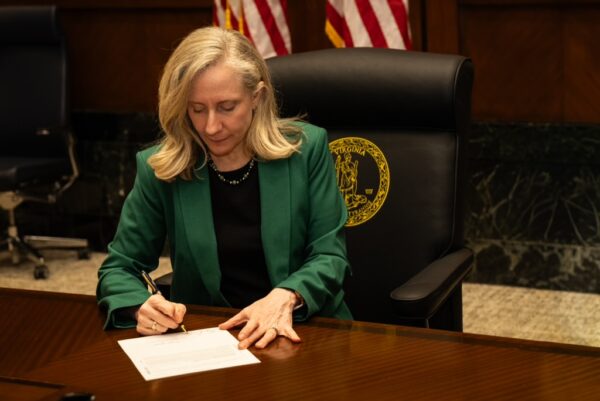
After more than 1,200 bills passed in the Virginia General Assembly, Gov. Abigail Spanberger has signed the first set of bills tackling several areas of affordability.
The governor’s action marks the first major set of bills signed from the 2026 General Assembly session. Spanberger had previously signed voter referendum legislation allowing mid-decade congressional redistricting to go before voters on April 21. The signed bills address housing, health care and energy.
“No Virginian should ever have to choose between seeing their doctor, paying their rent or mortgage, or keeping their lights on,” Spanberger said in a release. “I am signing this legislation to respond to the real, pressing concerns I have heard from Virginia families across the Commonwealth about high costs — particularly at the pharmacy counter, in the housing market, and on their utility bills.”
On housing, Spanberger approved bills to use Virginia’s bonding authority to support affordable housing development (HB 1227 and SB 729), to expand the Virginia Eviction Reduction pilot program (SB 628) and to allow manufactured homes in more zoning districts (HB 655 and SB 346).
On health care, Spanberger signed bills to limit how pharmacy benefits managers can increase prescription drug costs (SB 669), to administer nursing scholarship and loan programs to grow the health care workforce (SB 405), to eliminate additional fees on health care premiums for tobacco users (HB 220 and SB 630) and to prohibit insurance discrimination for taking pre-exposure prophylaxis (PrEP) for HIV prevention (HB 60).
Energy-related bills signed by the governor seek to protect electricity ratepayers from the costs of new substations serving high-energy users like data centers (HB 1191 and SB 377), to boost clean energy procurement by allowing large users to buy renewable energy certificates from the regional electric grid (HB 369), to evaluate ways to shield electric ratepayers from fuel cost spikes (SB 505) and to streamline permitting of new high-voltage transmission infrastructure in existing utility and highway corridors (HB 889 and SB 497)
Additional bills would allow electric cooperatives to create a virtual power plant program to manage reliability and grid demand and to offer incentives to residents who buy battery storage devices (HB 562) and set regulations on utilities developing electric vehicle charging stations (HB 1225 and SB 407).
Another pair of signed bills would create a free state tax filing program (HB 1180 and SB 591).
The governor also signed a bill from Alexandria state Sen. Elizabeth Bennett-Parker (D-39) to expand the vehicle registration fee exemption for disabled veterans to standard license plates (HB 94).
Spanberger has an April 13 deadline to act on other bills passed by the 2026 General Assembly. The General Assembly will reconvene April 22 and convene a special session the following day.
