

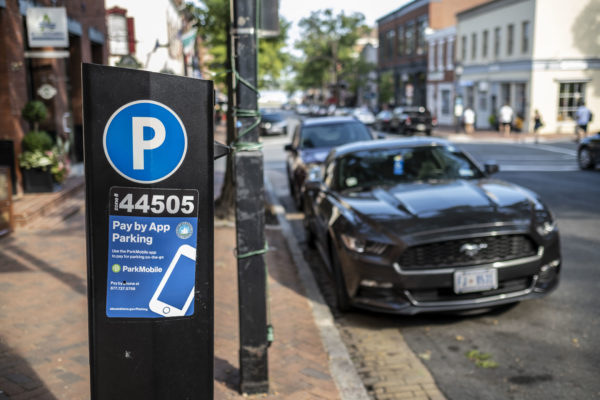
Alexandria City Council unanimously expressed support Tuesday night for expanding the city’s parking enforcement pilot program after data showed substantial improvements in citation rates, response times, and revenue collection since contractors began supplementing city staff in December 2023.
The pilot program, which deployed contractors to enforce parking along King Street and adjacent blocks in Old Town, has increased monthly citywide citations by 61%, from approximately 5,000 to nearly 8,000, according to a presentation by Deputy City Manager Yon Lambert at the Oct. 28 council meeting.
“The contractor has allowed us to make more consistent enforcement and better compliance with rules,” Lambert told council members. “It’s allowed us to provide faster response times, parking-related service requests, and more safety-related citations issued by APD as staff time was freed up.”

The program has generated substantial additional revenue for the city’s general fund, according to information provided to ALXnow after the meeting. Through the end of fiscal year 2025, the pilot produced $785,804 in additional citation revenue and $1.2 million from increased parking payments through kiosks and mobile apps — a 16% increase in paid street parking transactions.
In a follow-up statement on Wednesday, Lambert explained the revenue’s significance: “Revenue from parking meters and fines supports essential city services that residents and visitors rely on every day. These revenues help offset the cost of maintaining streets and sidewalks, as well as supporting public safety, traffic management, and transportation improvements. Without these revenues, the city would need to rely more heavily on general taxes to provide the same level of service.”

Beyond revenue, the program delivered measurable service improvements. Response times to non-emergency parking calls improved 16%, dropping from 43 to 36 minutes. The city reduced the average time to close 311 parking complaints by 45%, from six days to 3.3 days. Safety-related citations increased almost 34% citywide, from 130 to 174 per month.

The safety improvements particularly resonated with council members. City staff explained that contractor coverage in the pilot area freed police parking enforcement officers to focus more attention on dangerous violations like parking in bike lanes, obstructing crosswalks, and blocking fire hydrants throughout the city.
Outside the pilot zone, where city staff could refocus efforts, citation volume increased 23%, from about 3,600 to 4,400 monthly citations, according to analysis presented by Eli Smith from the Office of Performance Analytics.

Under the current arrangement, contractors work weekdays from 7 a.m. to 11 p.m. along King Street from the waterfront to the Metro station, plus two blocks north and south. They focus on specific violations, including meter violations, handicap violations, and loading zone infractions.
City parking enforcement officers handle more complex violations citywide and additional duties like responding to 311 requests and providing crossing guard coverage when needed.

The program addressed persistent staffing challenges in the Alexandria Police Department’s parking enforcement division, where vacancy rates ranged between 20% and 50% of authorized positions for five years prior to the pilot.

Lambert presented three options for council consideration: ending the pilot and returning to city-only enforcement, continuing the current program permanently, or expanding to additional areas and weekend hours while remaining revenue neutral. Staff recommended the third option.

All seven City Council members indicated support for that recommendation to make the program permanent while allowing measured expansion to weekend hours and additional high-demand areas.
Vice Mayor Sarah Bagley said she favors the expansion approach. “I’m certainly not interested in ending the contract, hearing some of this data,” Bagley said. “I am interested in potentially expanding it subject to some sort of analysis about the best way to do that.”
Councilman John Chapman agreed, noting the program allows city staff to focus on broader issues beyond ticketing. Councilman Abdel Elnoubi supported expansion while requesting evaluation metrics beyond just citation counts.
“The goal is not citation. The goal is to improve safety in our community,” Elnoubi said. “So, seeing how the safety has been improved, it’s also a way for us to justify this program.”
Mayor Alyia Gaskins emphasized the need for clear criteria in selecting new areas for expansion and praised the rapid implementation approach, suggesting the city document what worked for potential application to future projects.
Councilwoman Jacinta Greene raised concerns about contractors not consistently wearing uniforms, which she said creates confusion and potential safety issues — a complaint she continues to receive.
Staff acknowledged the pilot was launched without the city’s typical extensive community engagement process. Lambert called it “a sort of pretty fast tactical implementation” designed to quickly fill gaps in the police department. The city did conduct conversations with Old Town businesses and made adjustments based on feedback.
Councilman R. Kirk McPike requested geographic analysis showing which neighborhoods outside Old Town benefited from improved enforcement, noting this data would help respond to resident concerns about parking efforts being concentrated in Old Town.
The presentation was informational only, with no formal vote required. Staff will return with specific recommendations based on council input, potentially as part of the budget process.
