

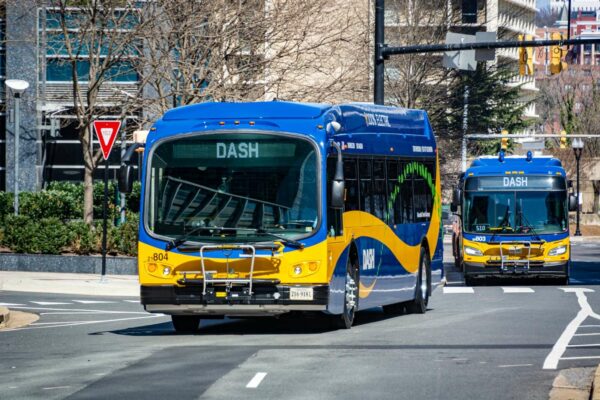
Three out of five Alexandria City High School students oppose the city’s proposal to replace school buses with DASH public transit, student representatives told the school board Thursday.
A survey of 131 high school students found 60.3% oppose the proposal — with 37.4% strongly opposed and 22.9% moderately opposed. Only 26% support the plan, while 13.7% reported being indifferent, according to data presented by student representative Madesen Lynch during the representatives’ regular update to the board.
“DASH buses are unreliable and fill up quickly,” one anonymous student commented in the survey. “Most of the time they are so full in the morning that they don’t stop for some bus stops, so you have to get there really early or be late to school.”
Student representative Darwin Salazar emphasized safety as a primary concern among respondents, particularly regarding after-school travel and waiting at bus stops. “Students have expressed that this concern has not been fully addressed by the city and current transportation planning,” Salazar said during her presentation.
The survey revealed current transportation patterns among high school students. In the morning, 50.4% take school buses, 16% ride DASH, and 33.6% walk or drive. Afternoon patterns show 45% using school buses, 25.2% riding DASH, and 29.8% walking or driving.
One hundred and four students reported concerns about crowded DASH buses, while 84 students cited worries about long wait times. Sixty-seven students expressed concern about having to take multiple DASH buses to reach school. “It takes me 45 minutes to get to school with the DASH bus and only 15 or less with the school bus,” another student wrote. “Whenever I take a DASH to school, I am always late no matter what time I leave.”
Several community members echoed the students’ concerns during public comments. Clara Kwache, a sophomore at Alexandria City High School, argued that combining DASH buses with school transportation would eliminate the flexibility that makes public transit appealing to students.
“Students prefer DASH buses because it doesn’t have a set time. It provides a sense of flexibility that would be stripped away if it were to be combined with the school,” Kwache said. She also expressed concern about losing traditional high school experiences, noting that the school’s large size already prevents events like pep rallies.
Senior Lily Clance raised questions about privacy and safety when students and the general public ride together, and asked about transportation arrangements for special needs students if school buses become unavailable.
Parent Kirsi Chavez shared a personal experience that highlighted safety concerns. Her daughter was assaulted by two students while riding a DASH bus to Minnie Howard campus after missing her school bus. “The two students saw her and they got on the bus and they assaulted her,” Chavez said, describing how the incident left her daughter with physical injuries and trauma.
Chavez contrasted the response protocols between DASH and school bus systems, noting that DASH camera footage can take up to a month to review, while school bus cameras are accessible immediately. She also pointed out that school bus drivers receive immediate dispatch support and can prevent students from leaving during incidents. “If you get on a dash bus, they’re not gonna know who the students are. They can’t suspend any children,” Chavez said, expressing concern that fights would continue without proper accountability measures.
The student feedback comes as the Alexandria City Council considers a three-phase plan to move high school students to public transit beginning in the 2026-27 school year. The proposal comes amid significant transportation challenges and financial pressures. A recent TransPar Group study found the district’s bus system operates at less than 60% overall capacity utilization.
ACPS Chief Financial Officer Turner’s analysis estimates potential savings of $939,000 annually if all high school routes were discontinued. However, Turner warned the savings assume “everything else stays constant” and noted that losing drivers could force the district to outsource transportation at potentially higher costs. The district currently operates 50 high school bus routes serving approximately 1,700 students. The city’s proposal could eliminate 10-12 of those routes in Phase 1 alone.
The Alexandria City School Board has already voiced significant concerns about the proposal during a Sept. 11 work session, with several members calling for scaled-back pilot programs or questioning the timing of such a significant change. Superintendent Melanie Kay-Wyatt expressed strong reservations about the district’s capacity to implement another major initiative while handling redistricting changes affecting approximately 1,400 students.
“We are very limited in capacity, and I think we really need to spend our time this year on supporting families and students for that transition,” Kay-Wyatt said during the work session. Board member Tim Beatty suggested a more cautious approach, saying that since there are few examples of this being done nationally, the district would need to start with “a much smaller pilot that was a controlled one or two routes, one neighborhood or two neighborhoods.”
The city’s original proposal envisions Phase 1 transitioning approximately 30% of current high school bus riders to existing DASH Lines 31 and 36A/B, which provide direct service to Alexandria City High School’s King Street and Minnie Howard campuses. Phase 2 would add enhanced service to DASH Line 35 to better serve West End students, potentially covering more than 60% of current bus riders, though some students would need to transfer between routes. Phase 3 envisions broader systemwide route changes allowing any student within a quarter-mile of a DASH stop to use public transit instead of school buses, potentially serving more than 86% of current riders.
The student representatives have decided to publish an opinion piece in Theogony, the school newspaper, to bring the issue to broader community attention. Salazar authored the piece, though she emphasized it represents a collective decision by all student representatives. The representatives also expressed concern for current school bus drivers who could face job insecurity if traditional bus routes are reduced or eliminated.
“Some students have raised the issue that if traditional bus routes are cut or reduced, our drivers would face lost income and job insecurity,” Salazar said. “This is not only a transportation issue, but also a matter of fairness and respect for those who support and dedicate themselves to our schools every day.”
The board and city council will continue discussions during a joint work session scheduled for Sept. 29 from 6 to 8 p.m. in the School Board Meeting Room at 1340 Braddock Place. The meeting is open to the public and can also be viewed via Zoom.
Student representative Salma Naqshbandi noted that among the 26% of students who support the proposal, reasons include potential cost savings, convenience, reliability, and environmental benefits of using the DASH system.
However, the overwhelming student opposition revealed in the survey data suggests significant community resistance to the city’s current proposal timeline and implementation plan.
