

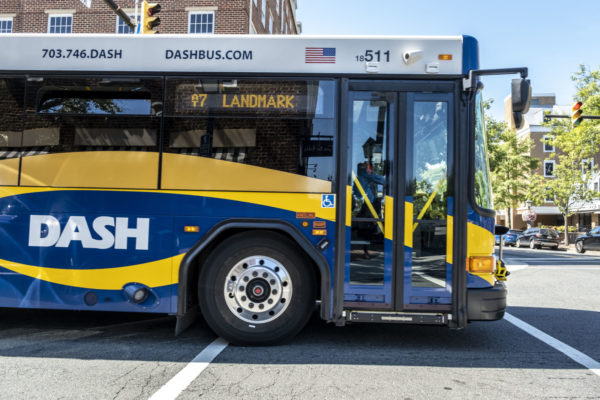
The Alexandria City Council received a comprehensive update on Tuesday night (June 24) regarding a proposal to transition Alexandria City High School students from traditional school buses to the city’s DASH public transit system. City Manager James Parajon recommended a three-phase implementation, beginning in the 2026-27 school year.
The initiative, which has been under study for five months through a joint City Council and School Board subcommittee, aims to provide student transportation that is safe, reliable, effective, and efficient while supporting environmental goals and potentially reducing costs.
“The initiative’s primary goal is first and foremost to make sure that, as a community, we provide safe student transportation. It’s reliable, effective, efficient,” Parajon said. “But most importantly, it’s safe.”
Under the recommended Phase 1 approach, approximately 30% of current high school bus riders would transition to DASH Lines 31 and 36A/B, which provide direct service to the King Street and Minnie Howard campuses. This phase would allow Alexandria City Public Schools to remove an estimated 10-12 of the existing 50 high school bus routes.
Josh Baker, General Manager and CEO of DASH, presented the phased approach, explaining that Phase 1 focuses on students living within a quarter-mile of routes offering direct rides to campus. “The first phase, I think, is pretty straightforward and simply saying that those are the people that live along the routes that have a one-seat ride directly to the ACHS campus,” Baker said.


Phase 2, anticipated for the 2027-28 school year, would focus on the West End, where there is “an incredibly high density of students who need access to student transportation,” Baker said. This phase would enhance DASH Line 35 and other West End services, though some students would require transfers between buses.
Phase 3 remains to be determined, but would explore broader network-wide changes to serve any student within a quarter-mile of a DASH stop, potentially covering 86% of current school bus riders.

The proposal emerged from a January memo by Councilman Abdel-Rahman Elnoubi and Vice Mayor Sarah Bagley, who cited persistent school bus driver shortages and budgetary challenges as reasons to explore consolidating services.
“We can take advantage of our free DASH bus system to transport ACPS high school students instead of ACPS transporting them via school buses,” the original memo stated.
Mayor Alyia Gaskins emphasized that Tuesday’s presentation was an update, not a decision point. “There is nothing that is being voted on today or finalized today,” she said. “The next step would be a discussion at the city schools. There also be a discussion between our two bodies so that all members of the school board and the council have the opportunity to discuss these recommendations together.”
Council members expressed varying priorities for evaluating the proposal. Councilman John Chapman stressed the importance of demonstrating concrete cost savings.
“I think that does need to be at the core, at least for me, that is the core of what this initiative should be,” Chapman said. “We should be looking at how the council has talked with the school board for efficiencies that save dollars and allow for dollars to be freed up.”
Councilman Kirk McPike highlighted the potential for redirecting transportation funds to educational priorities. “This proposal obviously didn’t see how it comes together in its final form, could provide an opportunity for us to redirect these dollars within the money that we give to the schools, away from the need for transportation and to the classrooms, to the upkeep of buildings, to the things that the schools need that are more education focused,” he said.
Safety considerations were a key focus of the presentation. DASH operates with 19 field supervisors, eight to 10 cameras on each bus, central dispatch coordination, and full insurance coverage through the Virginia Transit Liability Pool.
Data show that DASH had 20 total incidents in fiscal year 2024, out of 5.3 million boardings, with only one incident involving students. The system estimates approximately 2,200 student boardings daily, representing roughly 1,100 students.
The proposal would not affect elementary and middle school students, who would continue using traditional school buses. ACPS would also maintain specialized transportation services, after-school and event transportation, and school bus service for high school students not within a quarter-mile of DASH routes.
Councilman Canek Aguirre defended the exploration, noting ongoing transportation challenges. “We get emails every single year on the council about children not getting picked up online. I’m not talking just one or two. We’re talking about a whole bus not showing up,” he said.
The next steps include completing a detailed financial analysis over the summer, conducting comprehensive community engagement in the fall, and potentially scheduling a joint work session between the City Council and School Board.
Community engagement will include student and parent surveys, listening sessions, ride-along opportunities, and pop-up events at schools and community locations.
“Should we decide to move forward, then there would be a process of community engagement so that the community can weigh in. Parents, teachers, students, everyone in our school community,” Gaskin said.
The earliest implementation is expected to be in fall 2026, pending final analysis and approval by both governing bodies.
