


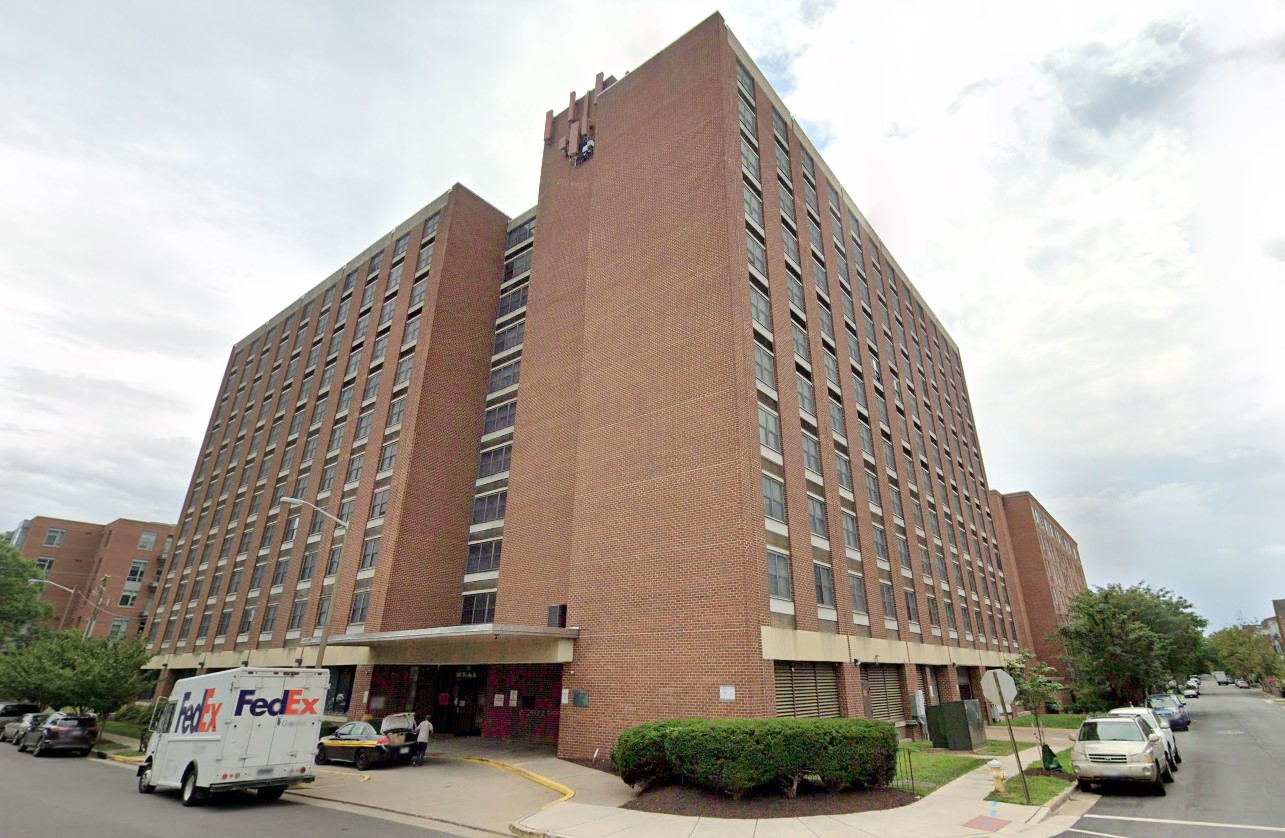
Plans to redevelop the Ladrey Senior Hi-Rise in Old Town have been deemed “infeasible” by the property owner, the Alexandria Redevelopment and Housing Authority.
The U.S. Department of Housing and Urban Development has “terminated operating support for building management and maintenance” due to delays in the redevelopment, and now ARHA plans on moving more than 150 residents out of the 1970s-era building by the end of the year. Consequently, ARHA wants the city to back loans to acquire The Alate (1122 First Street), a recently built senior housing apartment building in the Braddock neighborhood, for the relocation of Ladrey Senior Hi-Rise residents.
ARHA has told the city that the developer behind The Alate “wishes to exit the project and has agreed to its sale for $56.8 million,” according to a staff memo. The property was assessed at $53.1 million earlier this year, according to city records.
City Council will review the proposal at its meeting on Tuesday, June 10.
According to the city:
ARHA has determined that the redevelopment of Ladrey Senior Housing, as proposed by ARHA and its development partner, Winn, and approved by City Council in January 2024, is not feasible at this time because of changed conditions in the debt and equity (tax credit investment) markets. Due to delays in undertaking redevelopment of a building represented to HUD as obsolescent, HUD now requires that ARHA relocate Ladrey residents and has terminated operating support for building management and maintenance. HUD has authorized 168 vouchers to help ARHA relocate Ladrey residents to other housing.
Besides resident relocations to Silver Fox, ARHA plans to assist other residents move to housing of their choice within the City and elsewhere and anticipates all relocations will be completed by the end of 2025.
Regarding its future plans for Ladrey, ARHA is working with development partner, Winn, on plans to substantially renovate the existing building and use that to supplement ARHA’s future stock of senior housing. It is noted that a plan for the renovation of Ladrey must be reviewed and approved by HUD, and it is not yet clear if the scope of proposed renovations would require City approvals beyond permits.
City Council, in Jan. 2024, approved the plan to demolish the existing 11-story, 170-unit affordable apartment building at 300 Wythe Street, which houses seniors and residents with disabilities, as well as ARHA’s former headquarters at 600 N. Fairfax Street. The replacement would have been a 270-unit L-shaped building with heights ranging from six to seven stories.
When approved last year, then-Mayor Justin Wilson said that the project was important for the city’s most vulnerable population — seniors.
“I’m pretty excited about this project,” Wilson said. “We cannot lose the fact that this is a really impactful project for the community.”
City staff are questioning ARHA’s “capacity to complete and successfully maintain the project,” and are recommending a contingent approval. Doing so would give the city manager the authority to sign off on the project if “specific conditions are met by the bond pricing deadline, which is currently set for July 22, 2025.”
According to the city:
After this date, the process to unwind (“defease”) the bonds is complex and expensive. Among other things, even if bonds aren’t used, VRA and its investors would have to be paid the fees/return the bonds that were expected to yield over time. Such contingent flexibility in authority would allow the City Manager to determine, in consultation with Council and the City Attorney, whether any changes to the transaction’s terms and conditions would materially affect the City’s financial position. Staff plans to present a set of conditions for City Council’s consideration together with the VRA resolution.
ARHA plans on investing $6 million of its savings into the First Street property, renaming it Silver Fox, and has applied for Virginia Resources Authority bond funding.
City staff said they are concerned the housing authority’s “capacity to manage and maintain the Silver Fox property, to relocate Ladrey residents eligible for transfer to Silver Fox as well as those who must be placed elsewhere, to successfully complete the HUD processes involved to project base vouchers at an elevated payment standard, and to develop and implement a ‘Plan B’ for the future renovation of Ladrey.”
ARHA says it will hire third-party management for the Silver Fox property, as well as:
- Pay a PILOT (payment in lieu of taxes) as a partial offset to ARHA’s exempt property tax status
- Enter into an agreement with the City to repay expenses or debt it incurs on ARHA’s behalf related to Silver Fox
- Provide the City with additional collateral to help meet debt service coverage
City staff said that an ARHA default would require the City to make $3.5 million in annual debt service payments, “and the full debt would then be added to the City’s balance sheet, limiting the City’s borrowing capacity for other projects.”
While there are several concerns that staff are working with ARHA to mitigate, the two chief risks identified regarding Silver Fox are general uncertainty regarding federal voucher funding and ARHA’s capacity to complete and successfully maintain the project. ARHA’s ability to repay the VRA loan is premised on the agency’s ability to convert the tenant protection/relocation voucher authority allocated by HUD into project-based vouchers for Silver Fox. Currently, HUD allows vouchers to subsidize rents, up to market rate levels based on comparable projects in the zip codes in which projects are located. For Silver Fox, a project-based voucher could potentially make up the difference between what the household can afford to pay and standard market rate rents at privately owned multifamily developments within the Braddock Metro neighborhood. ARHA’s proforma for Silver Fox indicates that ARHA forecasts that project-based vouchers would yield monthly rents of approximately $2600+ for a one-bedroom unit and approximately $3,600+ for a two-bedroom unit. This elevated payment standard would ensure sufficient rent revenue generated to repay the VRA loan. However, if voucher funds are cut by HUD, it is unclear to staff if this assumption is reliable and/or how channeling future ARHA voucher resources to satisfy the VRA debt might constrain the number of overall vouchers that can be funded within the agency’s allocation. While ARHA has provided some information regarding these issues, City staff are seeking clarification on the HUD processes involved in project-basing vouchers and the timeline for a conversion, including whether it is administrative-only or requires specific HUD approvals.
ALXnow has reached out to ARHA for more on this development.
In the meantime, the next ARHA Board meeting is on Monday, June 23.
