

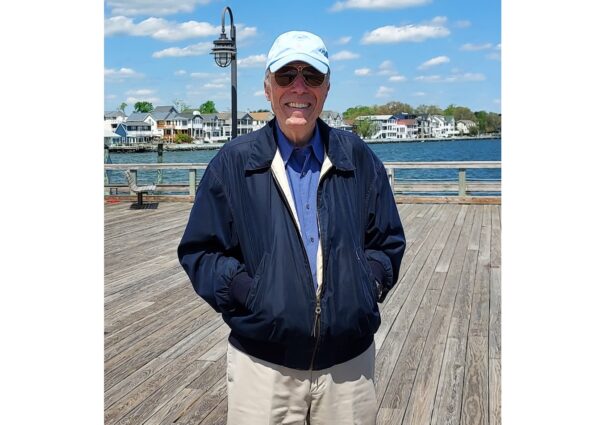
Alexandria resident George Vercessi was an adult when his late mother unexpectedly had a stroke. His tight-knit family was suddenly dealing with unfamiliar territory as every day brought new challenges for his mother’s recovery.
Until it happened to his mother, Vercessi didn’t know the impacts of a stroke on the body or what the recovery period looked like. He thought it might be even more difficult for younger family members to understand.
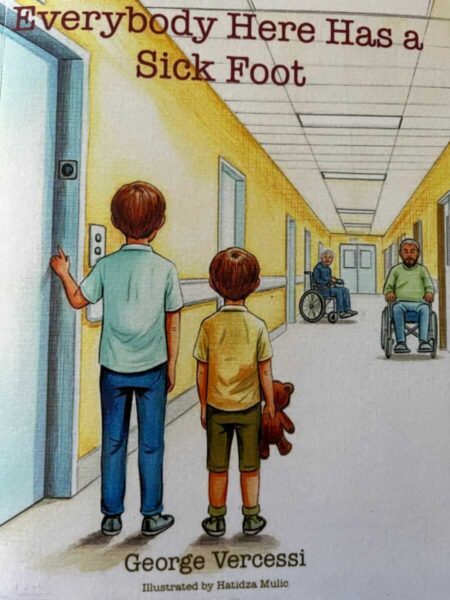
That’s why the retired Navy veteran decided to write a book called “Everybody Here Has Sick Foot” to help children know what is happening when a family member has a stroke.
About 795,000 strokes occur in the U.S. each year, or once every 40 seconds, according to the Centers for Disease Control and Prevention. Vercessi cited American Heart Association data showing incidences are decreasing among people over 75 and increasing for people 49 and younger over the last three decades.
Vercessi self-published the book and has already received feedback from readers that it has been valuable to them. “Everybody Here Has Sick Foot” is available in paperback and e-book formats.
ALXnow: Tell me about yourself and why you decided to write books.
George Vercessi: I’m a retired Navy captain. I live in Alexandria. My mother and her two sisters, my only real close family, lived in New York City around May of [1996]. I received a call from one of my aunts saying that my mother had a stroke, and so I drove up to New York. I couldn’t get any information from the doctors. I didn’t know anything about strokes, and so the whole process was confusing, to say the least. And so I just took a notebook with me wherever I went with them and started writing everything they told me, including when they got her out of the induced coma that she was in. Then through therapy and all this, I had all these notes, and it encouraged me that if I was having trouble understanding it, were other people going to experience the same thing?
So I decided at one point to write a book about it, and I thought I would put it in the perspective of a young boy, and this way I could work in the whole family. And I completed the book many years ago and sent copies to the pharmaceutical companies that make statins and other drugs that reduce blood for stroke victims, thinking they might be interested in it as a public service to patients, but none of them were interested. So I just let it sit for a while, and then I decided I really needed to get this out just to help people. And so this past March, I self-published it with a company I’ve done other books with.
I’ve already received quite a bit of feedback from folks saying they wish they had this earlier to help them understand. And these are adults who have adult siblings who’ve had strokes. It really opened it up for them.
ALXnow: What is it like trying to write in a way that you could explain difficult situations like this to children who might not completely understand?
Vercessi: All my other novels, books are for adults, but I have written a couple of children’s stories, and so I try to put myself in the mind of a child. I use simplified words, terms. In the book I discuss aphasia, which is a form of inability for the victim, the stroke victim, to speak and understand languages. So I define it in the terms the boy would to his friend when explaining it to him, and that sort of stuff. And I just tried to put myself in the place of a child, not an infant, but a thinking child, like a preteen.
In this case, the main character is about 11 or 12 years old, and so he explains things and his fears to his father, and then he interprets things to his younger brother, who is younger than he is, and to his friend. Then when he’s confronted with a situation, you have to think as a child. When you see your mother paralyzed and unable to speak, what goes through his mind, and how does he react? And that’s what I try to do.
When I finished it and I polished it up, I went to the Alexandria Library children’s section, gave it to someone there to look at it and asked them to read it and tell me if they thought I was addressing issues the way a child would. They said yes, it was close, it was good, so I felt comfortable publishing it that way.
ALXnow: Did you do self-publishing?
Vercessi: I did self-publishing. My other children’s book is a Christmas tale. I had it illustrated, and this one I wanted to be illustrated as well, because I thought maybe either a child at that age would read it and appreciate seeing some illustrations, or a parent might want to read it to a child, and the illustrations would help. So I found an illustrator and told this lady who was the illustrator the scenes I wanted depicted in the book, and she complied.
ALXnow: Can you tell me a little bit about what your writing process is like?
Vercessi: I typically start with the idea, and then I let it flow. In other words, I let the characters develop, and then the characters essentially write the book for me. In other words, it wouldn’t be realistic for a character to do something that would be out of that character’s norm. So that’s the way I try to do it.
This doesn’t have any chapters because it’s brief. It’s about 50 pages. But in my other books, I try to end the chapter with a question or something that needs to be defined in the following chapter, which keeps the reader motivated to continue reading. Typically, I just let the story evolve, and when an event occurs, it opens up other questions or other situations that need to be defined, and then I follow that path.
ALXnow: Do you have any literary influences?
Vercessi: I read a lot. While I was writing my fiction pieces, I read a lot of fiction, and I particularly enjoyed reading Donald Westlake and Elmore Leonard-type mysteries. Leonard I liked because he allowed the dialog to define the character, and I thought that was a good way of writing. And then Westlake, he wrote different types of crime novels. Some were humorous, some were serious. Then I did research. Most of my books I researched the heck out of, and thankfully the internet is available. Otherwise, I’d be running to the library a lot.
ALXnow: Are you working on anything else? Do you plan on writing any other books?
Vercessi: I have two books that I’m working on right now. One is an anthology of maritime seamanship quotes. I’ve never done this before, so I’m not sure what my copyright requirements are. I don’t want to take anything and use it without somebody’s approval or legal aspects of it, so I’m working that, and I’ve got quite a few. I probably have enough to do a book, but there’s so much out there. I just keep doing it.
The other book, I think it’s going to be a novella instead of a novel about a police officer who decides he’s going to be a one-man vigilante team, who goes out to attack the people who are attacking police officers. He gets caught up in such a scheme that he essentially becomes as bad as the people he’s going after.
