

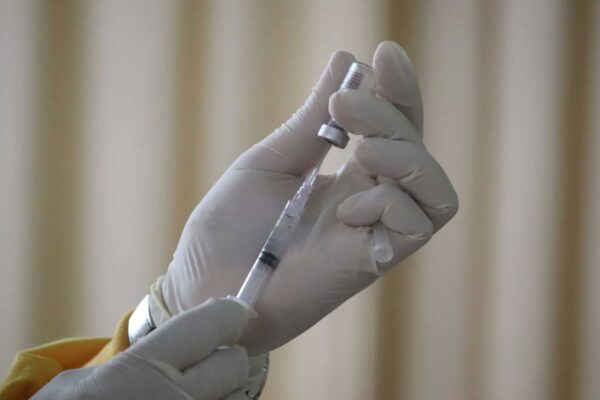
After President Donald Trump issued an order seeking more spaced out childhood vaccinations, the Virginia Department of Health joined other medical experts in backing the existing childhood vaccination schedule.
President Donald Trump on Monday signed an executive order calling for revamped childhood vaccine recommendations that promote his long-held but discredited theory that childhood shots should be spaced out into separate medical visits.
The order advocates separating the measles, mumps and rubella (MMR) vaccine into three different single-disease shots and administering all childhood immunizations at separate appointments whenever possible. It also directs the nation’s health department to improve research on vaccines, which are already extensively studied, and present a plan to offer separate measles, mumps, and rubella vaccines for children, since that is not currently an option in the United States.
VDH continues to recommend the same vaccine schedule from the American Academy of Pediatrics. Health officials anticipate healthcare providers “will continue to rely on their clinical training and professional judgment” and consult the American Academy of Pediatrics when discussing a child’s care with parents, caregivers and patients.
“Virginia’s families should be able to trust that our vaccine recommendations are grounded in the best available science and focused on protecting the health and well-being of their children,” Dr. Cameron Webb, the state health commissioner, said in a release. “The evidence supporting the AAP immunization schedule is extensive, and we remain confident that following it is one of the best ways to protect children from serious, preventable diseases.”
VDH said the executive order does not change Virginia’s school immunization requirements, which include two doses each of measles and mumps shots and one rubella dose. The doses don’t have to be administered together but usually are if the child receives the combined MMR vaccine in the U.S. First doses are given at a minimum age of 12 months old, and the second dose must be given before kindergarten.
Public health experts have raised concerns that spacing out shots as Trump suggests can lead to an increased risk that children become infected with a vaccine-preventable disease before returning for another visit. Childhood vaccines — and how and when to give them in combination — go through rigorous studies, and safety tracking continues for years as the shots are used.
Trump called the announcement a “major victory for parents rights, religious and constitutional rights, and for the gold standard science.”
Speaking about the order at the Oval Office on Monday, Trump repeatedly suggested the number or timing of vaccines could play a role in rising rates of autism spectrum disorder, even as scientific consensus and decades of studies have firmly concluded there is no link.
The American Academy of Pediatrics disputed the reasoning behind the executive order, which would decrease the number of diseases recommended for vaccinations from 18 to 11. AAP’s vaccine schedule continues to recommend vaccinations against 18 diseases.
“There is no new evidence to justify significant changes to childhood immunization guidance,” Dr. Andrew Racine, AAP’s president, said in a statement. “Dozens of studies involving millions of people show there is no link between vaccines and autism, and yet federal leaders continue to promote this outdated, disproven idea to scare families.”
Trump’s order recommends vaccinations against measles, mumps, rubella, diphtheria, tetanus, pertussis, polio, Haemophilus influenzae type b, pneumococcal disease, HPV and varicella. High-risk children are recommended to get respiratory syncytial virus monoclonal antibodies, hepatitis A, hepatitis B, meningococcal B, meningococcal ACWY and dengue. According to the order, any children can get hepatitis A, hepatitis B, rotavirus, meningococcal disease, flu and COVID-19 vaccines based on clinical decision-making between doctors and parents.
Meanwhile, VDH is convening a new Workgroup on Childhood Immunization Schedules and Public Health Emergencies in August as requested in the General Assembly’s state budget. The group of healthcare practitioners, insurance representatives, and public health stakeholders will review Virginia’s framework on access to childhood and emergency vaccines.
Image via Mufid Majnun/Unsplash

