

Alexandria apartment rents have increased since the start of the year but remain below the market’s mid-2025 peak costs, according to a new analysis.
The median citywide apartment rent of $2,230 in July — $2,042 for one-bedroom units and $2,508 for two bedrooms — was down 2.7% from a year before, according to data released July 29 by Apartment List.
Despite the decline, Alexandria’s median rental rate was up 3.4% since the start of 2026, following seasonal market norms. In addition, the city’s rental rate remained above the D.C. region’s median of $2,172.
Like the rest of Northern Virginia, Alexandria apartment renters have been on a roller coaster ride since 2020, when the pandemic upended traditional market norms.
In March 2020, just before Covid’s impact was fully felt locally, the median city rent stood at $1,921. By January 2021, the median rental rate had fallen to $1,746 before beginning a quick rebound.
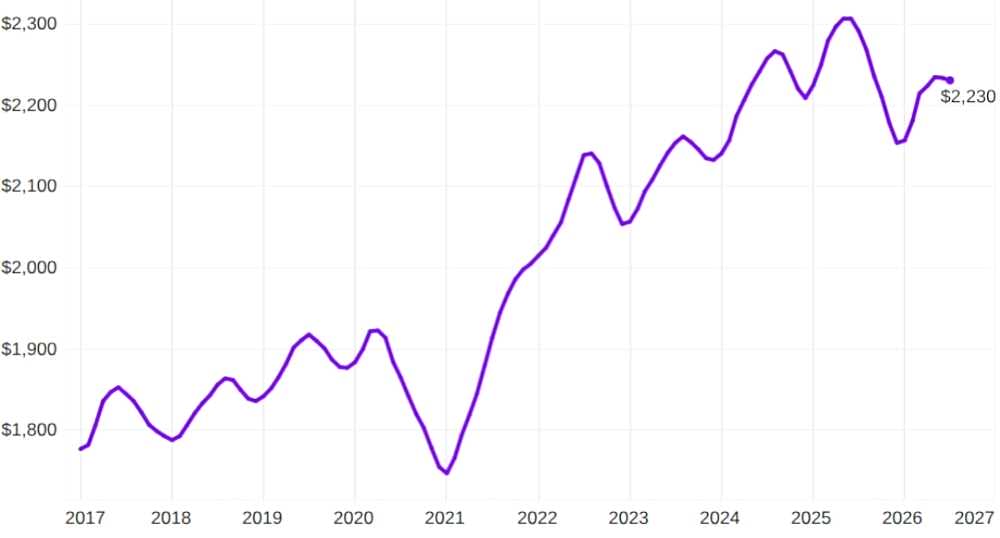
To date, the market peak occurred in June 2025, when the median Alexandria rent stood at $2,306, according to Apartment List.
In addition to providing specifics for hundreds of communities, Apartment List each month also ranks the 100 largest urban areas in terms of market performance.
Locally, those markets are the District of Columbia and Arlington.
In the latest report, Arlington retained its place as fifth most expensive of the 100 urban areas nationally surveyed by Apartment List.
At a median $2,611, Arlington trailed only four California communities: San Francisco ($3,714 median rent), San Jose ($3,118), Irvine ($3,059) and Fremont ($2,961).
The least expensive of the 100 were Toledo ($908), Detroit ($1,041) and Tucson ($1,045).
Of the 100, the highest year-over-year median rent increases were found in San Francisco (+9.4%), San Jose (+7.6%), Virginia Beach (+5.8%) and Honolulu (+4.8%). The steepest declines were recorded in San Antonio (-5.2%), Denver (-4%), Austin (-3.7%), Las Vegas (-3.3%) and Tampa (-3.2%).
Nationally, the median apartment rental rate in July was $1,220 for one-bedroom units, $1,347 for two bedrooms and $1,388 overall, down 1.1% from a year before but up for the sixth month in a row as rates follow typical seasonal norms.
According to Apartment List analysts:
“The broad contours of this seasonal pattern are a dependable trend, but in recent years we’ve seen sharper winter dips and more modest summer bumps as the market has gone through a soft spell amid a wave of new multifamily construction. As a result, full-year rent growth has been negative for each of the past three years.”
In dollar terms, the national median monthly rent is down $15 compared to July 2025.
Nationally, prices peaked in mid-2022 after a year and a half of skyrocketing growth. Since then, the nationwide median rent has been gradually drifting down and has fallen from that peak by a total of 3.7%, or $54 monthly.
Despite the prolonged pullback in prices, today’s rent levels remain 21% higher nationally than they were at the start of 2021.
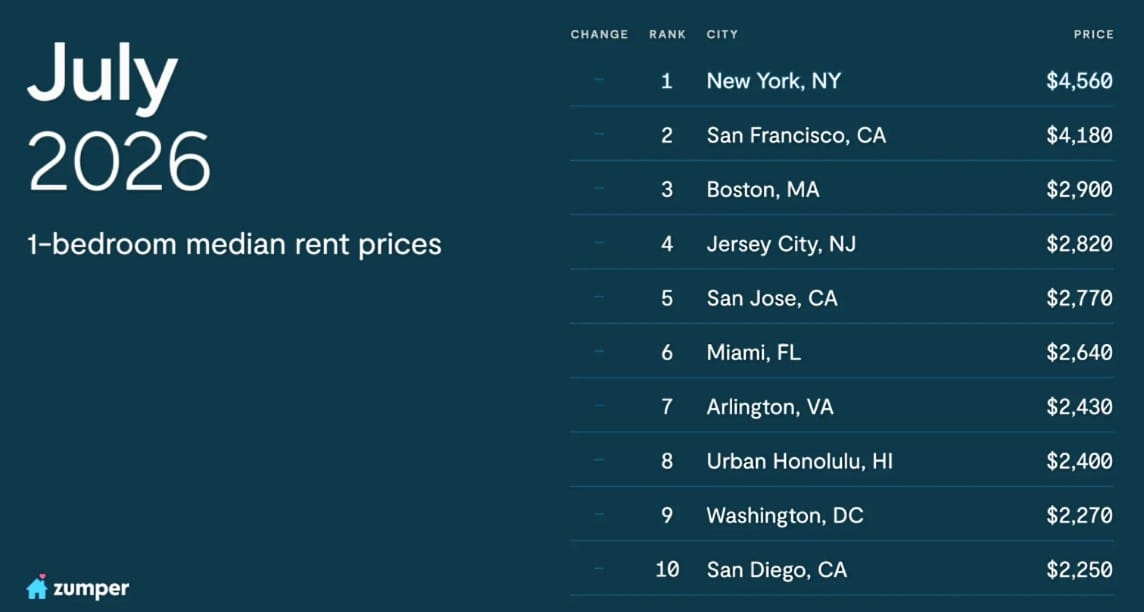
Another analytics firm, Zumper, on July 29 was out with its own July market report.
Nationally, the price of one-bedroom apartments stood at $1,520 for the month, with two-bedroom units at $1,906, in the Zumper survey. Following cyclical norms, national rents were up for the sixth month in a row.
Leading the pack nationally in the Zumper analysis was San Francisco, where median one-bedroom rents grew 23% year over year to $4,180 and two-bedroom rents were up 26% to $6,020, a national record high.
Zumper analysts expect the national market to follow norms and cool in the second half of the year:
“We are now approaching the tail end of the peak moving season, and the off-season cooldown in prices is likely to begin in another month or two. This trend is in line with typical seasonal patterns — prices generally increase in the spring and summer when most moves take place, and then soften in the fall and winter as moving activity slows.”
The most important driver behind the soft market conditions that have persisted for over three years has been a historic surge of multifamily construction, Zumper analysts said, with 2024 seeing the most new units (600,000+) for any year since 1986.
“Since then, deliveries of new apartments have slowed considerably, albeit while remaining fairly robust by historic standards,” analysts said. “Despite being at the tail end of the construction boom, the market had still been struggling to absorb the swell of new inventory — [but] is now finally changing.”
Image via Google Maps
