

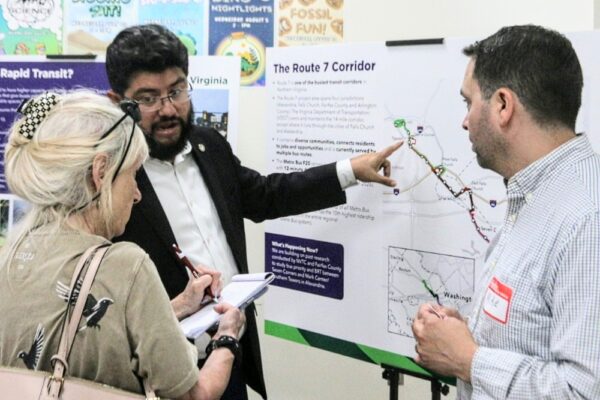
An Alexandria City Council member has a way to convince downstate lawmakers of the importance of funding Northern Virginia transit.
Councilman Canek Aguirre wants to take them for a ride.
“How do we get folks from Southwest, Southside and Richmond to understand local transit?” Aguirre asked at the Nov. 5 meeting of the Northern Virginia Transportation Commission (NVTC).
Partially answering his own question, Aguirre — who serves on the NVTC board of directors — said local leaders should encourage those lawmakers to “take the train up here, [then] we pick them up at the Alexandria station and put them on DASH to go to Fairfax Connector, to go to Arlington Transit and tour the whole thing.”
The idea was strong conceptually but had logistical challenges, acknowledged Aimee Perron Seibert, a lobbyist with Commonwealth Strategy Group LLC who provides services to NVTC.
“That’s always tricky,” she said. “It’s hard to even get our Northern Virginia legislators to do the tours.”
That didn’t mean outreach shouldn’t be made to downstate legislators to try and make transit excursions possible.
“One of the biggest things is to find places they’re already going to be in Northern Virginia and then try to attach things to that when they’re already up here or doing events here,” Seibert said.
The discussion was part of the NVTC board’s review of the organization’s draft annual performance report on the state of the Washington Metropolitan Area Transit Authority’s financial and operational performance.
The annual evaluation, required under state law, is expected to be finalized early next month by the NVTC board and forwarded to Gov. Abigail Spanberger (D) and the General Assembly.
Much of the discussion centered on convincing the General Assembly to provide more funding, especially dedicated funding sources, to support Metro and other local transit service.
“To maintain the system, it has to be paid for somehow,” said Adam Hager, the Metro program manager for NVTC. “Every dollar that is not generated from fares is going to have to come from subsidies — that’s effectively state and local taxes. It’s really a question of the right balance.”
Despite recent steps in the right direction, “the fundamental long-term funding question remains unsolved,” said Owen Williams, an NVTC program analyst.
While legislators gave Northern Virginia governments some of what they wanted in Metro funding during the 2026 session — totaling $153 million more per year for capital costs — it was a two-year fix that, if not extended, could saddle localities with paying tens of millions of dollars more each starting in fiscal 2029.
For local government officials, that balance involves the state government providing more financial resources. But some state lawmakers question why the region isn’t doing more to either fund the service itself, or offer creative solutions for state lawmakers to consider.
Simply asking for more money from Richmond is “kind of like saying ‘find that rainbow with a pot of gold at the end,'” said Del. Paul Krizek (D-16), a Fairfax Democrat who serves on the NVTC board.
Krizek wanted local leaders to “tell us, like, these are three really good [funding] options — or five or 10 or whatever. The more, the better.”
Fairfax County Supervisor Jimmy Bierman, another NVTC board member, was on board with that.
“Give ’em a menu of options,” said Bierman, who represents the Dranesville District, including McLean, Great Falls and Herndon, on the Fairfax board.
Such a menu already is in the hands of state lawmakers, courtesy of a special legislative subcommittee — known as SJ28 — that delivered a report on stabilizing transit funding in advance of the 2026 General Assembly session.
“A lot of this had been discussed and answered” in the SJ28 report, said Arlington County Board member Maureen Coffey, another NVTC board member.
Coffey acknowledged that the proposals are “maybe not as fresh in our minds any more,” and asked NVTC staff to ensure legislators received reminders of possibilities.
The SJ28 final report outlined a number of funding options, and state legislators agreed to one. They gave local governments in Northern Virginia the power to send their voters referendums that would increase local sales taxes by 1 percentage point, with the revenue going to either transportation or education.
Leaders in local governments opted not to put those referendums on the Nov. 3 ballot, irking some lawmakers who asked why Northern Virginia wasn’t using a tool that could help.
Even if sent to voters and approved, the funding that resulted would not get close to fully funding capital needs.
“Northern Virginia jurisdictions will need a workable way to meet the capital obligations,” Williams said.
The total expected cost of those obligations is $136 million across Northern Virginia for fiscal 2029, escalated by 3% per year. Arlington officials already have estimated they would need to raise the county’s real estate tax rate by 8 cents per $100 if the burden fell squarely on the county’s General Fund.
In the performance report set to be adopted by the NVTC board early next month, six areas were identified as ways to maintain Metro’s financial viability:
- Creating long-term funding options
- Ensuring that funding growth is contained to 3% annually
- Negotiating sustainable contracts with unions
- Effectively budgeting overtime costs
- Revisiting existing fare policies and strengthening enforcement
- Establishing a regional audit of local funding
After discussion of Metro performance, NVTC members focused on plans for lobbying efforts during the 2027 General Assembly session, which opens Jan. 13 and is expected to run 45 days.
Circling back on Aguirre’s comments, NVTC chair Sarah Bagley — one of his colleagues on the Alexandria City Council — said Northern Virginia leaders shouldn’t ask others to do what they themselves aren’t doing.
She urged NVTC members to ride transit when in other parts of the commonwealth.
“It’s incumbent on us to ride the [downstate transit] systems,” she said. “It gives you more credibility.”
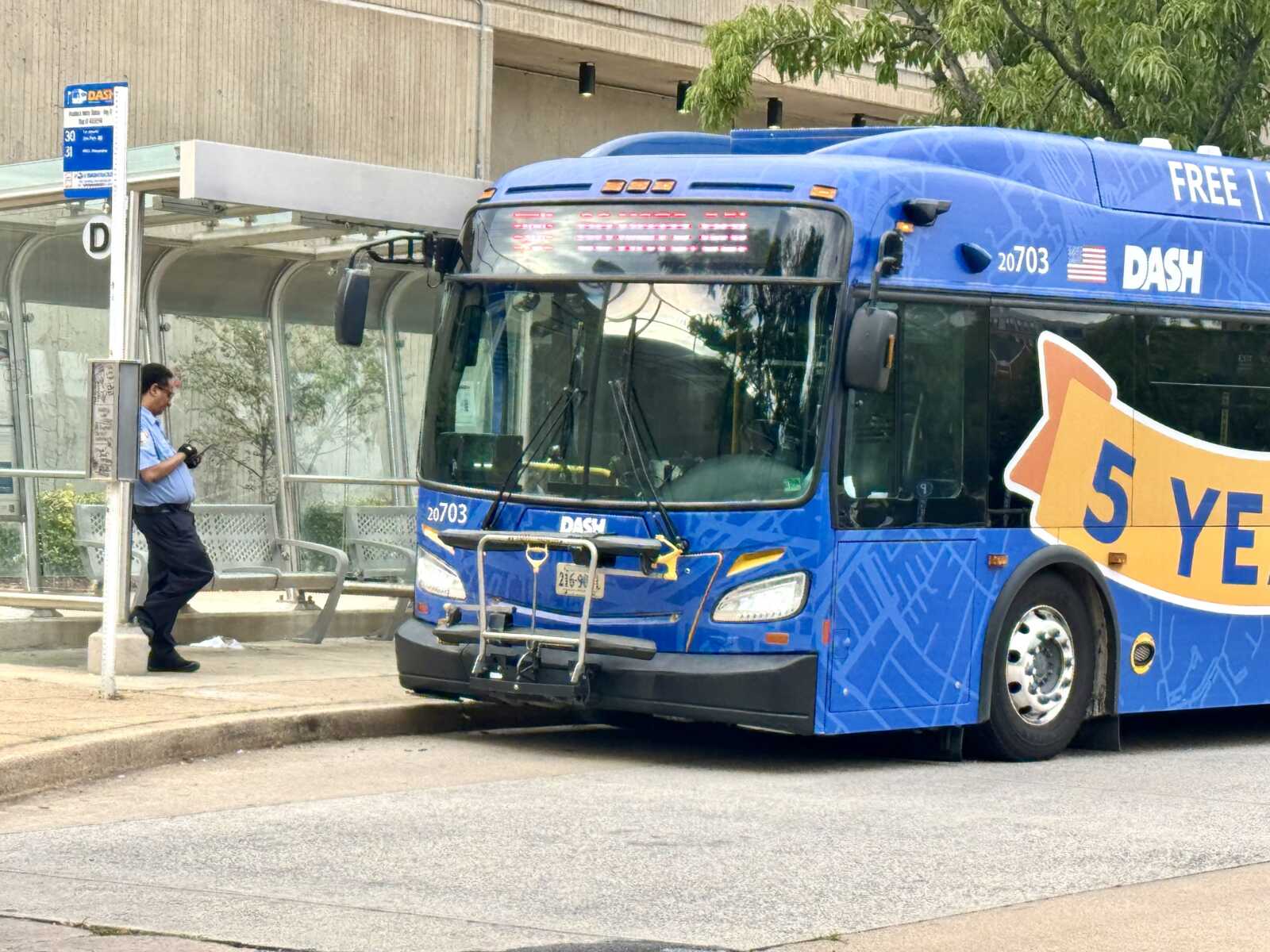
As for DASH, the bus system is considering service cuts as it faces a $2.4 million shortfall in its latest budget. DASH must also find a way to repay the city $3.3 million after an overspending error in the last fiscal year.
The state is also in the midst of studying whether to consolidate four regional bus systems — Alexandria’s DASH, Arlington Transit, Fairfax Connector and Fairfax City’s CUE. A final report will be provided to the General Assembly in December.
