

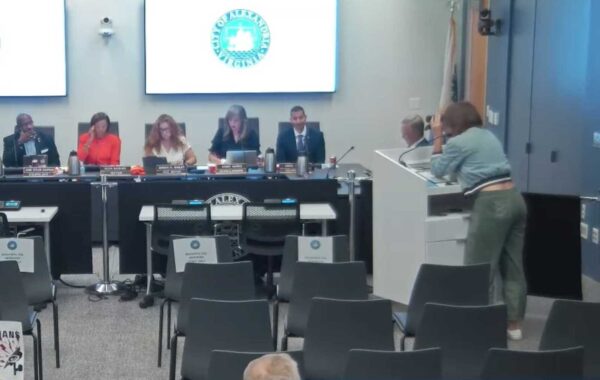
As it weighs the city’s future with automatic license plate recognition (ALPR) technology, Alexandria City Council got an earful from residents on the subject at Saturday’s public hearing.
One speaker peered at City Council through binoculars and asked how they liked being watched.
“You guys feeling super safe yet?” Nikki Enfield asked City Council, after putting down the binoculars. “I’m sensing some hostility. It’s ok when the government watches its citizens, but if we watch you back, ugh. I mean, it’s not like you were doing anything illegal, right? So why would you care if I was watching you?”
The Alexandria Police Department has 61 Flock license plate readers and other cameras along public roadways, according to Flock’s transparency portal. Privacy concerns have been raised against the cameras. In Virginia, Flock data can only be shared between local and state law enforcement agencies, raising concerns that Alexandria’s data could be shared via another jurisdiction.
Alexandria’s contract with Flock started in 2023 and can be terminated at any time. A number of City Council members, including Mayor Alyia Gaskins, want to discontinue the city’s contract with Flock. At a meeting earlier this month, Gaskins said she does not see a role for Flock cameras in Alexandria. City Council is currently waiting on a report on the cameras from APD.
Susan Douglas told City Council that the city shouldn’t work with any ALPR vendor.
“Eliminating Flock while allowing room for other ALPR vendors is like putting a one-inch band-aid on a gushing femoral artery,” Douglas said. “No one should be gathering this information on our residents, and particularly not for residents who are not committing crimes, this technology enables law enforcement to establish a database of potential suspects before there’s even a crime, and that’s backwards.”
The public feedback came as the city’s neighboring jurisdictions are moving away from using the technology. Last week, the Arlington County Board voted to discontinue use of Flock cameras and the Fairfax County Board of Supervisors voted to suspend installation of Flock cameras.
Alison O’Connell, a former City Council candidate, recently co-founded the group DeFlock ALX.
“ALPRs violate our privacy, and there is no meaningful way to regulate the way this data is shared between private companies, law enforcement, local and federal government,” O’Connell said. “It puts our immigrant communities in danger through direct access by ICE and jurisdictions that allow it, side door access to ICE and the federal government when friendly officers allow that, and federal subpoenas that supersede our state laws, ALPRs and their placement disproportionately impact minority community members.”
Glen Pine said that city residents never consented to mass surveillance.
“Our city is now packed with so-called automated license plate readers, which are AI technology capturing pictures and videos of our vehicles, plus their interiors, plus their occupants, the immediate surroundings, bumper stickers, and more than 100 other data points,” Pine said. “This camera dragnet generates massive amounts of data for easy retroactive searching, transforming our daily movements into potential evidence.”
APD will host a listening session on ALPR technology on Thursday, Sept. 24, at the James M. Duncan Branch Library (2501 Commonwealth Avenue) and on Wednesday, Oct. 7, at Patrick Henry Recreation Center (4653 Taney Avenue). Both meetings will be held from 6:30-7:30 p.m.
“Alexandria residents are invited to attend a community listening session to provide feedback on the technology APD uses to help ensure public safety,” APD said on social media. “Participants will have an opportunity to learn about APD’s use of technology, ask questions, share concerns, and provide feedback to help inform future decisions.”
According to APD:
APD uses ALPR technology only for legitimate law enforcement purposes, consistent with Virginia law and APD policy. Key safeguards include:
- ALPR searches must have a legitimate law enforcement purpose, such as a criminal investigation or missing person case.
- ALPR data is not used for immigration enforcement.
- Access is limited to trained and authorized personnel only.
- All searches are documented, tracked, and regularly audited.
- ALPR data is retained for 21 days, consistent with Virginia law and APD policy.
- APD does not provide ALPR data access to federal agencies or law enforcement agencies outside Virginia without a valid court order.
Our goal is to responsibly use every lawful tool available to help solve crimes, deliver justice for victims, and protect the community while respecting constitutional rights and maintaining public trust.
