


Alexandria’s jobless rate was stable year over year in new data but remains elevated compared to levels recorded before the Trump administration’s federal government downsizing began.
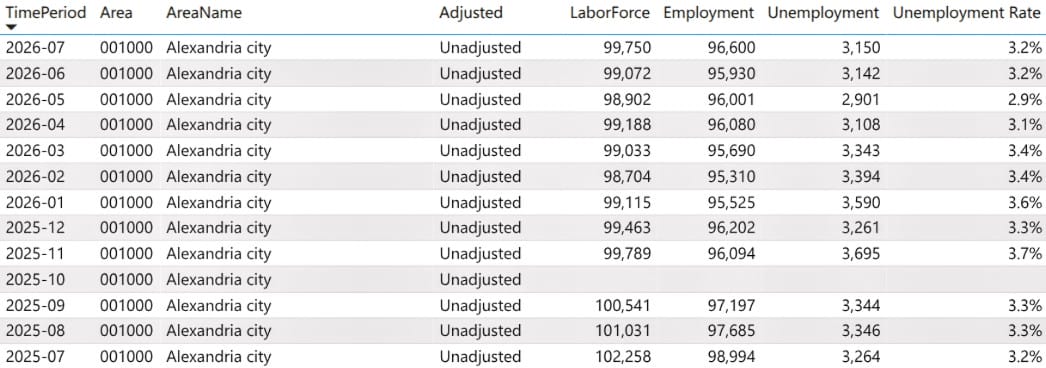
A total of 96,600 city residents were counted as employed in the civilian workforce in July, with 3,150 seeking jobs, according to figures reported Sept. 2 by the Virginia Department of Workforce Development and Advancement.
The resulting unemployment rate of 3.2% was unchanged from July 2025, when there were 98,994 city residents in the workforce and 3,264 seeking jobs.
July typically is one of the strongest months of the year in Alexandria’s jobs report. The only two times in recent years, if ever, that the city recorded more than 100,000 residents in the civilian workforce came in July 2019 (100,244) and July 2024 (100,188).
While the local jobs picture appears to have largely stabilized in recent months, the unemployment total of July 2026 was 38% higher than the 2,288 recorded in December 2024, the last full month of the Biden administration.
That month, Alexandria’s jobless rate had stood at 2.3%.
Among neighboring jurisdictions, the year-over-year unemployment picture largely was stable in July:
- In Fairfax County, the unemployment rate of 3.4% was up from 3.3% a year before
- In Arlington, the jobless rate of 2.9% was down from 3%
- In Falls Church, the jobless rate of 3.3% was down from 3.6%
- In the City of Fairfax, the jobless rate of 3.1% was up from 3%
Across Northern Virginia as a whole, July’s jobless rate of 3.4% was up from 3.2% a year before. Total employment was down slightly to 1.68 million and joblessness rose from 57,442 to 59,027.
Statewide, July’s jobless rate was 3.7%, up from 3.6% a year before, with the total number of unemployed rising from 163,503 to 166,820 during the period.
Declining Va. labor force raises red flags
Even as the local region appears to be absorbing federal government downsizing into the overall economic picture, concerns are being raised about a statewide declining civilian labor force.
The commonwealth’s civilian labor force declined by nearly 68,000 people between early 2025 and June 2026, a 1.5% decrease, and the decline has accelerated in recent months.
That’s according to a new data analysis by the University of Virginia’s Weldon Cooper Center for Public Service.
Virginia’s unemployment rate is projected to hold near 3.9% through late 2026, well below the level the Weldon Cooper Center projected in May. But, analysts cautioned, that does not signal a stronger labor market; it reflects a substantial contraction in the number of people working or looking for work.
Because people who retire, stop searching for work or move out of state are no longer counted as unemployed, employment “can fall sharply without producing an equivalent rise in the unemployment rate,” analysts said.
“The moderate rise in unemployment conceals a real contraction in the pool of workers participating in Virginia’s economy,” said João Ferreira, acting director of the Center for Economic and Policy Studies at the Weldon Cooper Center.
“The scale and persistence of this decline are unusual relative to the state’s recent experience, and they point to greater underlying weakness than the unemployment rate alone would suggest,” he said.
According to the state government, Virginia’s labor force participation rate decreased by 0.1 percentage points to 63% in July.
The participation rate measures the proportion of the civilian population age 16 and older that is employed or actively looking for work.
In late August, the Spanberger administration launched Virginia Jobs Day, a new monthly initiative designed to provide Virginians with a comprehensive, data-driven report on the commonwealth’s labor market and what current workforce trends indicate about the state of Virginia’s economy.
Each month, Virginia Jobs Day will bring together labor market information from across the commonwealth to “provide a clearer picture of where Virginia’s economy stands, how conditions are changing, and where opportunities are emerging,” state officials said in announcing the initiative.
“Virginia Jobs Day gives Virginians a regular and comprehensive report on the state of our labor market, while helping explain what the numbers tell us about the broader commonwealth economy,” Virginia Secretary of Labor Jessica Looman said in a statement accompanying the announcement.
Metro area’s unemployment picture mixed
Both the number of those employed and seeking jobs declined in July from a year before across the Washington, D.C., region, according to new federal data.
With 3,473,856 residents counted as part of the civilian workforce and 137,741 looking for work, July’s metro area jobless rate of 4% was down from 4.1% in July 2025.
Northern Virginia’s total workforce, counting those with and without jobs, declined 2.3% year over year to just under 1.74 million — a loss of just over 40,000 as some residents leave the workforce and others relocate.
Despite the slightly improved unemployment rate, the Washington region’s decline of 2.2% of total nonfarm employment year over year was the largest drop nationally, both in percentage and raw terms.
The region was one of 241 of the nation’s 387 metropolitan areas to record a lower year-over-year jobless rate in July, according to the federal Bureau of Labor Statistics. Rates were higher in 128 areas, unchanged in 18.
A total of 22 metro areas had jobless rates of less than 3% during the month, with seven areas reporting rates of 8% or more.
In July, the lowest unemployment rates were found in Bismarck, N.D., Rapid City, S.D., and Sioux Falls, S.D., at 1.9% each. The highest rate was reported in El Centro, Calif., at 19.7%, followed by Yuma, Ariz, at 18.9%.
Of the 56 metropolitan areas with a 2020 Census population of a million or more, Honolulu had the lowest jobless rate in July, 2.8%. The highest rate was reported in Fresno, Calif., at 7.7%.
Figures are non seasonally adjusted. July 2026 figures are preliminary and subject to revision.
Image via Vitaly Gariev/Unsplash
