


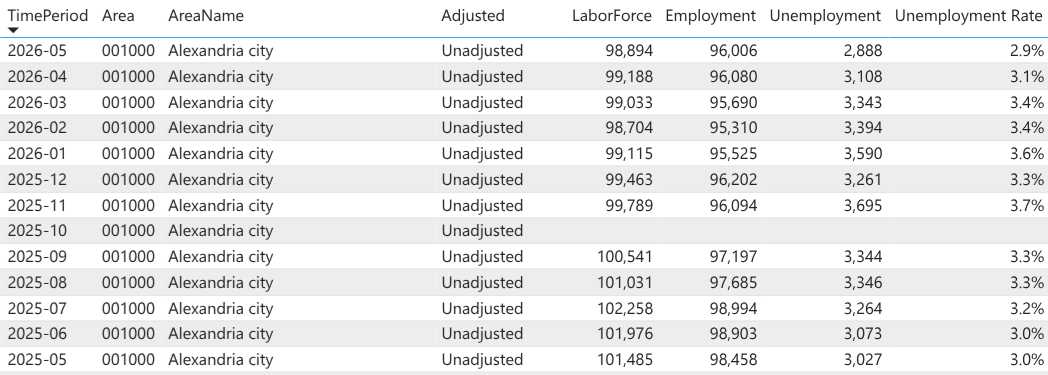
As the number of Alexandria residents counted as unemployed dropped below 3,000 for the first time in more than a year, the city’s jobless rate reached its lowest level since April 2025, according to new state data.
A total of 96,006 Alexandria residents were counted in the civilian workforce for the month, with 2,888 seeking jobs, according to figures reported July 1 by the Virginia Department of Workforce Development and Advancement.
The new data broke a string of 12 months where the jobless rate stood at 3% or higher.
But for the seventh consecutive month, Alexandria’s total workforce — employed and unemployed — was less than 100,000. May’s total of 98,894 was the second lowest during that period.
That drop could have a number of causes, including retirements, people moving out of the area, those taking work-from-home positions with employers from outside the region, and those moving from payroll to freelance jobs.
Some have suggested the decline represents an exodus of talent from Northern Virginia to areas where jobs are more plentiful and the cost of living is not so high. But that may be an oversimplification.
“It’s too early to say. We don’t know for sure if people are moving out,” said Marisa Hayes, a research analyst at Northern Virginia Community College, speaking at the Alexandria/Arlington Workforce Development Council meeting on June 25.
In the most recent data, Arlington and Alexandria’s combined labor force — those employed and those looking for work — was down 2.4% year over year, a drop of about 6,000.
As a result, “there are a lot of thought leaders pushing the gloom-and-doom thing,” said David Remick, executive director of the region workforce council.
Remick said he is not among them.
“I try to look at the glass half filled every now and then,” he said.
Another who didn’t buy into the possibility of a major talent drain was Helen Ding — like Hayes, a research associate at Northern Virginia Community College — who provided the statistical update at the council’s meeting.
“We’re doing all right,” Ding said of the current employment picture — perhaps not a rousing endorsement, but more optimistic than some others.
Northern Virginia’s unemployment rate of 3.3% for the month was up from 3% a year before, representing 1,671,290 in the workforce and 57,480 seeking jobs.
In Virginia, the jobless rate of 3.6% was up from 3.3% a year before, representing 4,324,554 with civilian jobs and 195,363 in search of work.
In May, Virginia’s private sector workforce declined by 8,300 while government employment was up 300, according to state officials. The increase was due entirely to hiring by local governments, as employment with the state and federal governments was down.
The commonwealth’s labor force participation rate decreased by 0.1 percentage points to 63.3% in May. That rate measures the proportion of the civilian population age 16 and older employed or actively looking for work.
Nationally, year-over-year unemployment rates were lower in May in 191 of 387 metropolitan areas, higher in 164 and unchanged in 32, according to the Bureau of Labor Statistics.
A total of 47 areas had jobless rates of less than 3%, with seven areas reporting rates above 8%.
May’s national unemployment rate was 4.1%, little changed from a year before.
Among all metro areas, Bismarck (N.D.) and Sioux Falls (S.D.) had the lowest jobless rates, at 1.8% each. The highest rate was reported in El Centro, Calif., at 16.9%.
Of the 56 metro areas with populations of a million or more, Honolulu had the lowest rate at 2.4%, with Fresno reporting the highest at 7.4%.
In terms of nonfarm employment, the D.C. region had the largest year-over-year numerical drop at 100,500 or 3%, according to federal data.
Figures are non seasonally adjusted. All May 2026 data is preliminary and subject to revision.
Image via Mina Rad/Unsplash
