


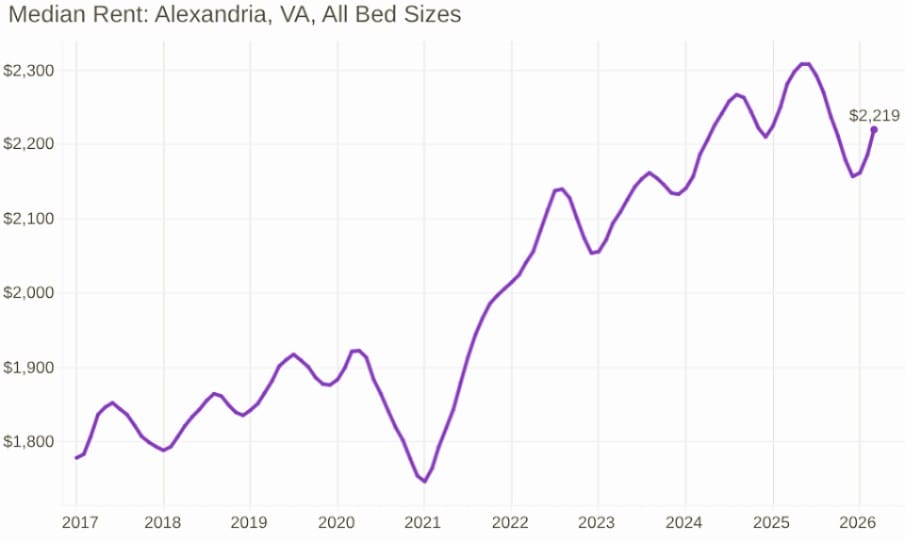
Alexandria’s median apartment rental rate in March was up 2.5% during the first quarter of 2026 but remains 2.7% below where it stood a year ago.
The median citywide rental rate was $2,032 for one-bedroom units, $2,497 for two bedrooms and $2,219 overall, according to figures reported March 30 by Apartment List.
The overall median was up 1.5% from February as the rental market began transitioning from winter to spring.
March’s overall median was off from the peak Alexandria rental rate of $2,307, set in both May and June 2025. In the city, median rental rates had grown to $1,922 just prior to the pandemic, then dropped to $1,746 in January 2021 before beginning a rebound.
In neighboring jurisdictions, the median apartment rent in Fairfax County in March was $2,359, down 2.3% year over year. In Arlington, it was $2,585, down 1.7%. The D.C. region’s overall median rent for the month was $2,137.
The region faces many of the same headwinds as other areas of the nation, Apartment List analysts said.
“A shaky labor market, renewed inflation concerns and overall macroeconomic uncertainty are taking a toll on demand,” they noted.
In Apartment List’s monthly ranking of 100 urban areas, the four most expensive localities were all in California: San Francisco ($3,262), Irvine ($3,056), San Jose ($2,916) and Fremont ($2,797). Arlington ranked fifth.
On the other end of the spectrum, the least expensive median rental rate for the month was $868, turned in by Toledo, Ohio. Rounding out the top five lowest were Wichita, Kan. and Cleveland (each $1,018), Tucson, Ariz. ($1,021) and Detroit ($1,036).
The national median rent has now fallen from its 2022 peak by a total of 5.5%. In March, it stood at $1,363, down 1.7% year over year.
“The rental market has begun to turn the corner into the busier spring leasing season, but multifamily conditions remain soft,” Apartment List analysts said.
Median rents were down year over year in 36 of the 52 metro areas with populations of more than a million, according to Apartment List analysts:
“Rent trends vary significantly by region, with annual declines currently concentrated primarily in the South and Mountain West regions. Meanwhile, many markets in the Northeast, Midwest and parts of the West Coast continue to see prices trend up despite the winter slowdown.”
“As a result of all this new inventory, more vacant units are sitting on the market, meaning that property owners face more competition for renters and have less pricing leverage.”
The Austin metro continues to have the softest conditions among the nation’s large rental markets, with the median rent there down by 6% over the past year. The Virginia Beach metro now sits atop the ranking of fastest year-over-year rent growth, at +5.5%.
Units are taking an average of 38 days to get leased after being listed, five days longer a year before and more than twice as long as it took units to turn over when the market was at its hottest in mid-2021.
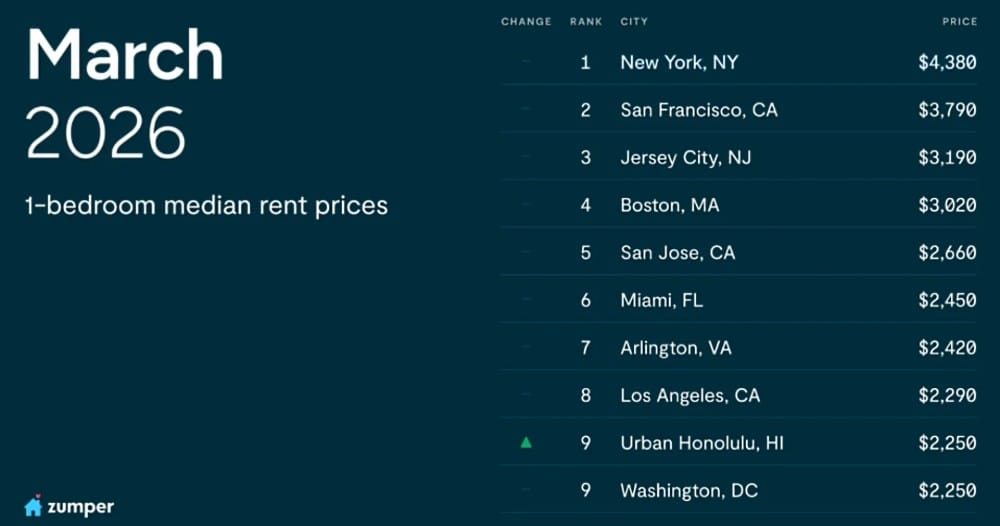
Zumper survey shows similar results: Nationally, the median one-bedroom apartment rent of $1,502 in March was down 1.4% year over year, with the median two-bedroom rent down 1.3% to $1,880 in survey data released by Zumper.
Both apartment sizes showed month-over-month increases, rising 0.2% and 0.1%, respectively.
Though modest, “this marks the first time both bedroom types have posted monthly gains since May 2025, pointing to a return to more typical seasonal patterns after an unusually soft summer and fall,” Zumper analysts said.
According to Zumper CEO Shawn Mullahy:
“While rents are still down year-over-year, the pace of those declines is clearly slowing, and early signs of spring demand are beginning to push prices upward again. As we head into peak leasing season, we expect competition to pick up, particularly in markets that have already absorbed a significant wave of new supply and are beginning to rebalance.”
Median rents for one-bedroom units in the five most expensive localities were $4,380 in New York City; $3,790 in San Francisco; $3,190 in Jersey City, N.J.; $3,020 in Boston; and $2,660 in San Jose. Just outside the top five were Miami and Arlington.
Some of the biggest year-over-year declines in the Zumper survey came in Florida, where rents had increased significantly during the immediate post-Covid period.
“All Florida markets in our report had either flat or declining annual rents, as domestic migration cools in the state while supply levels remain elevated,” Zumper analysts said.
The biggest year-over-year decline in Florida localities came in Tampa, where the median rent has dropped 12.1% over the past year.
