

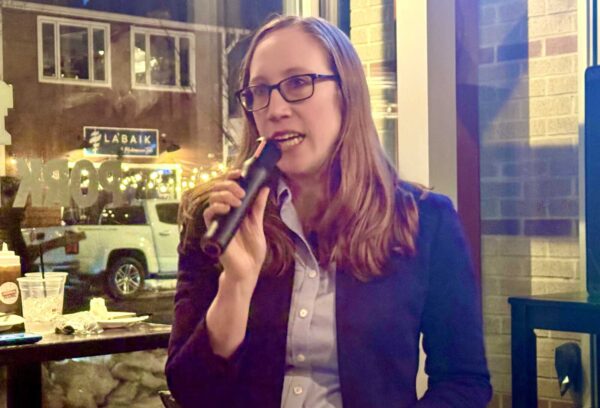
The General Assembly session that wrapped up in mid-March was an especially busy one for state Sen. Elizabeth Bennett-Parker (D-39).
In addition to introducing legislation and other regular duties, Bennett-Parker ran a mid-session campaign to replace former state Sen. Adam Ebbin in Senate District 39. The former delegate won the Feb. 10 special election in the district, which covers Alexandria and parts of Arlington and Fairfax counties.
Amidst her transition from the House of Delegates to the Senate, 11 of Bennett-Parker’s bills passed. The state senator said the 2026 session featured over 2,400 introduced bills, about half of which passed.
“I think we had a really productive session,” Bennett-Parker told ALXnow. “We passed a lot of great bills, addressing the values of our community and helping to create a more affordable Virginia and move Virginia forward.”
Bennett-Parker was the chief sponsor of a constitutional amendment to support automatically restoring the right to vote for people convicted of felonies after their sentences were served. That measure will be put to voters in the Nov. 3 general election, along with amendments to codify marriage equality and reproductive rights. If approved, the constitutional amendments would go into effect in 2027.
The state senator says the voting rights amendment also strengthens protections for voters with disabilities.
“Right now, someone placed under a guardianship essentially automatically loses their right to vote, and this would strengthen that so they only lose the right to vote if a judge determines that they are not capable of understanding the act of voting,” Bennett-Parker said.
Bennett-Parker’s HB4, linked to Gov. Abigail Spanberger (D)’s affordability agenda, gives localities a framework to preserve affordable housing when publicly supported multifamily rental properties are at risk of losing their affordability restrictions. The bill passed the House 65-34.
Bennett-Parker said the bill is a response to an estimated 17,000 housing units in Virginia that will lose their affordability provisions in the next few years. These may be units that received state or federal assistance such as the Low Income Housing Tax Credit Program, which sets affordability restrictions for 30 years.
“This bill would allow localities … basically a right of first refusal to purchase those buildings, when the restrictions are expiring, if they’re being sold and if they can match the purchase price to the third party offer,” Bennett-Parker said. “So the owner receives the same purchase price and the units remain affordable.”
Another housing bill (HB 95) supports a payment plan for eligible tenants who owe one month or less of rent. Bennett-Parker cited 2024 data showing that one-third of evictions involved tenants who owed a month of rent or less.
“We know that many folks live paycheck to paycheck, and one unexpected medical expense or car expense can cause you and your family at risk of losing their home,” the state senator said.
Her third housing bill (HB 379) would require more upfront eligibility information on rental applications so renters don’t pay application fees for properties they aren’t eligible to lease.
Bennett-Parker also sponsored a bill in Democrats’ gun control package. HB 93 tightens restrictions on people who already cannot own guns due to domestic assault and battery convictions and protective orders, ensuring that they transfer their firearms to someone who doesn’t live with them and is at least 21 years old.
“There’s really no mechanism in place to ensure that that transfer happens, and so this bill basically simply creates a form so the courts and law enforcement know who is supposed to have your gun and can follow up if there is concern that that transfer has not happened,” Bennett-Parker said.
Other advanced bills include:
- HB 94 allows disabled veterans to choose a standard license plate for their free license plate qualification
- HB 380 requires training materials on celiac disease for restaurants
- HB 381 requires the medical examiner or funeral home to notify next-of-kin when a body is transferred to a funeral home with a whole organ retained after an autopsy or investigation.
- HB 383 exempts certain small businesses that offer short workshops from being regulated like colleges and universities to help retain and grow these small businesses.
- HB 385 allows ABC employees to conduct tastings rather than just the liquor companies.
- HB 975 modernizes the Mixed Beverage Annual Review law to support restaurants and customers.
Bills from other members that Bennett-Parker says will impact Alexandria include minimum wage increases, updates to localities’ speed camera authority, bills responding to federal immigration enforcement, bills seeking to improve prescription drug affordability, a bill targeting excessive vehicle noise, tenant protection bills, a paid leave program and expanded eligibility for class action lawsuits.
While the state budget wasn’t finalized before the session ended, Bennett-Parker is confident that budget conferees will resolve the data center tax dispute that has divided the House and Senate.
Bennett-Parker said the Senate version of the budget includes $1 million for preservation and accessibility improvements at Alexandria’s Freedom House Museum. She said K-12 investments in the state budget also have implications for Alexandria in addition to other Virginia school divisions.
Spanberger’s deadline to act on 2026 bills is April 13. The General Assembly will reconvene on April 22 and will have a special session beginning the next day to work on the budget.
According to Bennett-Parker, she spent 114 hours on the House and Senate floors, had 79 constituent meetings and took 1,896 votes.
“I’m just really honored to have the opportunity to serve Alexandria as well as parts of Arlington and Fairfax in the Senate and look forward to continuing to work with my colleagues as well as constituents to move Virginia forward,” Bennett-Parker said.
