


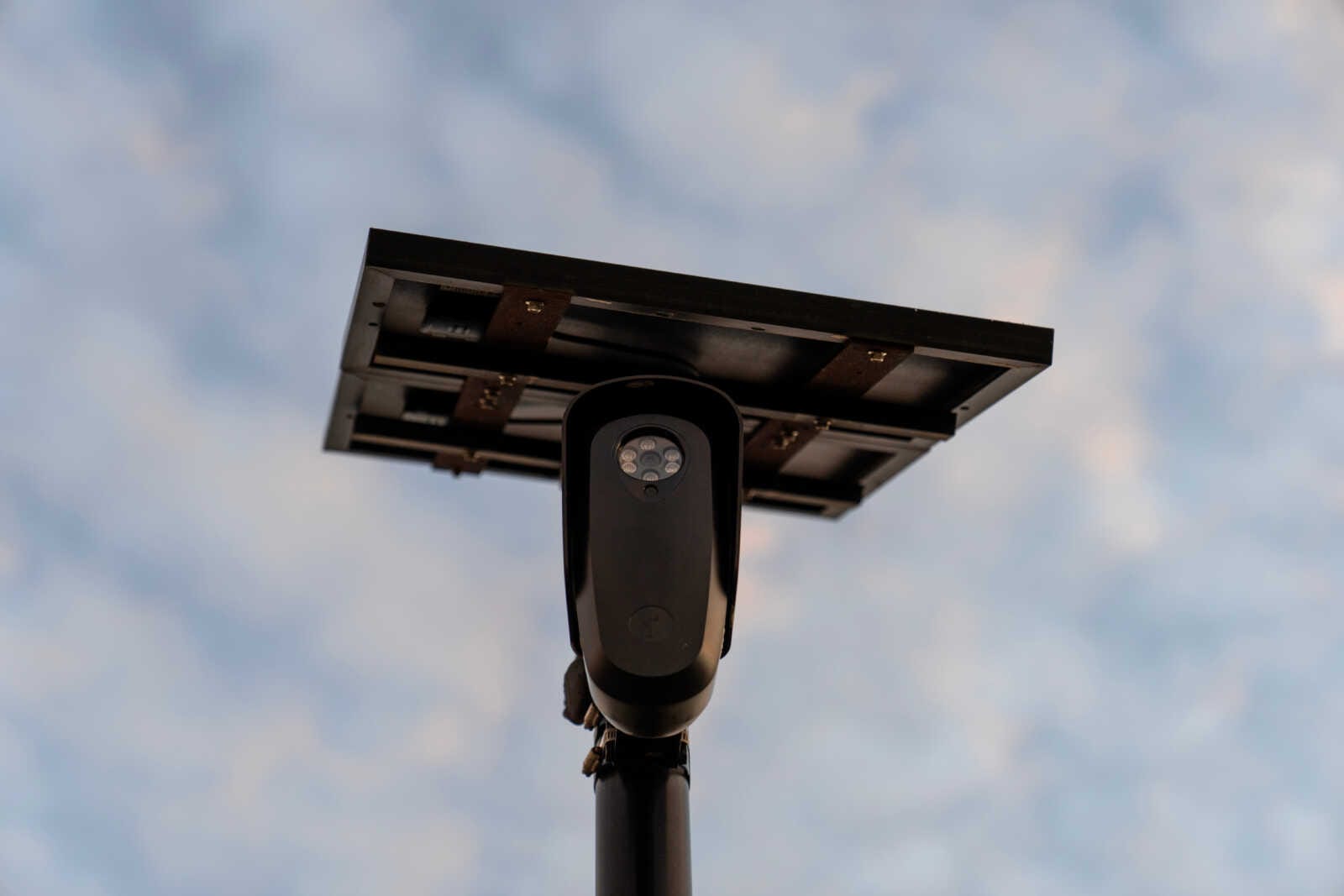
Alexandria’s City Council unanimously adopted a resolution Tuesday night guiding the police department’s future use of automated camera systems and automatic license plate reader (ALPR) technology in the city.
While developed by city staff, Alexandria Police Chief Tarrick McGuire endorsed the city’s 14-page resolution and formally sent the proposal in a memo to City Manager Jim Parajon. McGuire has defended the use of ALPRs as necessary technology in his efforts to fight crime, and the new follows public outcry over widespread surveillance and City Council’s action in October to deactivate its 61 Flock automatic license plate readers. The resolution requires City Council approval for any future request by the Alexandria Police Department to use surveillance equipment.
Before getting approval to use an ALPR camera in the future, APD will have to create a surveillance impact report and develop a surveillance use policy to be posted for public review at least 21 days before a City Council public hearing. APD would also have to send that information at least 45 days before that hearing to the city’s Commission on Information Technology, Human Rights Commission and Independent Community Policing Review Board for comment.
“The community, through their elected representation, has the ability to deny just as much as they have the opportunity to approve with the guardrails that we’re setting in place in this approval process,” said Vice Mayor Sarah Bagley, who made the motion to approve the resolution.
Local group DeFlock Alexandria wants to ban all ALPRs in the city. The group supports the resolution, and said that until recently the police placed more than 60 ALPRs across the city without public input or consent.
“We see this resolution as a move toward transparency and public input,” the group told ALXnow in a statement. “We are glad council took this important first step. It is crucial that we build upon it. Our work is not done until Alexandria City Council has passed an ordinance banning all ALPRs in the city, both mobile and stationary, regardless of vendor.”
City Councilwoman Sandy Marks said that the city needs to eventually adopt a formal ordinance on surveillance tech.
“I would like to revisit this conversation and hold ourselves accountable to have it again to make these updates and consider making those updates into a full ordinance,” Marks said.
The resolution is based on the American Civil Liberties Union’s Community Control Over Police Surveillance (CCOPS) model, which has been adopted in 26 other localities, including San Francisco and New York City.
“Governments and police forces should not be able to use surveillance technologies for any purpose without informing and securing the permission of the people they serve,” the ACLU said. “If you don’t have that right where you live, you should demand your elected representatives sponsor and adopt a CCOPS law.”
The resolution also gives the city up to a year to evaluate other new surveillance technology that’s in use throughout all city departments.
APD started its contract with Flock in 2023. Last year, the Alexandria Police Department made nearly 21,000 automated license plate reader queries between August 2025 and August 2026, directly leading to 72 felony charges and 65 misdemeanor charges. That’s about 5% out of the total 2,694 criminal arrests made during that period.
ALPR surveillance still OK in ‘exigent circumstances’
In “exigent circumstances,” APD can still use surveillance technology without public or City Council approval.
APD defines an exigent circumstance as an “unforeseen, urgent, emergency situation in which a rapid response is needed to address a significant, imminent threat to life or property.”
According to the resolution:
A. APD may temporarily acquire, or temporarily use, surveillance technology in exigent circumstances without following the provisions of this Resolution, provided that the APD does all of the following:
- Use the surveillance technology to respond solely to the exigent circumstance;
- Cease use of the surveillance technology within 14 calendar days, or when the exigent circumstance ends, whichever is sooner; if an exigent circumstance lasts longer than 14 days, the APD shall request an extension of no more than 14 days from the City Manager; multiple extensions may be requested if the exigent circumstance(s) so require;
- Keep and maintain only data related to the exigent circumstance and dispose of any data that is not relevant to an ongoing investigation, unless its retention is:
— Necessary to address the exigent circumstance;
— Authorized by a court based on a finding of probable cause to believe the information constitutes evidence of a crime; or
— Otherwise required by law;- Not disclose to any third party any information acquired during exigent circumstance unless such disclosure is: (a) Authorized by a court based on a finding of probable cause to believe the information constitutes evidence of a crime; or (b) Otherwise required by law; and
- Within 30 business days of the conclusion of the exigent circumstance, submit a written report to the City Council:
— Identifying the surveillance technology that was acquired and/or used;
— Describing the exigent circumstance in enough detail to determine if it met the definitional standard provided in this Resolution;
— Describing how the surveillance technology was used; and
— Describing why the use of the surveillance technology was specifically necessary to address the threat presented by the exigent circumstance. (B) Any surveillance technology temporarily acquired in exigent circumstances shall be returned within 7 business days following the end of the exigent circumstances.B. Any surveillance technology temporarily acquired in exigent circumstances shall be returned within 7 business days following the end of the exigent circumstances.
