

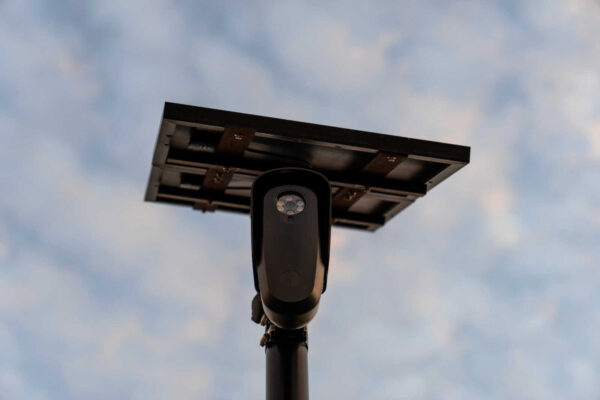
Alexandria Police Chief Tarrick McGuire has released his department’s recommended guiding principles for future use of automated camera systems and automatic license plate reader (ALPR) technology in Alexandria.
McGuire’s proposed 14-page resolution heading to City Council Tuesday (Nov. 24) would require City Council approval for any future request by the Alexandria Police Department to use surveillance equipment. Each request would have to be posted publicly at least 21 days before a public hearing.
Before getting approval to use an ALPR camera in the future, APD would also have to create a surveillance impact report and develop a surveillance use policy to be posted for public review at least 21 days prior to the public hearing.
Last month, after public outcry over privacy concerns, City Council ordered the deactivation of its 61 automated license plate readers across the city.
“I’m glad we’re here because we need a reset moment,” City Councilman Abdel Elnoubi said after the City Council vote. “We do not want to be deploying a technology that’s collecting data today, and that data can be used to go after our residents tomorrow.”
APD started its contract with ALPR firm Flock in 2023. The department made nearly 21,000 automated license plate reader queries between August 2025 and August 2026, directly leading to 72 felony charges and 65 misdemeanor charges, about 5% out of the total 2,694 criminal arrests made during that period.
One of the individuals located by ALPR technology is a former D.C. police officer who was arrested in December 2025 for allegedly drugging and raping more than a dozen women in Alexandria.
While APD had the option to discontinue its contract with Flock at any time, the department is also asking in the resolution to keep any ALPR technology that gets approved online for five years.
“If approved, technologies will be authorized for five years unless the use or technology materially changes,” McGuire wrote in his memo. “Council may approve a technology only if its benefits outweigh its costs, civil rights are safeguarded, and its deployment is not discriminatory or viewpoint-based and has no disparate impact.”
APD would also create an annual surveillance report for City Council on the costs, locations, instances for use and what data was shared with outside entities. The report would be released in April.
The resolution is based on the American Civil Liberties Union’s Community Control Over Police Surveillance (CCOPS) model.
According to the ACLU:
To date, CCOPS laws have been adopted in 26 jurisdictions from coast to coast, where they serve to protect and empower nearly 18 million people. In 2019, the nation’s first municipal ban on the use of facial recognition technology came as a part of a CCOPS law in San Francisco, and in 2020, the nation’s largest city and police force – New York City – adopted a CCOPS law.
Governments and police forces should not be able to use surveillance technologies for any purpose without informing and securing the permission of the people they serve. If you don’t have that right where you live, you should demand your elected representatives sponsor and adopt a CCOPS law.
Local group DeFlock ALX released a statement saying its members are pleased that the draft resolution will go before City Council.
“The moratorium on future ALPR technology is a critical step toward protecting the safety, privacy and Democratic freedoms all Alexandrians,” the group told ALXnow in a text message. “It is heartening to see that council listened to the community demand to get rid of this dangerous technology and is working toward a framework for greater transparency and public engagement in the future. The resolution’s focus on meaningful public engagement signals a promising shift toward the value of community consent. We believe it is critical builds upon this resolution and passes an ordinance to ban all ALPRs.”
ALPR surveillance OK in ‘exigent circumstances’
In “exigent circumstances,” APD would still be able to use surveillance technology without public or City Council approval.
APD defines an exigent circumstance as an “unforeseen, urgent, emergency situation in which a rapid response is needed to address a significant, imminent threat to life or property.”
According to the proposed resolution:
A. APD may temporarily acquire, or temporarily use, surveillance technology in exigent circumstances without following the provisions of this Resolution, provided that the APD does all of the following:
- Use the surveillance technology to respond solely to the exigent circumstance;
- Cease use of the surveillance technology within 14 calendar days, or when the exigent circumstance ends, whichever is sooner; if an exigent circumstance lasts longer than 14 days, the APD shall request an extension of no more than 14 days from the City Manager; multiple extensions may be requested if the exigent circumstance(s) so require;
- Keep and maintain only data related to the exigent circumstance and dispose of any data that is not relevant to an ongoing investigation, unless its retention is:
— Necessary to address the exigent circumstance;
— Authorized by a court based on a finding of probable cause to believe the information constitutes evidence of a crime; or
— Otherwise required by law;- Not disclose to any third party any information acquired during exigent circumstance unless such disclosure is: (a) Authorized by a court based on a finding of probable cause to believe the information constitutes evidence of a crime; or (b) Otherwise required by law; and
- Within 30 business days of the conclusion of the exigent circumstance, submit a written report to the City Council:
— Identifying the surveillance technology that was acquired and/or used;
— Describing the exigent circumstance in enough detail to determine if it met the definitional standard provided in this Resolution;
— Describing how the surveillance technology was used; and
— Describing why the use of the surveillance technology was specifically necessary to address the threat presented by the exigent circumstance. (B) Any surveillance technology temporarily acquired in exigent circumstances shall be returned within 7 business days following the end of the exigent circumstances.B. Any surveillance technology temporarily acquired in exigent circumstances shall be returned within 7 business days following the end of the exigent circumstances.
