

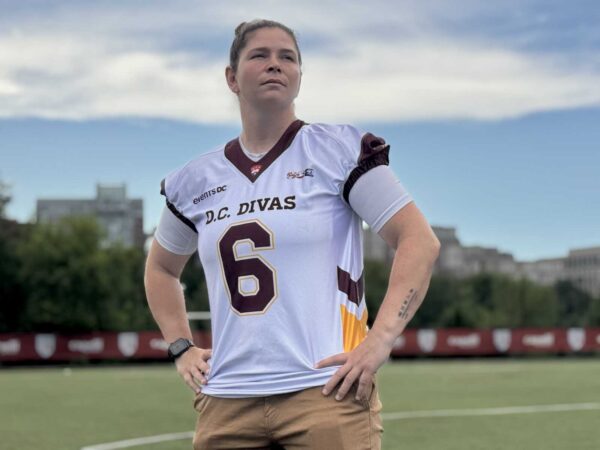
Alexandria’s Amanda Congialdi wants to taste a championship win one last time before she retires.
The 34-year-old starting quarterback of the D.C. Divas was named the Women’s Football Alliance‘s most valuable player of the year in July, but says no accolade can compare to winning a national title. Her first year on the team, back in 2016, the Divas took the national crown, and since then she says the team has worked back to get itself into championship shape.
“It’s like now it’s just an addiction,” Congialdi told ALXnow. “Every year feels like there’s more urgency to win it, not just to get there. We put a lot of pressure on ourselves, because we’re known to be one of the best organizations in the world of women’s football.”
The Divas made it to the nationally televised championship game in 2025. Congialdi played through a broken ankle during the game, and the Divas lost 26-14 to the St. Louis Slam.
“This is like a full-time job,” she said. “You have to pay for everything yourself. You have injuries, you have jobs, you have kids, you have everything else that you have to tend to in life outside of this full-time job that is football.”
By day, Congialdi is the operations manager at a pet daycare in the city and then spends the majority of her spare time on football business. She’s been playing professional football for 15 years, starting for her hometown Philadelphia Firebirds in 2011, where she played for five years.
“My life is synonymous with two things — dogs and football,” Congialdi said. “You either know me through dogs or you know me through football.”
After the Divas hold tryouts in September, she’ll work out with her teammates until the season opener in April, and play games on Saturdays through the playoffs in July.
This year, the Divas fell 35-23 to the Pittsburgh Passion in the National Conference Championship game at home at Annandale High School. The Passion went on to lose the Pro Division National Championship to the Minnesota Vixen 42-14 on July 25 at Tom Benson Hall of Fame Stadium in Canton, Ohio.
Congialdi says she wants five more years to mark 20 years of playing professional ball.
“The ankle is great now,” she said. “The arm is starting to die down a little bit, but at the same time, I feel like as long as my mind stays sharp, as long as I still have the passion for it, still have the work ethic in the off-season, I’m going to continue.”
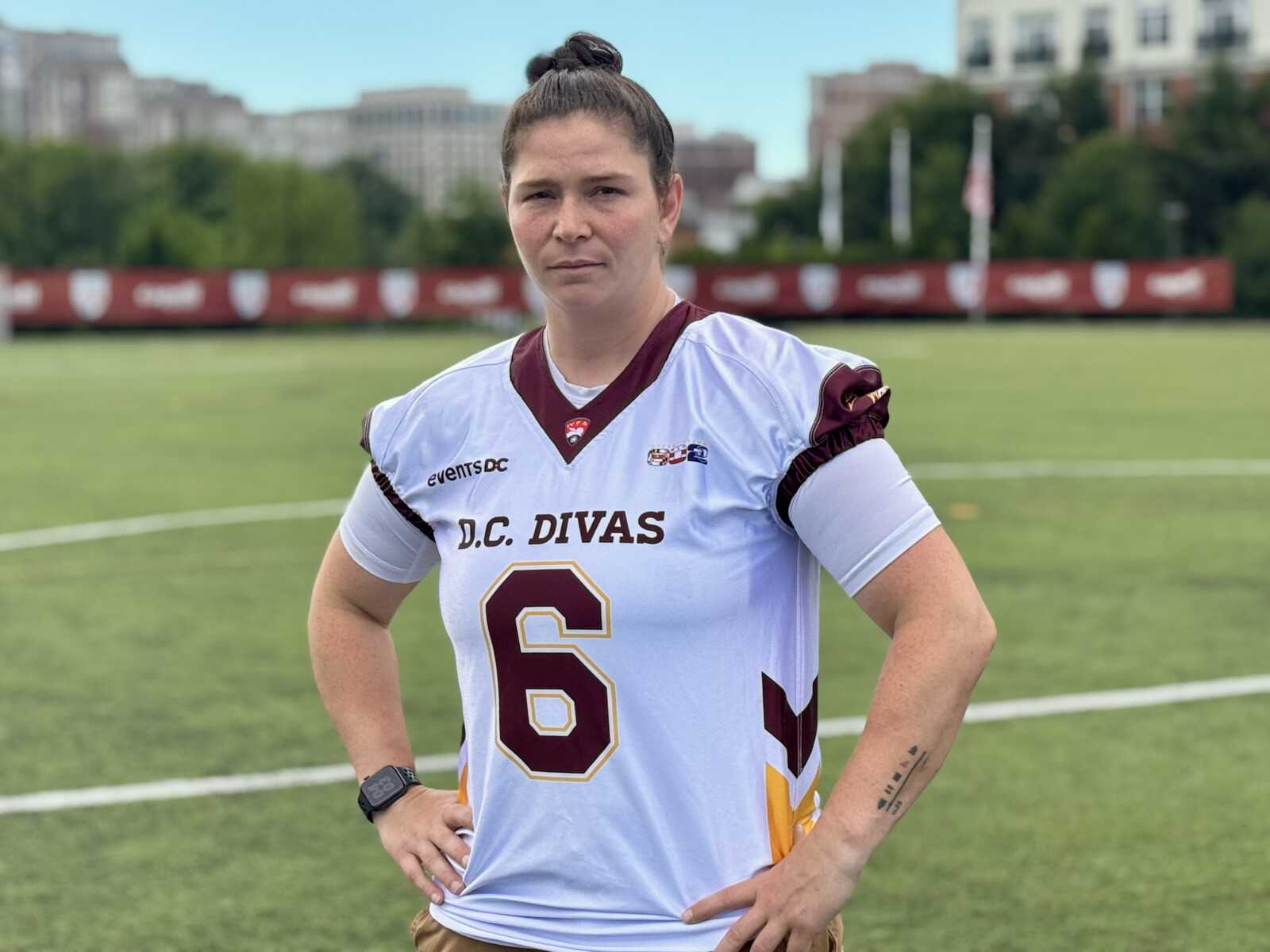
Growing up with football
Congialdi grew up in a die-hard Philadelphia Eagles household, spending Sundays watching pro football all day with her dad. She says she started playing with her older brother when she was 11.
“I was playing with grown men and they would always let me play quarterback with the official-size NFL ball,” Congialdi said. “So, I feel like that’s where I developed my arm strength. When I started playing women’s football, I was more advanced because a lot of women start playing when they’re adults, because we don’t have a little league.”
Congialdi tried out for the Firebirds when she turned 18, two years after she first saw a flier for women’s tackle football tryouts. She called the number and was told she’d have to wait for two years to be eligible to play.
“When I was young, I felt like I was the best player in the team,” Congialdi said. “I played offense and I played defense at the same time, and I played punt return. I played everywhere because we had a small team, but when I came over to D.C. I felt like a rookie all over again. Here was an organized, professional team, and that humbled me.”
The Divas won the national championship in Congialdi’s first season, under quarterback Allyson Hamlin.
“It was amazing,” Congialdi said. “That team, there were 10-to-12 players who’d been together for 10-plus years. Ten years is hard in women’s football.”
Paying to play
Like Congialdi, the most elite women’s pro footballers don’t have major endorsement contracts, and players have to pay out of pocket for their uniforms, equipment and travel expenses. Teams also have to rent workout spaces and fields for practice and play, and hire referees, medical staff and physical trainers.
Congialdi says it costs about $400 a year to play for the Divas, although individual costs with other teams can run as high as $1,200.
“I don’t get paid for this,” she said. “But you get paid in passion, in memories, in relationship building. We get paid in so many other ways that we’re fulfilled that it’s worth it for us to actually come out of our pockets and put money into this just to play.”
The pro women’s football leagues around the country need to merge in order to create a women’s national football league, Congialdi said.
“In a perfect world, there would be one league with the best of the best in women’s football,” she said. “Instead you have great players in this league, great players in that league.”
All that can change, though, as the profile of women playing football is on the rise. The NCAA added women’s flag football to its Emerging Sports for Women program earlier this year. Next year, the National Football League will launch its pro women’s and men’s flag football league, and flag football will be a sport in the 2028 Olympics in Los Angeles.
“Girls are starting to elevate their IQ, because flag football is going to be put on a bigger stage,” Congialdi said. “I feel like we’re really starting to scratch the surface in terms of getting that financial backing that we need.”
